- Get Your Free, Instant Water Report
- Custom Sizing Recommendations
- Get quality recommendations to match your specific needs
Best Whole House Water Softeners Systems For City Water
Hard city water leaves scale on your fixtures, spots on your dishes, and wears down your appliances faster than it should.
SoftPro's city water softeners eliminate hardness at the source — choose from our budget-friendly ECO, high-efficiency Elite, or salt-free conditioner depending on your home and lifestyle.
SoftPro™ Elite Smart HE - Best Water Softener for City Water
$2,468.65 $1,367.00
SoftPro ECO™ City Water Softener - Best Water Softener Systems for City Water
$1,628.65 $967.00
SoftPro™ Elite Salt Free Water Conditioner [CITY WATER]
$1,982.25 $1,299.00
Best Water Softeners for City Water: Complete Guide
Complete Buying Guide for City Softeners
Looking for the perfect water softener for your home?
Whether you're tired of constantly scrubbing chalky residue off your shower doors or concerned about protecting your new appliances, we've got you covered with solutions for every household and budget.
From economical workhorses to cutting-edge smart systems, we'll help you find the ideal water softener to transform your home's water quality.
Why City Water Needs Softening...
While municipal water is sometimes treated to be safe for drinking, it often remains surprisingly hard.
Those white spots on your dishes and stubborn scale buildup around faucets?
That's dissolved calcium and magnesium – minerals that wreak havoc on your plumbing, appliances, and daily life.
Even treated city water can contain hardness levels well above 10 grains per gallon, leading to all sorts of household headaches.
Understanding Your Options
Today's water softeners come in three distinct categories to match different household needs:
Economy-Focused Solutions
For budget-conscious homeowners who still demand quality, the SoftPro ECO delivers reliable softening performance without breaking the bank.
This newest addition to the SoftPro lineup proves that effective water treatment doesn't have to come with a premium price tag.
It's an ideal choice for first-time buyers or those wanting to protect their home without a significant upfront investment.
High-Efficiency Performance
The SoftPro Elite city water softener represents the perfect balance of advanced technology and proven reliability.
Its heavy-duty resin and sophisticated regeneration settings maximize softening while minimizing salt and water consumption.
For families looking to solve their hard water issues while keeping operating costs low, this high-efficiency workhorse delivers exceptional long-term value.
Smart Home Integration
Meet the SoftPro Smart Home+ water softener with DROP technology – the perfect solution for tech-savvy homeowners who want complete control and monitoring of their water treatment system.
From automatic leak detection to real-time performance tracking through your smartphone, this system brings water softening into the modern age.
Benefits Beyond Soft Water
Installing a quality water softener system delivers advantages that extend far beyond eliminating scale buildup:
Protection for Your Home
- Extended appliance lifespan (water heaters, dishwashers, washing machines)
- Preserved plumbing efficiency & water pressure
- Reduced maintenance needs for fixtures & faucets
- Lower energy bills from more efficient appliance operation
Daily Life Improvements
- Softer, more manageable hair after showering
- Cleaner, spot-free dishes from the dishwasher
- Softer laundry with brighter colors
- Less soap & detergent needed for cleaning
- Reduced time spent scrubbing bathroom surfaces
Long-Term Cost Savings
While the initial investment in a quality water softener might give you pause, consider the long-term savings:
- Up to 50% reduction in cleaning supply costs
- Extended appliance lifespans, saving thousands in replacement costs
- Lower utility bills from more efficient water heaters
- Reduced plumbing repair & maintenance expenses
Making the Right Choice
When selecting a water softener for city water, consider these key factors:
System Capacity
Your ideal system size depends on:
- Household size & daily water usage
- Current water hardness level
- Peak water demand periods
- Future family growth plans
Installation & Maintenance
All SoftPro systems come with:
- Clear DIY installation instructions & support
- Essential components included (bypass valve, safety float)
- Access to technical support & educational resources
- Simple maintenance requirements
Technology Level
Choose based on your preferences:
- Basic digital controls (SoftPro ECO)
- Advanced programming options (SoftPro Elite)
- Smart home integration (SoftPro Smart Home+)
The SoftPro Water Softener Advantage
What sets SoftPro apart in the crowded water treatment market?
It starts with family values.
Founded by Craig "The Water Guy" Phillips, Quality Water Treatment has built the SoftPro line on principles of honest pricing and genuine customer support.
With his son Jeremy managing sales and daughter Heather overseeing operations, every customer gets the attention and guidance they need to make the right choice for their home.
This family-first approach extends to every aspect of the business:
- Transparent Pricing Without Hidden Fees
- Comprehensive Product Support
- Flexible Financing Options
- Free Technical Assistance
- Educational Resources & Guides
Taking the Next Step
Ready to solve your city water challenges?
Consider these action items:
- Get Your Water Tested to understand exact hardness levels
- Calculate Your Daily Water Usage & peak demands
- Compare SoftPro Softener Models based on your specific needs
- Review Installation Requirements & support options
- Explore Financing Options if needed
Making Your Investment Count
Whichever SoftPro system you choose, you're investing in more than just a water softener – you're investing in your home's infrastructure and your family's quality of life.
From the budget-friendly ECO to the high-tech Smart Home+, each system is built to deliver years of reliable service while tackling the unique challenges of city water.
Remember, the best water softener isn't necessarily the most expensive one – it's the one that fits your specific needs, budget, and lifestyle while providing consistent, efficient performance.
With SoftPro's range of options and commitment to customer support, you can feel confident in finding the perfect solution for your home.
Our lineup for city water solutions includes the budget-friendly SoftPro ECO for cost-conscious homeowners who want reliable performance, the high-efficiency SoftPro Elite for those seeking maximum performance with minimal salt usage, and the innovative SoftPro Smart Home+ for tech-savvy users who want remote monitoring and smart home integration.
FREE WATER Analysis Report
Size Does Matter - Check Your Water & Options

Quick & Simple
Request Support & Customer Service
It's simple and quick.
Our team will help you right away!
•Order status / delivery
•Tech support
•Warranty information
•And more...
Hard water is wrecking your home. Slowly. Quietly. Expensively. That chalky film on your shower doors? The spotty dishes you keep rewashing? The appliances dying years ahead of schedule? That's not bad luck. That's your city water. SoftPro fixes it. Whether you're watching your budget or want the smartest system on the block, there's a solution here built for your home, your water, and your wallet.
Municipal water is treated to meet safety standards. But "safe to drink" doesn't mean "soft." Most city water across the United States still carries significant levels of dissolved calcium and magnesium, and those minerals are the bad guys behind hard water. Even after running through a treatment plant, hardness levels routinely exceed 10 grains per gallon (GPG). In the South, Midwest, and Southwest? They climb well above 20 GPG.
Those white rings around your faucets? Hard water. The filmy residue on your shower glass? Hard water. The spots on your clean dishes straight out of the dishwasher? Also hard water. Left untreated, these minerals pile up inside your water heater, dishwasher, and washing machine, shaving years off their lives and sending your energy bills climbing.
And that's not all. City water often carries residual chlorine and chloramine, disinfection byproducts that are necessary for safe delivery but notorious for wrecking the way your water tastes, smells, and feels. A quality softener paired with whole-house filtration knocks out both problems in one shot.
Salt-based water softeners have been around a long time. The science is solid. The process is called ion exchange, and it's the gold standard for getting hardness minerals out of your water.
Here's how it goes down: Inside your softener's resin tank is a bed of tiny resin beads charged with sodium ions. Hard water flows through. Calcium and magnesium ions in the water are attracted to the beads and swap places with the sodium. What comes out the other side is genuinely soft water, stripped of the minerals that cause scale, soap scum, and appliance damage.
Over time, those beads run out of sodium and need to be recharged. That's the regeneration cycle. A saltwater brine solution flushes through the tank, reloads the beads with fresh sodium, and rinses the captured hardness minerals down the drain. How often that happens depends on your household's water usage and your system's grain capacity, meaning how many grains of hardness the unit can pull out before it needs to recharge.
Worth noting: some homeowners prefer potassium chloride over sodium chloride, especially if they have dietary sodium concerns or septic systems in environmentally sensitive areas. Either option works perfectly in SoftPro systems. Potassium does the same ion exchange job without adding sodium to your wastewater discharge.
Grain capacity might be the most important spec to nail when buying a city water softener. Get it wrong and you're either running out of soft water between regenerations or wasting salt cycling more often than you need to.
The sweet spot for most families is regenerating roughly every 4 to 7 days. Here's the math to find your number:
Number of people x 75 gallons per day x water hardness in GPG = daily grain removal requirement
Multiply that by 7 to get your weekly demand. Then size your softener to match.
For example, a family of four with city water testing at 18 GPG needs a system that can handle roughly 37,800 grains per week. A 38,000-grain capacity unit is an efficient fit. A bigger household or harder water? Step up to 48,000 or 64,000 grains.
SoftPro systems range from 24,000 grains for smaller homes all the way up to 64,000 grains and beyond for larger properties. Every household can right-size their investment.
Let's cut through the noise.
Salt-based water softeners using ion exchange are the only technology proven to completely remove hardness minerals. They get your water down to near-zero GPG. Real protection for your pipes, appliances, and fixtures. And real lifestyle benefits: richer soap lather, softer skin and hair, spot-free dishes, brighter laundry.
Salt-free water conditioners don't remove hardness minerals. They change the structure of calcium and magnesium so the minerals are less likely to stick to surfaces. It can reduce scale formation, and it's a solid option if you want to skip the salt entirely or live somewhere with salt-based softener restrictions. SoftPro's Elite Salt Free Water Conditioner is built for exactly this situation. Real scale prevention. No brine tank, no regeneration cycle, no salt purchases.
Magnetic systems use electromagnetic fields on the outside of pipes to try to alter mineral behavior. Low-cost, easy to install, and honestly? The independent research on effectiveness is thin and inconsistent. Not recommended as your primary solution if you're dealing with moderate to high hardness.
For most city water households, a proven salt-based ion exchange system is the move.
SoftPro ECO City Water Softener: Reliable Performance, Budget-Friendly Price
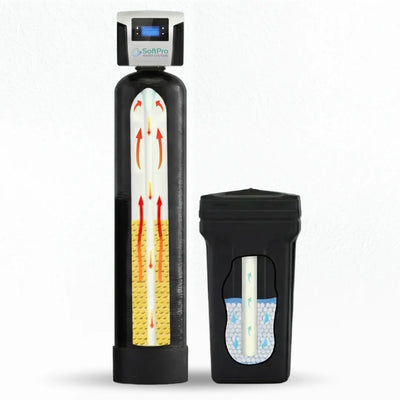
The ECO is for budget-conscious homeowners who refuse to compromise on quality. Built around upflow regeneration technology, it uses up to 75% less salt and 64% less water than traditional downflow systems. Affordable upfront. Genuinely economical to run year after year.
The ECO uses demand-initiated regeneration. It watches your actual water usage and regenerates only when necessary, not on a fixed timer that runs regardless of need. For an average family, that means regenerating roughly every 8 to 10 days on about 2 pounds of salt per cycle. Real monthly savings without ever running short on soft water.
An internal safety float in the brine tank prevents overflow. A bypass valve lets you isolate the softener for maintenance without killing your home's water supply. The ECO is sized for homes with 3/4" plumbing and everyday household flow demands. Got 1" plumbing or higher peak flow requirements? The SoftPro Elite's 1" valve is the better fit.
Best for: First-time buyers, smaller households, and homeowners who want reliable soft water with the lowest total cost of ownership.
SoftPro Elite Smart HE Water Softener for City Water: High-Efficiency Performance at Its Best
The Elite is the flagship. And it earns that title through build quality, smart programming, and long-term efficiency that genuinely stands apart.
At the core is WQA Gold Seal NSF-approved 10% crosslink resin, which is more durable than the 8% resin most competitors use. Higher crosslink density means the resin resists chlorine degradation and physical breakdown over years of use. Expected service life: up to 20 years under normal city water conditions.
The Elite's upflow regeneration pushes the brine solution up through the resin bed from the bottom, targeting the most depleted resin first instead of flushing the whole bed unnecessarily. Every cycle saves salt. A pre-brine calculation figures out exactly how much brine is needed before each regeneration, using up to 30% less salt than conventional approaches. Soft water refills the brine tank instead of raw hard water, keeping injectors cleaner and extending system life.
The control valve is where the Elite really pulls ahead for city water. Because clean municipal water doesn't carry the sediment load of well water, the Elite can skip up to 10 backwash cycles, saving water with zero loss in performance. If system capacity drops below 3%, a 15-minute quick recharge carries you through until the scheduled 2:00 a.m. regeneration. Built-in vacation mode stops unnecessary cycling while you're away. An automatic 7-day refresh prevents bacterial growth in a dormant resin bed.
Capacity runs from 24,000 up to 64,000 grains. The 1-inch ported valve handles high flow rate homes, meaning no pressure drops at the shower while the dishwasher and washing machine run at the same time.
Best for: Families who want maximum softening efficiency, the lowest long-term operating costs, and a system you set up once and basically forget about.
SoftPro Elite Salt Free Water Conditioner: City Water Softening Without the Salt
Want to avoid sodium entirely? Or maybe your city has restrictions on salt-based softeners? The SoftPro Elite Salt Free Water Conditioner is a legitimate alternative worth taking seriously.
Instead of removing hardness minerals through ion exchange, this system uses a template-assisted crystallization (TAC) process to convert dissolved calcium and magnesium into microscopic crystals that stay suspended in the water rather than adhering to pipe walls and appliance surfaces. The minerals are still in your water. They just can't form the scale that damages your plumbing and equipment.
No brine tank. No salt to buy. No regeneration cycle. No wastewater discharge. No sodium added to your water. No electricity needed. For the right household, especially those with mild to moderate hardness levels or a strong preference against salt, this is an elegant, low-maintenance approach to scale prevention.
Best for: Homeowners who want scale prevention without salt, those in areas with softener discharge restrictions, or households with dietary reasons to avoid added sodium.
Hardness minerals are the primary concern for most city water households. But they're rarely the only one. Municipal water often arrives at your tap carrying a mix of secondary issues that a softener alone won't touch.
Chlorine Taste and ChloramineChlorine taste in city tap water is one of the most common household complaints. Municipal systems use chlorine and, increasingly, chloramine (a chlorine-ammonia compound) to keep water disinfected throughout the distribution network. Both are effective disinfectants. Both also affect the way your water tastes, smells, and feels. And both can accelerate resin bead degradation in a standard softener over time.
SoftPro's pairing of the Elite softener with a Chlorine+ Carbon whole-house filter handles this directly. The filter's catalytic carbon media is engineered to break down chloramine, a compound that standard activated carbon struggles to remove efficiently. Catalytic carbon's enhanced surface structure gives it the reactivity to neutralize chloramine molecules completely, not just knock them down partially.
PFOA and Chemical Contaminants
PFOA chemicals, part of the broader PFAS family of "forever chemicals," have been identified in municipal water systems across the country. A standard ion exchange softener isn't designed to remove PFOA. SoftPro's Gold+ package pairs the Elite softener with a Fluoride and Chlorine+ SUPER Filter that uses catalytic carbon combined with bone char media to go after a broader range of chemical contaminants, including PFAS compounds.
Iron, Filtration Upgrades, and Whole-House Packages
City water typically doesn't carry the iron concentrations you find in well water. But some older municipal distribution systems, especially those with aging infrastructure, can leach trace iron into your supply. In those cases, pairing your softener with one of SoftPro's iron filters adds a smart extra layer of protection.
SoftPro's Gold and Gold+ packages are purpose-built combination systems. Instead of buying a softener and a whole-house filter separately and hoping they'll play nice together, these packages deliver a matched, professionally sized softener-plus-filter setup designed to work together from day one.
Comparing softeners beyond the SoftPro lineup? Here's what actually matters:
Bypass Valve: Every quality softener installation needs a bypass valve. It lets you redirect water around the softener for maintenance, servicing, or emergencies without shutting off your home's water supply. All SoftPro systems include one.
Water Shut-Off and Leak Detectors: For peace of mind, look for systems that support automatic water shut-off in the event of a malfunction or unexpected leak. SoftPro's Gold packages, combined with compatible filtration components, offer leak detector options that can flag or stop a leak before it causes real damage. Especially important if you're installing in a finished basement or near finished living spaces.
Flow Rate: Your softener has to supply your entire home at peak usage without pressure drops. The SoftPro Elite's 1-inch valve is designed for higher flow rate homes, so you've got consistent pressure whether the dishwasher, shower, and washing machine are all running at once.
Self-Cleaning Filter: When bundling a whole-house filter with your softener, a self-cleaning filter design seriously cuts down on manual maintenance. SoftPro's catalytic carbon filters are engineered for long service intervals with minimal hands-on work.
Acid Neutralizers: More relevant to well water than city water, but some municipal systems in areas with naturally acidic source water can benefit from acid neutralizers as part of a broader treatment plan. If you've got unexplained blue-green staining on fixtures or copper plumbing, low-pH city water might be the culprit. SoftPro's team can help you identify the right solution.
Every SoftPro city water softener ships with everything you need for a straightforward DIY installation:
- Resin tank pre-loaded with high-performance ion exchange resin (up to 64,000-grain units ship fully loaded)
- Brine tank with safety float
- Bypass valve
- Quick-connect fittings (where applicable)
- Full installation instructions and video guides
- Access to live technical support throughout installation
The bypass valve is one of the first things to connect during installation. It's what lets you commission the system, isolate it for maintenance, and keep a water supply to your home if the softener ever needs service. Don't skip it.
Once connected and programmed with your water hardness level and household size, the system runs on autopilot. Demand-initiated regeneration handles itself based on actual water usage. Your only ongoing job is keeping the brine tank stocked with salt or potassium and occasionally checking the display.
Founded by Craig "The Water Guy" Phillips and run as a family business with his son Jeremy overseeing sales and daughter Heather managing operations, SoftPro was built on honest pricing and genuine customer care. Over 100,000 satisfied customers. A lifetime warranty backing every system. That's how you earn a reputation as one of the most trusted names in residential water treatment.
Every SoftPro city water softener comes backed by:
- Lifetime warranty on tanks
- 10-year warranty on the control valve
- 60-day money-back guarantee
- Free technical support before and after purchase
- Factory-direct pricing with no middleman markup
Whether you start with a water analysis to understand your hardness levels, reach out to compare models, or jump straight to the system that fits your household, the SoftPro team is available Monday through Friday, 9am to 7pm CST at 855-683-8488 to walk you through the right choice for your home.
Frequently Asked Questions
Find the Right Whole House Water Filter for Your Home
There's a moment every homeowner hits. The coffee tastes like a swimming pool. The shower smells like rotten eggs. The toilet bowl has a rust ring that won't quit. You didn't sign up for any of that.
Here's the thing: you don't have to live with it.
SoftPro's whole house water filters are built on one idea: every tap in your home deserves clean, quality water. Whether you're on city water loaded with chlorine, chloramines, and PFAS, or well water fighting iron, hydrogen sulfide, and low pH, there's a system engineered for exactly your situation.
This guide walks you through all four systems in our lineup. What they do, who they're right for, and how to pick the right one with confidence. No upsell. No scare tactics. Just straight talk from a family-owned company with 30+ years in water treatment.
Why "Safe" Water Still Needs Filtration
Municipal treatment plants follow EPA rules, but those rules allow "acceptable" levels of a lot of stuff you probably don't want in your morning glass. We're talking disinfection byproducts, residual chlorine and chloramines, PFAS (aka "forever chemicals"), pesticide traces, herbicides, and in older pipes, trace heavy metals like lead.
Well water is a whole different beast. No municipal treatment means dissolved iron, manganese, hydrogen sulfide, sediment, and pH issues that can wreck your plumbing, destroy your appliances, and make your daily life genuinely miserable. Contaminants like uranium and molybdenum can even show up naturally in certain groundwater, which is exactly why testing before buying any filter is non-negotiable.
A whole house water filter tackles all of it at the point of entry. Every gallon. Every faucet. Every showerhead. Every appliance. Clean water, everywhere it flows.
The SoftPro Water Filter Collection
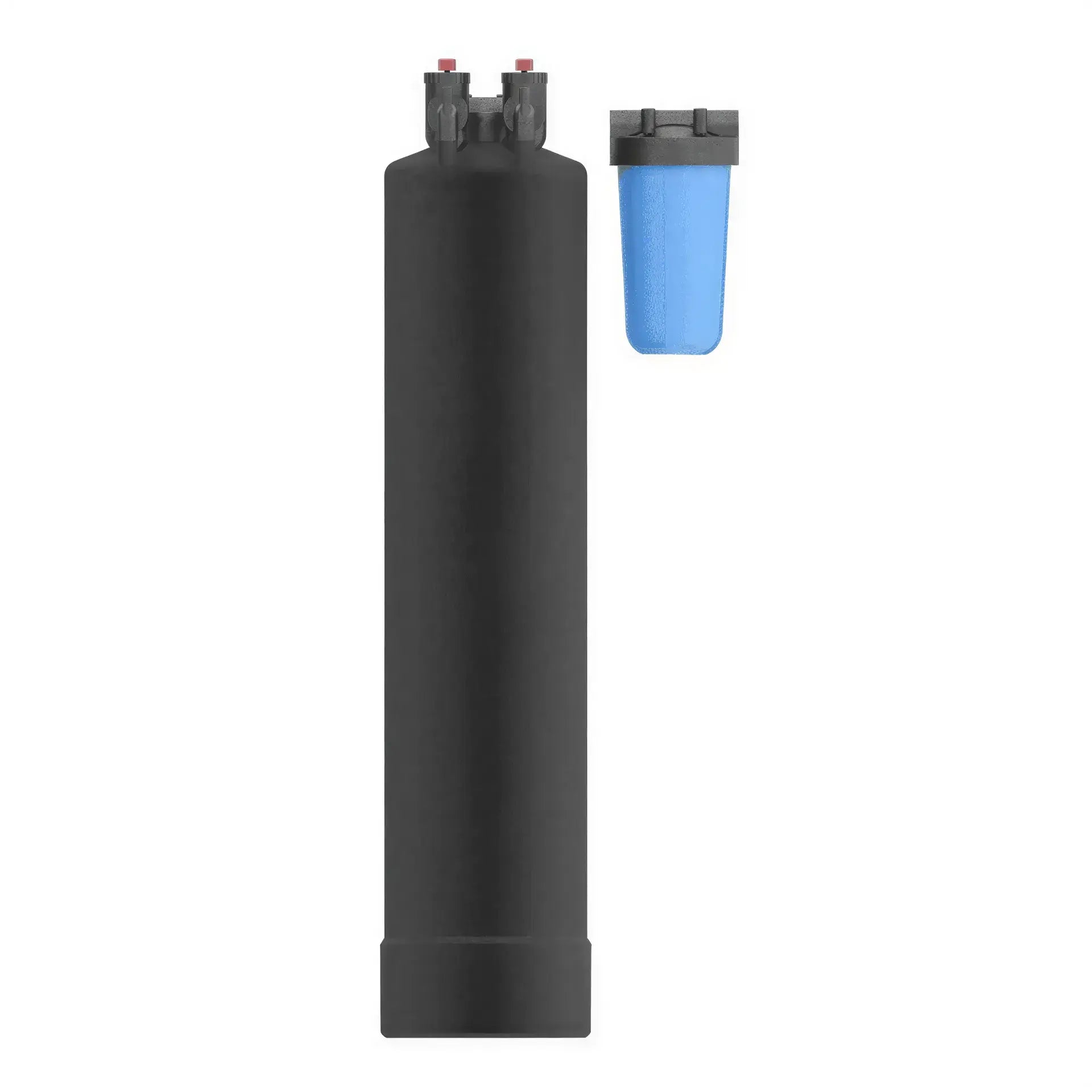
1. SoftPro Fluoride and Chlorine+ SUPER Filter
Whole House Catalytic Carbon + Bone Char Filter | Best for City Water with Fluoride Concerns
This is the most loaded city water filtration system we make. The SUPER Filter combines two distinct filtration media in a single upflow tank: 1.0 cubic foot of catalytic carbon and 0.5 cubic foot of bone char carbon. A total 1.5 cubic foot media bed built for homes with up to four to six bathrooms.
What it removes: Fluoride, chlorine, chloramines, PFAS (forever chemicals), arsenic, pesticides, herbicides, petroleum compounds, VOCs, TTHMs (trihalomethanes), and pharmaceutical byproducts.
How the technology works: Standard granulated activated carbon handles chlorine and basic taste-and-odor issues okay. But it has real limits. Catalytic carbon is a souped-up version that goes through additional processing to enhance its surface chemistry, allowing it to break down chloramine bonds through a catalytic reaction rather than just adsorption. That distinction matters because the majority of U.S. municipal systems now use chloramine as their disinfectant, and basic activated carbon can't reliably touch it.
The bone char component handles fluoride. Bone char is carbonized animal bone processed at high temperatures. It creates a unique porous structure that pulls fluoride ions out of water as it passes through. It also addresses certain heavy metals and trace inorganic compounds that standard carbon media can't get to, including strontium, which third-party testing has confirmed this system reduces.
The upflow design isn't an accident. Downflow carbon systems develop channeling, where water takes the path of least resistance through the media, cutting contact time and killing filtration efficiency. In an upflow setup, water enters at the bottom and rises through the media evenly. Maximum contact. Maximum filtration. No electricity needed. No wastewater produced.
Media life and maintenance: Under normal use, the media lasts 6 to 10 years or 600,000 to 1,000,000 gallons. No maintenance required between replacements. Pro-grade bypass kit included.
NSF/ANSI Standards: Built in alignment with NSF/ANSI 42, covering aesthetic contaminants including chlorine taste and odor reduction. Third-party testing confirms chlorine reduction to non-detectable levels and meaningful real-world fluoride reduction.
Heads up: This system is for city municipal water only. Not for private well water.
2. SoftPro Chlorine+ Carbon Whole House Water Filter
City Water Filters Series | Best for Chlorine, Chloramine, PFAS and Pesticide Removal
Not concerned about fluoride but still want serious whole-house protection from chlorine, chloramines, PFAS, and the general chemical mess that municipal treatment leaves behind? This is your system. The Chlorine+ Carbon Filter uses high-grade catalytic carbon in an upflow backwashing design, the same core technology as the SUPER Filter, without the bone char layer.
What it removes: Chlorine, chloramines, PFAS (forever chemicals), pesticides, herbicides, VOCs, TTHMs, and other chemical contaminants common in city water.
Why catalytic carbon over standard activated carbon: Standard GAC removes chlorine and improves taste. Catalytic carbon goes further. The catalytic surface breaks down chloramine bonds through a chemical reaction, not just physical trapping. That matters because chloramine exposure in hot showers and baths has been linked to respiratory irritation and skin dryness. SoftPro's specs show chlorine reduction of 95% or better and chloramine reduction of 85% or better from this system.
The upflow backwashing design handles its own maintenance on autopilot. The control valve runs periodic backwash cycles that reverse flow through the media bed, flush captured contaminants to drain, and extend media life. No manual work needed. Set it and forget it.
What this filter does NOT do: It doesn't reduce TDS the way a reverse osmosis filter or ion exchange system does. It targets specific chemical contaminants through adsorption and catalytic reaction. If your primary concern is lowering overall TDS or removing dissolved minerals, a point-of-use reverse osmosis system is a better fit for drinking water, and a water softener handles hardness throughout the home.
Media life: Catalytic carbon media typically lasts 5 to 10 years depending on water quality and household usage. No power required to filter. The control valve uses electricity only for the automated backwash cycle.
Heads up: Designed for city/municipal water. Not for private well water.
3. SoftPro Iron Master AIO: Iron Filter for Well Water
Air Injection Oxidation + Katalox Media | Best for Iron, Sulfur and Manganese Removal
The Iron Master AIO is the most capable residential iron filtration system SoftPro makes. Purpose-built for well water. Not adapted from a city water design. If your well water is leaving orange stains everywhere, running brown from the tap, hitting you with rotten egg smell, or carrying a metallic taste that won't quit, this system handles all of it. Zero chemicals involved.
What it removes: Dissolved iron (ferrous) and particulate iron (ferric) up to 30 PPM, manganese, hydrogen sulfide (the source of that sulfur odor), and sediment down to 3 microns. The oxidation process also naturally raises and stabilizes pH as part of the treatment sequence.
How Air Injection Oxidation (AIO) works: Iron in well water comes in two forms. Ferrous iron is dissolved and invisible in clear water. Ferric iron has already oxidized into visible rust particles. Standard water softeners using ion exchange can handle modest dissolved iron, but they weren't designed for the higher concentrations or mixed iron types many well owners deal with.
The Iron Master maintains an air pocket at the top of the pressure tank to oxidize dissolved ferrous iron into filterable ferric iron before it ever hits the media bed. The Katalox media, a catalytic filtration medium that actively enhances the oxidation process, then captures the oxidized particles. The Katalox media certificate with exact specifications ships with every unit. The backwash cycle automatically flushes captured iron from the media bed to restore capacity. No manual work. No chemicals. No potassium permanganate. No chlorine feed systems. Low operating costs and nothing to store, mix, or refill.
Iron and sulfur removal in practice: At 30 PPM iron capacity, the Iron Master handles levels that would overwhelm any competing residential system. Real-world user testing has documented iron reduction from levels as high as 8 to 12 PPM down to below 0.1 PPM, well under the EPA secondary standard of 0.3 PPM.
pH adjustment as a bonus: The air injection oxidation process raises pH as a byproduct of treatment. For well water with mild to moderate acidity, this can reduce or eliminate the need for a separate pH adjustment system. For more severely acidic water, check out the SoftPro pH Neutralizer Calcite Filter below.
Sediment filtration built in: The system filters to 3 microns, handling fine sediment, silt, and clay without requiring a separate pre-filter housing. Simpler installation. Fewer ongoing costs compared to multi-stage setups.
Media life: Katalox media is expected to last 10 to 15 years under normal residential conditions.
4. SoftPro pH Neutralizer Calcite Filter
For Acidic Well Water | pH Adjustment System Using Calcite Media
Acidic water with a pH below 7.0 is a slow-motion plumbing disaster. It quietly corrodes copper pipes, attacks fixture finishes, leaches lead and other metals from plumbing joints, leaves blue-green staining around drains, and aggressively shortens the lifespan of water heaters, softeners, and appliances. If your water tests acidic and the Iron Master's natural pH correction isn't enough for your situation, the pH Neutralizer Calcite Filter is the dedicated fix.
How it works: The system uses calcite (calcium carbonate mineral media) in a backwashing tank format. As acidic water contacts the calcite, the calcium carbonate dissolves gradually into the water and raises pH toward neutral. No chemical feed pumps. No soda ash injection. No caustic chemicals. Just a natural, mineral-based reaction that requires zero chemicals, zero pumps, and zero injection equipment.
Why pH matters beyond taste: Corrosive acidic water doesn't just mess with flavor. It extracts trace metals from your plumbing, including lead, that would otherwise stay inert. Addressing pH at the point of entry protects your entire household water system, not just the drinking water at one faucet.
Calcite media replenishment: Unlike carbon media that gets replaced all at once, calcite media gradually dissolves into the water as it works. That means periodic media top-ups are part of routine maintenance. The backwash cycle keeps the media bed clean and properly conditioned between replenishments.
How to Choose the Right Water Filter for Your Home
The best water filter is the one matched to your actual water chemistry. Not the priciest system. Not the most marketed one. Here's how to think it through.
Start with a water test. City water customers can request their municipality's annual Consumer Confidence Report, which lists detected contaminant levels. Well water owners should test annually with a certified lab. Knowing your actual chlorine levels, iron concentration, pH, fluoride, and total dissolved solids gives you the facts to choose and size correctly.
City water concerns: If your issue is chlorine taste, chloramine odor, or chemical exposure including PFAS, the Chlorine+ Carbon Filter targets those specifically. If fluoride removal matters to your household, step up to the Fluoride and Chlorine+ SUPER Filter.
Well water concerns: Iron staining, metallic taste, and sulfur odor all point to the Iron Master AIO. If water testing also shows pH below 7.0 and the AIO's natural pH correction isn't enough, add the pH Neutralizer Calcite Filter.
Pairing filters with a water softener: Whole house water filters and water softeners solve different problems and work great together. Filters remove chemical contaminants. Softeners remove hardness minerals through ion exchange. If you've got both hard water and chemical contamination concerns, SoftPro offers paired system packages that protect your plumbing and appliances from both threats at once.
What these systems don't replace: For drinking water reduction of nitrates, very low fluoride levels, or high TDS at the kitchen faucet specifically, a reverse osmosis system at the point of use gives a higher level of contaminant reduction for that single outlet. SoftPro's whole house filters are not reverse osmosis systems. They're designed for the flow rates and contaminant profiles suited to whole-home treatment.
The Technology Behind SoftPro Filtration Systems
Catalytic Carbon vs. Standard Activated Carbon Standard activated carbon removes chlorine and improves taste through adsorption. Catalytic carbon goes through additional surface activation that lets it break down chloramine molecules through chemical reaction, not just trap them. For households on chloraminated water, that difference is significant.
Bone Char Carbon Bone char is a natural media made from animal bones processed at high temperatures. Its porous structure gives it the ability to adsorb fluoride ions, certain heavy metals, and organic compounds that activated carbon can't touch. It's been used in water treatment for centuries, and modern processing has refined its consistency and efficiency.
Upflow vs. Downflow Backwashing Designs SoftPro's whole-house carbon filters use upflow tank design. Water enters at the bottom and rises through the media bed, providing more uniform contact time and preventing the channeling problems that reduce efficiency in downflow configurations. The automatic backwash cycle periodically reverses flow to clean the media bed and restore performance.
Air Injection Oxidation (AIO) AIO maintains an air pocket at the top of the filter tank. As well water enters, it passes through this oxygen-rich zone and converts dissolved ferrous iron into filterable ferric iron. Katalox catalytic media captures the oxidized particles, and automated backwash flushes them out. The entire process is chemical-free.
pH Neutralization via Calcite Calcite (calcium carbonate) slowly dissolves in acidic water, raising pH through a natural mineral reaction. No electricity. No pumps. No chemicals. Periodic media top-up maintains ongoing performance.
Built-In Peace of Mind
Lifetime Limited Warranty Every SoftPro filtration system ships with a lifetime limited warranty. The mineral tank and major components are built for long-term service. This isn't a product you replace every few years.
Free Shipping All system purchases ship free to the contiguous U.S. Alaska, Hawaii, and Puerto Rico excluded.
60-Day Money-Back Guarantee SoftPro stands behind every system with a 60-day money-back guarantee. Enough time to confirm it's delivering real results in your home.
What's Included Every system ships with all necessary installation components, including a pro-grade bypass kit, fittings, and installation instructions. Video installation support and direct access to SoftPro's technical team are included at no additional cost for the life of the system.
No Hidden Costs SoftPro sells factory-direct. The price you see isn't padded for dealer markups, commission sales teams, or inflated installation packages. Free technical assistance from real, knowledgeable people is part of every purchase.
A Note on NSF/ANSI Standards
When evaluating any water filtration system, NSF/ANSI certifications give you an objective, third-party performance benchmark. NSF/ANSI 42 governs aesthetic contaminant reduction, including chlorine taste and odor, and is the relevant standard for whole house carbon filtration systems. NSF/ANSI 53 covers health-related contaminant reduction. SoftPro systems are engineered in alignment with these standards. If specific certification documentation matters to your purchasing decision, SoftPro's customer team can provide the relevant performance data and third-party testing documentation.
Frequently Asked Questions
Do I need a water filter if I already have a water softener? Water softeners remove hardness minerals through ion exchange. They do not remove chlorine, PFAS, fluoride, iron, or chemical contaminants. If water quality and chemical exposure matter to you (and they should), a water filter handles what a softener was never designed to do.
Can I install a SoftPro filter myself? Yes. These systems are designed for installation by local plumbers, handymen, and experienced DIY homeowners. Full installation instructions and video support are included. SoftPro's technical team is available free of charge to assist any installer.
Will a whole house filter affect my water pressure? Properly sized and installed, SoftPro whole house filters maintain strong household flow rates. The upflow design on carbon systems and the 3-micron sediment filtration on the Iron Master are engineered to minimize pressure drop even during peak household usage.
Do these systems waste water? The carbon and fluoride filters produce no wastewater during filtration. The automated backwash cycle uses water to clean the media bed, but that's a periodic process, not ongoing waste. Unlike reverse osmosis technology, which produces reject water for every gallon it makes, whole house backwashing filters are significantly more efficient in daily water consumption.
Get your water tested. SoftPro offers a free water analysis consultation that helps you size the right system for your household's specific water chemistry and usage.