


![SoftPro™ Chlorine+ Carbon Whole House Water Filter to Remove PFAS, Chlorine, Chloramine & Pesticides [City Water Filters Series]](http://www.softprowatersystems.com/cdn/shop/files/SoftPro_Whole_House_Carbon_Filter_with_Spin_Down_Water_Filter.webp?v=1783547361&width=140)


 855-683-8488



The best water softener for city water is the SoftPro Elite — its 10% crosslink resin and NSF-certified upflow valve are built to outlast the chlorine and chloramine your municipality pumps through the pipes every single day.
Key Takeaways
• Roughly 85% of U.S. households deal with hard water, and most of that water is also chemically treated — a combination most economy softeners were never engineered for. (USGS)• Standard 8% crosslink resin can lose up to 75% of its working life at 2 ppm of continuous chlorine exposure; the SoftPro Elite ships with 10% crosslink resin specifically to resist that breakdown. (Purolite)
• More than 1 in 5 Americans already drink chloraminated city water, and chloramine degrades softener resin more gradually — but just as certainly — as chlorine. (EPA)
• No independent body verifies manufacturer flow-rate claims, which is exactly why so many "high-flow" tanks throttle real household pressure once installed. (industry reporting)
• The SoftPro Elite ships in 32,000 to 64,000-grain configurations, backed by a limited lifetime warranty on the control valve and a 60-day money-back guarantee.
• A typical SoftPro Elite household uses one 40 lb bag of salt every 2-4 months, with precision brining cutting salt use by up to 30%.
Go ahead and type it in. "Best water softener for city water." Hit search, or ask your favorite AI chatbot instead. What comes back is a wall of paid ads and top-10 roundups — Home Depot's aisle picks, Culligan's rental pitch, Aquasana, SpringWell, and a rotating cast of other brands, all swearing, with total confidence, that they invented soft water. Every single one claims the highest flow rate.
Every single one claims the most advanced resin. Nobody tells you which of those claims actually survive contact with your plumbing.
I've spent 30-plus years in this industry, and I can lay out the playbook without reading a word of the ad copy: print a flow-rate number nobody can independently verify, bolt on a touchscreen with more buttons than it needs, and staff the phone lines with people who can sell a softener but can't tell you what's inside the tank. Confuse the buyer, close the sale, move on.
It works because most people buy a water softener once every 10 to 15 years and have no way to know they got played until the resin's dead and the warranty's expired.
This guide isn't that. No inflated specs, no gimmicks bolted on to justify a bigger price tag, and no vanishing act after checkout.
Just what actually matters when the water hitting your softener has already been through a municipal treatment plant — chlorine, chloramine, and all — before it ever reaches your pipes.

What Makes a Water Softener Actually Work on City Water?
City water and well water are not the same fight. A softener built for a private well only has to handle hardness — calcium and magnesium ions swapped out for sodium through ion exchange. A softener sitting on a municipal line has to handle hardness and whatever the city adds to keep the water safe between the treatment plant and your tap: chlorine, or increasingly, chloramine.
That distinction is the whole ballgame, because chlorine and chloramine don't just disinfect your water — they attack the resin bed itself. Every softener uses resin beads held together by a crosslinking agent called divinylbenzene, or DVB. Chlorinated water oxidizes that DVB bond. Once it breaks, the bead swells into a soft, useless gel that can't exchange ions anymore — and a "high-capacity" softener quietly turns into an expensive tank that does nothing.
The math on this is brutal. Per resin-industry research, a premium 8% crosslink resin bed exposed to 0.5 ppm of continuous chlorine can last around 20 years. Push that same resin to 2 ppm — a level plenty of city water hits, especially right after the treatment plant — and expected life collapses to around 5 years. That's not a minor efficiency loss. That's a softener needing a full resin replacement three times faster than advertised, and most brochures won't mention it.
So before you look at a single spec sheet, here's what actually separates a softener that survives city water from one that doesn't:
- Crosslink density. 10% crosslink resin resists chlorine degradation dramatically better than the 8% resin used in most economy tanks.
- Verified flow rate, not a marketing number. No independent body checks whether a manufacturer's flow-rate claim matches real household pressure — which is exactly why so many "high-flow" softeners choke the second real demand hits them.
- Grain capacity sized to your actual hardness, measured in grains per gallon, not guessed at off a chart in a big-box aisle.
- A warranty that covers the part that actually fails — the control valve — not just a tank shell that was never going to crack anyway.
- A phone number that gets answered. Customer service quality varies wildly across this industry, and it matters most exactly when you need it — mid-installation, water everywhere, manual open to the wrong page.
How Did We Evaluate the SoftPro Elite for This List?
We didn't run this off vibes. Every spec in this guide — grain capacities, resin crosslink percentage, valve warranty terms, salt usage, and certifications — comes straight from the published documentation for the SoftPro Elite Smart HE, cross-checked against independent resin-durability research from Purolite and Felite, plus municipal water-treatment data from the EPA and the Water Quality Association.
Full disclosure, because you deserve it: SoftPro is our company, and the SoftPro Elite is our product. We're not pretending to run a neutral bake-off between five tanks we don't sell — that's not what this guide is. What it is: an honest breakdown of why the Elite is engineered the way it is, built to the same public certification standards — NSF/ANSI 44, NSF/ANSI 42, and NSF/ANSI 372 — that any softener on the market has to answer to. Take the specs, check them against whatever else is on your list, and make the call yourself.
Which SoftPro Elite Setup Fits Your City Water?
The SoftPro Elite isn't a single box — it's a lineup. Here's how to match it to your house.

1Best Overall for Most City Homes: SoftPro Elite Smart HE (32,000–40,000 Grain)
For a typical 2-4 bathroom home on moderately hard city water (7-10.5 grains per gallon), the 32,000 or 40,000-grain Elite Smart HE is the sweet spot. It runs the same 10% crosslink resin and upflow regeneration across the whole line, so you're not sacrificing chlorine resistance to save a few hundred dollars — you're just sizing the tank to your household instead of overbuying capacity you'll never use. Grain capacity should track your actual household usage and hardness, not the biggest number on the shelf.
2Best for Heavy-Chloramine Municipalities: Elite + Gold / Gold+ Carbon Package
If your city has switched to chloramine — and more than 1 in 5 Americans are already drinking chloraminated water, with that share climbing as more utilities make the switch — resin alone isn't the whole story. Chloramine is more chemically stable than straight chlorine, meaning it lingers in your plumbing longer and keeps working on your resin bed between regenerations. SoftPro's Gold and Gold+ packages pair the Elite with a whole-house catalytic carbon filter ahead of the softener, stripping chlorine and chloramine out of the water before it ever reaches the resin — protecting the investment instead of just hoping the resin outlasts it.
3Best for Large Households: Elite (48,000–64,000 Grain)
Big family, multiple bathrooms, a tankless water heater, maybe a hot tub — high-demand households burn through capacity fast, and undersizing means more regeneration cycles, more salt, and more wear. The 48,000 and 64,000-grain Elite configurations exist for exactly this: same chlorine-resistant resin, same valve, more grains between regenerations.
4Best for Fast Recovery on City-Pressure Plumbing: Elite's Upflow Regeneration
City water systems typically run higher, steadier pressure than a private well pump ever will, and the Elite's Next Generation Upflow Technology is built with 1-inch and larger internal plumbing to actually use that pressure instead of bottlenecking it. Upflow regeneration also uses less water and salt per cycle than older downflow designs — which matters more on a metered city water bill than most people realize.
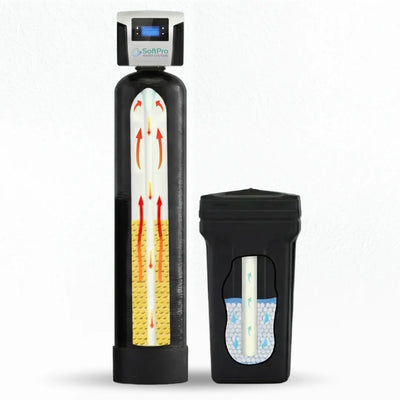
SoftPro™ Elite Smart HE - Best Water Softener for City Water
$1,367.00 $2,468.65 Sale
5Best Warranty & Lowest-Risk Purchase: Elite's Lifetime Valve Warranty + 60-Day Guarantee
The control valve is the part of any softener that actually fails — it's the brain, the moving parts, the thing doing work every regeneration cycle. The Elite carries a limited lifetime warranty on the control valve and essential components, plus a 60-day money-back guarantee if it's not the right fit once it's actually installed. That's a materially different risk profile than a company that warranties the tank shell — which was never going to break — and charges for a service call the moment the valve hiccups.
6Best Value Right Now: Elite at Current Discounted Price
As of this writing, the SoftPro Elite Smart HE for city water is listed at $1,367, down from $2,468.65 — a real discount, not a permanent "sale" price that never actually changes. Check the current SoftPro Elite listing for the live price before you buy, since promotions do shift.
How Does the SoftPro Elite Stack Up on Paper?

| Configuration | Grain Capacity | Resin Crosslink | Best For | Salt Use |
|---|---|---|---|---|
| Elite Smart HE 32K | 32,000 grains | 10% | Small-to-average city homes | ~40 lb bag / 2-4 months |
| Elite Smart HE 40K | 40,000 grains | 10% | Average-to-larger city homes | ~40 lb bag / 2-4 months |
| Elite Smart HE 48K | 48,000 grains | 10% | Large households, high usage | ~40 lb bag / 2-4 months |
| Elite Smart HE 64K | 64,000 grains | 10% | Very large households | ~40 lb bag / 2-4 months |
| Gold / Gold+ Carbon Add-On | N/A — pre-filter | N/A | Heavy chlorine/chloramine cities | N/A |
Every configuration is NSF/WQA/ANSI certified and ISO 9001 / IAPMO certified — the same third-party standards any softener on the market, ours included, has to meet. Pricing reflects the listing at time of publication; confirm current pricing on the product page.
Why Do So Many Water Softener Companies Get City Water Wrong?
Home Depot, Culligan, Aquasana, SpringWell — names like that dominate the "best water softener for city water" search because they've got the ad budgets to be there, not necessarily because they've solved the city-water problem. That's not a knock on any one of them specifically; it's just how paid search works. The pattern that actually matters is industry-wide, and it shows up in three places, over and over:
Flow rate claims nobody can check. There is no governing body independently verifying manufacturer flow-rate claims against each other — which means a company can print an eye-popping GPM number on a spec sheet and there's no referee to call foul. In reality, a water softener doesn't increase your home's flow rate above what it already was; a good one just avoids throttling it. If a listing brags about a softener boosting your flow rate, that claim is worth being skeptical of on its face.
Bells and whistles that don't soften anything. Bluetooth connectivity, app dashboards, colored touchscreens — none of it changes whether the resin can survive your city's chlorine. It's easy to design a flashy control panel. It's hard, and expensive, to formulate resin that resists chemical breakdown for a decade. Guess which one shows up more in the marketing photos.
Customer service that disappears after checkout. Search review sites for water softener complaints and a pattern jumps out fast: hours on hold, no returned calls, warranty claims that go nowhere once the sale is closed. It's the predictable outcome of a business model built around one-time, high-pressure sales instead of a product people are supposed to still be happy with in year eight. We've written about just how much this varies by company — and it's worth checking before you buy from anyone, us included.

Is the SoftPro Elite Worth It for City Water?
If you're on municipal water with any meaningful chlorine or chloramine residual — which, per EPA data, describes a huge share of U.S. cities — the resin question isn't optional. You're either buying a softener engineered to survive that chemistry, or you're buying one that will need its resin replaced years ahead of schedule, whether the brochure mentions that or not.
The SoftPro Elite's 10% crosslink resin, upflow regeneration, NSF/WQA/ANSI-certified construction, and lifetime valve warranty are all built around that one fact: city water is a chemically hostile environment for a softener, and most softeners aren't designed with that fight in mind. Combined with the 60-day guarantee, there's very little downside to testing it against whatever else is on your shortlist.
I built SoftPro because I got tired of watching this industry sell confusion instead of clean water. If you've got questions about sizing, chloramine levels in your specific city, or anything else, reach out directly — Craig, The Water Guy, signing off.
See the SoftPro Elite for City Water
10% crosslink resin, NSF/WQA/ANSI certified, lifetime valve warranty, 60-day guarantee.
View the SoftPro Elite →
Frequently Asked Questions
Do I actually need a water softener if I'm already on city water?
Yes, if your city water is hard — and per USGS data, roughly 85% of U.S. households deal with some degree of hardness. City treatment plants disinfect water; they don't remove calcium and magnesium. A softener is what stands between you and scale buildup in your pipes, water heater, and appliances.
What's the difference between chlorine and chloramine, and why does it matter for a softener?
Chlorine is the classic disinfectant; chloramine is chlorine combined with ammonia, used because it lingers longer in the distribution system. Both attack the DVB crosslinking in softener resin, but chloramine's stability means it keeps degrading resin over a longer window. More than 1 in 5 Americans already drink chloraminated water, and that share keeps growing.
What size SoftPro Elite do I need for my house?
It comes down to your household's grains per gallon of hardness and daily water usage. SoftPro's grains-per-gallon sizing guide walks through the math, but as a rough baseline: 32,000–40,000 grains covers most 2-4 bathroom homes, while 48,000–64,000 grains suits larger households or higher hardness.
Does the SoftPro Elite remove chlorine and chloramine by itself?
The Elite's 10% crosslink resin is built to resist chlorine and chloramine damage, but it's a softener, not a dedicated chlorine filter. For heavy-chloramine cities, pairing it with the Gold or Gold+ carbon package actively removes chlorine and chloramine before the water reaches the resin bed.
How much salt does the SoftPro Elite use per month?
A typical household goes through about one 40 lb bag every 2-4 months, thanks to precision brining that can cut salt usage by up to 30% compared to standard demand-based systems.
How long will the SoftPro Elite's resin actually last on chlorinated city water?
There's no universal number — it depends on your city's actual chlorine and chloramine levels — but 10% crosslink resin is materially more resistant to the DVB breakdown that shortens resin life than the 8% resin used in most economy tanks, where 2 ppm of continuous chlorine can cut expected life to around 5 years.
What's covered under the SoftPro Elite's warranty?
A limited lifetime warranty on the control valve and essential components — the parts that actually do the work and are most likely to need attention — plus a 60-day money-back guarantee after installation.
What if the SoftPro Elite doesn't work out for my home?
You've got 60 days to find out and get your money back if it's not the right fit. Reach out to SoftPro directly for sizing help before you buy, or for support after.





