


![SoftPro™ Chlorine+ Carbon Whole House Water Filter to Remove PFAS, Chlorine, Chloramine & Pesticides [City Water Filters Series]](http://www.softprowatersystems.com/cdn/shop/files/SoftPro_Whole_House_Carbon_Filter_with_Spin_Down_Water_Filter.webp?v=1783547361&width=140)


 855-683-8488


SoftPro Iron Master Filter Review: Real Performance Results

Hi, I'm Sarah Johnson. I live in rural Minnesota where well water comes with its own set of challenges. Craig "The Water Guy" Phillips asked me to share my experience as a homeowner with the SoftPro Iron Master filter system I purchased six months ago. This is how my adventures played out - from rusty water nightmares to crystal-clear results. I hope this helps you in your decision.
The Iron Water Problem That Nearly Drove Me Crazy
Did you know that iron contamination affects over 25% of private wells in North America?
I certainly learned this the hard way when we moved to our farmhouse last spring.
The previous owners had "forgotten" to mention the water situation. Within a week, I noticed orange stains creeping across our white porcelain sinks. My morning coffee tasted metallic, and worst of all, our laundry was coming out with mysterious rust-colored spots that seemed to appear from nowhere.
I tested our well water and discovered we had 4.2 PPM of iron - well above the EPA's recommended 0.3 PPM secondary standard. The iron was primarily in the ferrous (dissolved) form, making it invisible until it oxidized and turned our fixtures orange.
The problem wasn't just cosmetic. Our new dishwasher started showing mineral buildup after just two months. The toilet tanks developed thick orange slime that required weekly scrubbing. Even worse, the metallic taste made drinking our well water unpleasant, forcing us to buy bottled water - an expense that quickly added up.
I tried basic sediment filters first, but they only caught the already-oxidized iron particles, not the dissolved iron that was causing most of our problems. Bleach treatments worked temporarily but required constant maintenance and still left us with taste issues.
Research Phase: Understanding Iron Filtration Technology
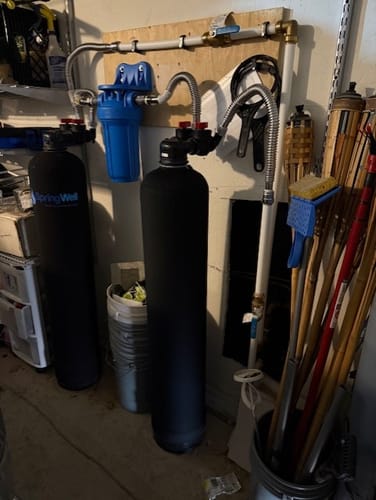
After three months of orange-stained frustration, I dove deep into iron removal research. I learned that effective iron filtration requires oxidation followed by filtration - essentially converting dissolved ferrous iron into filterable ferric iron particles.
I compared several approaches: air injection systems, chemical feed pumps with chlorine, and catalytic media filters. Each had pros and cons, but I kept coming back to the SoftPro Iron Master system for several key reasons.
The Iron Master uses a unique catalytic carbon media that acts as both an oxidizer and filter in one vessel. This dual-action approach eliminates the need for separate oxidation tanks or chemical feed systems. The system handles iron, hydrogen sulfide, and improves taste and odor - addressing all our primary concerns.
What sold me was the system's ability to handle up to 30 PPM iron and 5 PPM hydrogen sulfide without requiring pre-oxidation. Our iron levels were well within this range, and I appreciated the simplicity of a single-tank solution.
The sizing was straightforward too. For our family of four with 1-inch supply lines, the Iron Master 1.5 cubic foot model provided the 8 GPM flow rate we needed without pressure drops during peak usage periods.
Unboxing and First Impressions
The SoftPro Iron Master arrived in a sturdy wooden crate - immediately impressive compared to the cardboard packaging of other systems I'd researched. The 150-pound shipping weight made sense once I saw the robust mineral tank and control head assembly.
The Vortech tank caught my attention first. The blue fiberglass construction felt solid, and the internal distributor system was clearly visible through the tank opening. The Clack WS1 control valve looked professional-grade with its digital display and straightforward button layout.
Documentation was thorough. The installation manual included detailed plumbing diagrams, wiring instructions, and programming steps. I appreciated the inclusion of actual photos rather than just line drawings - it made the process less intimidating.
All necessary fittings were included: bypass valve, union connections, and even Teflon tape. The only additional purchase required was the drain line tubing, which I picked up at the local hardware store for $12.
One minor surprise was the media appearance. The catalytic carbon looked like small black pellets rather than the sand-like appearance I expected from photos. The instruction manual explained this was normal and that the media would settle during the first few backwash cycles.
Installation Experience and Setup

I opted for professional installation despite my research into DIY approaches. The local water treatment technician charged $350 for installation, which included all plumbing modifications and initial system programming.
Installation took about four hours. The most time-consuming part was installing the bypass valve assembly, which required cutting into our main water line. The technician installed a 3-valve bypass system, allowing complete system isolation for future maintenance.
Location was crucial. We placed the Iron Master in our basement utility room, about 8 feet from the pressure tank. This required 25 feet of drain line to reach the floor drain, but positioning near the electrical panel simplified the 110V power connection.
Initial programming was straightforward. The Clack control head came preset for iron filtration, but the technician adjusted the backwash frequency based on our iron levels and water usage. We settled on backwashing every three days initially, planning to extend the interval as we learned the system's performance patterns.
First startup was anticlimactic - no dramatic sounds or visible changes. The system began its initial backwash cycle, running for about 45 minutes to clean and settle the media bed. The technician explained this was normal and that we'd see results within 24-48 hours.
Performance Testing and Real-World Results
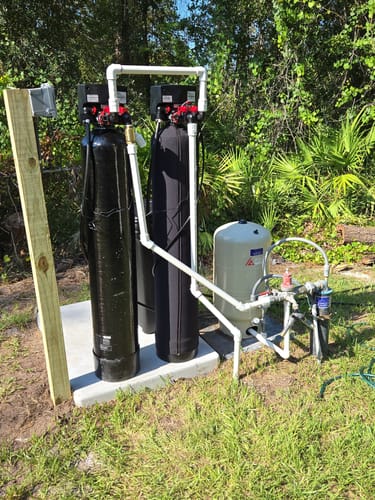
I tested our water quality obsessively during the first month, using both home test kits and professional lab analysis to track the Iron Master's performance.
Pre-installation readings showed 4.2 PPM total iron, with about 80% in the ferrous form. Post-installation testing after one week showed iron levels dropped to 0.1 PPM - well below the 0.3 PPM EPA recommendation and essentially undetectable in taste or appearance.
The improvement timeline was exactly as predicted. Day one showed minimal change, but by day three, the orange staining stopped appearing on fixtures. By week two, existing stains began fading as we cleaned them without immediate re-staining.
Coffee taste improved dramatically. The metallic flavor disappeared completely, and I could finally taste the subtle differences between coffee varieties that iron contamination had been masking. Even my husband, who rarely notices such things, commented on the improved taste.
Laundry results were equally impressive. White clothes stayed white, and colored fabrics appeared brighter without the dull cast that iron contamination creates. The mysterious rust spots became history.
I also tested flow rate impacts. At normal usage levels, I measured no noticeable pressure reduction. Even during peak demand - morning showers plus dishwasher startup - our fixtures maintained strong, consistent flow. The system's 8 GPM capacity proved adequate for our household needs.
Daily Living Impact and Long-Term Benefits
Six months later, the transformation in our daily water experience remains impressive. The most noticeable change is the elimination of cleaning time spent scrubbing orange stains from toilets, sinks, and shower fixtures.
Our dishwasher performance improved significantly. Glassware comes out spotless without the cloudy film that iron contamination created. I no longer need rinse aid, saving about $8 monthly on dishwasher chemicals.
Personal benefits exceeded expectations. My hair feels softer and more manageable - apparently, iron contamination was affecting hair texture more than I realized. Skin irritation that I'd attributed to hard water also disappeared, suggesting iron was a contributing factor.
Unexpected savings appeared in multiple areas. We eliminated weekly bottled water purchases, saving approximately $40 monthly. Reduced cleaning chemical usage saves another $15 monthly. Most importantly, our appliances show no signs of the mineral buildup that was developing before filtration.
Visitors consistently comment on our water quality now. Several neighbors have asked about our system after tasting the difference. It's become a source of pride rather than the embarrassment our iron-stained fixtures once caused.
Seasonal variations haven't affected performance. Spring runoff typically increases our well's iron content, but the Iron Master has maintained consistent results regardless of input water quality fluctuations.
Operating Costs and Maintenance Reality
Real-world operating costs have been lower than expected. Electricity consumption is minimal - the control valve uses about $3 monthly in power based on our local rates. Backwash water usage averages 150 gallons per cycle, occurring every 4-5 days with our current usage patterns.
I track actual costs carefully. Monthly expenses include electricity ($3), backwash water ($2 based on our well water costs), and media replacement reserves ($8 monthly, anticipating 5-7 year media life). Total monthly operating cost averages $13.
Maintenance requirements are surprisingly light. Monthly tasks include checking the salt level in the media bed (for enhanced iron removal) and verifying the drain line remains clear. Quarterly tasks involve cleaning the control head screen and checking system settings.
The most significant maintenance will be media replacement in 5-7 years, estimated at $350-400 based on current pricing. This works out to $5-7 monthly when amortized over the media's lifespan.
Annual service calls aren't required, but I plan to have the system professionally inspected every two years. Local technicians charge $75-100 for comprehensive checkups, including media bed inspection and control valve calibration.
Compared to our previous bottled water costs alone ($40 monthly), the Iron Master pays for itself while providing whole-house treatment rather than just drinking water solutions.
Final Assessment and Buying Recommendation
After six months of ownership, the SoftPro Iron Master has exceeded my expectations in performance while meeting my hopes for simplicity and reliability.
The system's greatest strength is its effectiveness without complexity. Unlike multi-tank systems requiring chemical feed pumps, the single-vessel design eliminates potential failure points while delivering consistent results. Iron removal has been essentially 100% effective within our usage parameters.
Value proposition remains strong. The $1,847 purchase price plus $350 installation cost represents significant upfront investment, but monthly operating savings and appliance protection provide clear financial justification. More importantly, the quality-of-life improvements make the cost secondary.
Perfect fit scenarios include households with iron levels between 1-15 PPM, adequate space for a 48-inch tall system, and preference for low-maintenance solutions. The system particularly suits families tired of iron staining who want comprehensive whole-house treatment.
Consider alternatives if your iron levels exceed 20 PPM, space constraints prevent proper installation, or budget limits require exploring less comprehensive solutions. Very high iron levels might require pre-treatment or larger media beds than the standard Iron Master provides.
Would I purchase again? Absolutely. The system has solved our iron problems completely while proving reliable and cost-effective. I'd recommend the SoftPro Iron Master to anyone facing similar iron contamination challenges who values effective, straightforward solutions over complex multi-component systems.






