


![SoftPro™ Chlorine+ Carbon Whole House Water Filter to Remove PFAS, Chlorine, Chloramine & Pesticides [City Water Filters Series]](http://www.softprowatersystems.com/cdn/shop/files/SoftPro_Whole_House_Carbon_Filter_with_Spin_Down_Water_Filter.webp?v=1783547361&width=140)


 855-683-8488


Why Your Water Softener Burns Through Salt — and the Upflow Fix That Can Cut It by Up to 30%
Table of Contents
If you're hauling 40-pound bags of salt every month, there's a good chance your softener is fighting its own design. Upflow regeneration flips the physics — and the savings are bigger than you might think.
- Upflow (counter-current) regeneration pushes brine upward through the resin bed.
- which, combined with a low salt dose, can cut salt use by as much as a third compared with downflow systems[1][2].
- Advanced upflow models like the SoftPro Elite report up to 75% salt savings and 64% water savings versus conventional downflow units[3].
- Counter-current regeneration produces lower hardness leakage, meaning consistently softer water even at reduced salt doses[1].
- The resin bed lasts longer because even brine distribution prevents channeling and underutilized pockets[4].
- Households on high-hardness water (above 25 GPG) see the most dramatic efficiency gains from switching to upflow[5].
Table of Contents


![SoftPro™ Elite Salt Free Water Conditioner [CITY WATER]](https://cdn.shopify.com/s/files/1/2723/7368/files/SoftPro_Elite_Salt_Free_Water.webp?v=1785375872)
The problem with downflow softeners
Most water softeners sold in the last thirty years regenerate downflow — brine enters the top of the resin tank and flows downward through the resin bed.
This is called co-current regeneration, because the brine travels in the same direction as the service water that flows through the tank during normal operation[2].
It works. It's proven. It's also wasteful.
Here's why. During service, hard water enters from the top and deposits calcium and magnesium onto the resin as it flows down. The resin at the top of the bed gets hit first and hardest — it's the most exhausted.
The resin at the bottom is the last line of defense, and it's the portion that determines the quality of the water leaving the tank.
When brine regenerates this bed from the top down, the strongest brine contacts the most exhausted resin first. By the time the brine reaches the bottom of the bed — the critical polishing layer — it's already loaded with displaced hardness ions and diluted.
The result is incomplete regeneration at the outlet end, which means hardness leakage into your softened water[1].
To compensate, downflow systems use more salt per cycle to push enough sodium through the entire bed.
That's why a conventional downflow softener might burn through six to fifteen pounds of salt per cubic foot of resin per regeneration, while an upflow system can achieve the same or better results with four pounds or less[6].
How upflow regeneration actually works
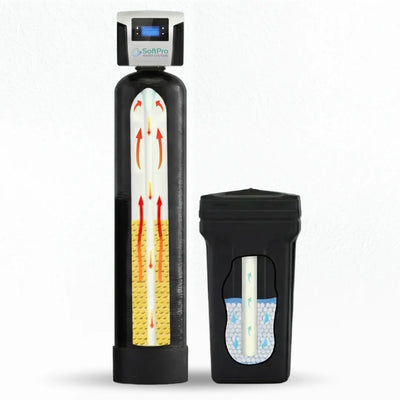
Upflow regeneration reverses the brine direction. Instead of entering at the top, brine is introduced at the bottom of the resin tank and travels upward through the bed.
This is called counter-current regeneration, because the brine moves opposite to the service flow[2].
The difference sounds small. The chemistry is not.
In counter-current regeneration, the freshest, most concentrated brine contacts the least depleted resin — the bottom layer, which is the polishing zone.
As the brine pushes upward, it progressively encounters more exhausted resin, but by the time it reaches the top (where the resin is most loaded with hardness), the brine still has enough sodium concentration to drive the exchange reaction backward and displace the calcium and magnesium[6].
The key advantage: the bottom of the bed — the last thing the softened water touches before leaving the tank — gets the cleanest, most concentrated brine.
That means the polishing zone is fully regenerated every cycle, which directly reduces hardness leakage[1].
Water softening works by ion exchange: calcium and magnesium ions (the hardness) stick to resin beads that are pre-loaded with sodium ions.
During regeneration, a concentrated salt brine floods the resin and the sheer excess of sodium ions pushes the equilibrium backward, knocking the calcium and magnesium off the resin and replacing them with sodium[7].
In upflow systems, the brine concentration is optimized at around 6% NaCl — lower than the 8–15% used in downflow systems — because the counter-current path extracts more exchange capacity per pound of salt[6].
The salt savings, by the numbers
The efficiency case for upflow regeneration is grounded in ion exchange chemistry. Here is what the independent literature says, what SoftPro's own figures say, and what one owner reported — labeled so you can tell them apart.
- Up to about 30% less salt — Industry technical literature puts the combined benefit of counter-current regeneration and a low salt dose at a 15–25% efficiency gain, or as much as a third less salt.
- Most of that gain comes from the lower salt dose that counter-currgeneration makes possible, not from flow direction alone[1][2].
- Up to 75% salt savings (SoftPro's figure) — Advanced upflow models like the SoftPro Elite, which combine counter-current brining with precision brine calculation and demand-initiated regeneration, report up to 75% salt reduction versus conventional downflow units from brands like Whirlpool, Kenmore, and Morton[5].
- 40–64% less water waste — Upflow systems require less water per regeneration cycle, with advanced models cutting wastewater by up to 64%[3][5].
- One owner's report — A SoftPro Elite owner on Reddit reported using two 40-lb bags of salt per year with upflow regeneration, compared to two bags per month with their previous Fleck downflow system.
- That is one household's experience, not a typical result; your salt use depends on hardness, water use, and settings[8].
Translated into dollars: if you're spending $10–15 per month on salt with a downflow softener, an upflow system can cut that to $3–5. Over a ten-year system life, that's $800–1,200 in salt savings alone — often more than the price difference between a standard and high-efficiency unit.
Why hardness leakage drops
Hardness leakage is the amount of calcium and magnesium that slips through the resin bed uncaught. It's the single most important measure of softener performance — if water isn't actually soft, nothing else matters.
Counter-current regeneration keeps leakage low even at reduced salt doses. The Water Conditioning & Purification industry's technical literature notes that "hardness leakage is quite low in counter-currently regenerated softeners, even at salt doses less than 4 lbs/ft³," which allows the system to produce "zero soft" water while using less salt[1].
This is the core trade-off that upflow systems win: downflow softeners can produce zero-soft water too, but they need higher salt doses to do it.
Upflow systems achieve the same result with less salt because the brine's path through the bed is thermodynamically more efficient[6].
Low-salt doses are always more efficient than high doses. — Peter Meyers, ResinTech, in Water Conditioning & Purification Magazine[1]

Who benefits most from upflow
Not every household will see the same savings. The efficiency gains from upflow regeneration scale with water hardness and usage:
- High-hardness households (25+ GPG): The harder your water, the more salt your softener consumes per cycle, and the more dramatic the savings from counter-current efficiency. Homes on water above 25 grains per gallon see the largest reductions[5].
- Large families / high water usage: More water means more regeneration cycles, which amplifies per-cycle savings into significant annual reductions.
-
A caution for well water with iron: Iron fouls resin, and low salt doses are less effective at stripping it off. The same industry literature that makes the case for counter-current regeneration notes it is less attractive on well water with foulants than on municipal water.
If you have iron, treat it ahead of the softener with a dedicated iron filter and set the salt dose accordingly[1].
- Environmentally conscious households: Less salt means less chloride discharged into wastewater, and less water wasted per cycle reduces overall household water consumption.
For homes on moderate-hardness municipal water (under 10 GPG) with low usage, the savings are real but less dramatic. Proper sizing, valve programming, and resin capacity matter more than flow direction alone in those cases[2].
SoftPro™ Elite Smart HE - Best Water Softener for City Water
$1,367.00 $2,468.65 Sale
Upflow vs. downflow: side-by-side
| Feature | Upflow (Counter-Current) | Downflow (Co-Current) |
|---|---|---|
| Brine direction | Bottom to top | Top to bottom |
| Salt efficiency | Up to about a third less salt[1] | Baseline (higher doses needed) |
| Water waste | 40–64% less per cycle[5] | Baseline |
| Hardness leakage | Low, even at reduced salt doses[1] | Higher at low salt doses |
| Resin bed utilization | Even when the bed is well packed and the valve controls brine flow[4] | Outlet end regenerated last |
| Brine concentration | ~6% NaCl (optimized)[6] | 8–15% NaCl |
| Resin life | Longer (even regeneration) | Standard |
| Design complexity | More valve-dependent[2] | Simpler, widely used |
The bottom line
Upflow regeneration isn't a gimmick — it's a fundamentally more efficient application of ion exchange chemistry. By sending brine in the opposite direction of service flow, counter-current regeneration ensures that the most critical part of the resin bed (the polishing zone at the bottom) gets the freshest, most concentrated brine.
The result is less salt, less water, lower hardness leakage, and longer resin life.
If you're replacing an older downflow softener or installing one for the first time in a high-hardness area, an upflow system like the SoftPro Elite can recover much of its efficiency premium through salt and water savings, with the payback depending on your hardness and usage[3].
If you're currently hauling two bags of salt a month, it's worth finding out how much of that is your water and how much is your softener's design[8].
The technology is proven. The chemistry is sound. The savings are real. The question is whether your current softener is worth the salt you're putting into it.
References
- Meyers, P. "Countercurrent Regeneration of Softeners: Weighing the Pros and Cons." Water Conditioning & Purification Magazine, Dec. 15, 2001. wcponline.com
- Quality Water Lab. "Upflow vs. Downflow Water Softener: Which Is Better?" qualitywaterlab.com
- SoftPro Water Systems. "SoftPro Elite Smart HE Water Softener — Product Specifications." softprowatersystems.com
- Pentair Water Solutions. "Upflow vs Downflow Water Softeners." May 1, 2021. pentair.com
- SoftPro Water Systems. "Downflow Softeners Waste Salt: The Upflow Edge." softprowatersystems.com
- Water Treatment Guide. "Achieving Brine Efficiency in Softening." watertreatmentguide.com
- MCBA. "Ion Exchange Water Softening: Resin Chemistry Guide." mcba.co.uk
- Reddit user testimonial. r/Plumbing, "Has anyone tried the SoftPro Elite water softener yet?" reddit.com
- Quality Water Treatment. "Understanding Long-Term Cost Savings: High-Efficiency vs. Traditional Water Softeners." qualitywatertreatment.com
- SoftPro Water Systems. "Upflow vs. Downflow Water Softeners: Which Is Really More Efficient?" softprowatersystems.com






