


![SoftPro™ Chlorine+ Carbon Whole House Water Filter to Remove PFAS, Chlorine, Chloramine & Pesticides [City Water Filters Series]](http://www.softprowatersystems.com/cdn/shop/files/SoftPro_Whole_House_Carbon_Filter_with_Spin_Down_Water_Filter.webp?v=1783547361&width=140)


 855-683-8488


Activated Carbon Iron Filter Water Treatment: Real Benefits, Hard Limits, and the Best Use Cases Explained

Activated carbon filters can remove iron from your water, but they work best under specific conditions. They're great at adsorbing dissolved ferrous iron (Fe²⁺), yet struggle with ferric iron without sediment pre-filtration. Performance depends heavily on pH, water hardness, and carbon saturation levels. Carbon block filters outperform GAC for iron removal, offering longer contact time and finer filtration. Understanding your exact water chemistry is the key to making these systems actually work for you.
Key Takeaways
- Activated carbon filters remove dissolved ferrous iron (Fe²⁺) through adsorption but struggle with ferric iron (Fe³⁺), which requires sediment pre-filtration.
- Carbon block filters outperform GAC by offering longer contact time, finer pores, and greater adsorption efficiency for iron removal.
- Optimal pH between 6.5–7.5 maximizes activated carbon performance; acidic conditions significantly reduce iron oxidation efficiency.
- High iron concentrations saturate carbon media quickly, causing breakthrough and allowing unfiltered iron to pass through untreated.
- Activated carbon works best in combined systems alongside aeration or ion exchange, particularly for residential well water treatment.
How Activated Carbon Filters Actually Remove Iron From Water

When it comes to removing iron from water, activated carbon filters rely on a process called adsorption — fundamentally, dissolved iron ions stick to the carbon's vast internal surface area rather than passing through. That enormous surface area is the key advantage here; more contact area means more opportunity to capture iron before it reaches your tap.
There's another mechanism worth understanding: activated carbon can assist in oxidizing soluble ferrous iron (Fe2+) into insoluble ferric iron (Fe3+), making it far easier to trap. However, acidic water conditions reduce this efficiency considerably by keeping iron more soluble.
And as the carbon saturates over time, removal capacity drops — eventually causing breakthrough, where iron slips through entirely. Consistent maintenance isn't optional; it's essential.
Which Iron Types These Filters Handle: and Which They Don't
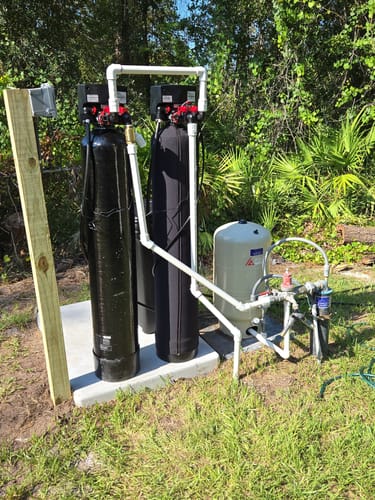
Understanding which iron types activated carbon handles — and which it doesn't — helps you set realistic expectations for your filtration system. Activated carbon excels at adsorbing ferrous iron (Fe²⁺), the dissolved form commonly found in well water. Ferric iron (Fe³⁺), however, has already oxidized and precipitated into solid particles — carbon simply wasn't designed for that job.
| Iron Type | Activated Carbon Performance |
|---|---|
| Ferrous (Fe²⁺) | Effective adsorption |
| Ferric (Fe³⁺) | Poor — requires sediment filtration |
| High iron concentrations | Limited — breakthrough risk over time |
We recommend pairing activated carbon with sediment pre-filters when ferric iron is present. Knowing your iron type before selecting a system isn't optional — it's foundational to getting filtration right.
GAC vs. Carbon Block: Which Performs Better on Iron?
Now that we recognize activated carbon's strengths and blind spots with different iron types, it's worth asking which carbon filter format actually delivers better results — GAC or carbon block?
Carbon block wins on iron removal. Its tightly compressed structure creates longer contact time, finer pore filtration, and greater surface area — all of which translate into higher adsorption efficiency for soluble iron and sharper overall water clarity.
GAC's looser granules allow faster flow rates, but that speed costs you contact time and density, two factors that matter greatly when targeting iron.
There's also a cost angle: GAC requires more frequent replacement in iron-heavy water, making carbon block the smarter long-term investment.
If iron removal is your priority, carbon block is the clear choice.
Water Conditions That Determine Whether These Filters Work
Even the best carbon filter underperforms if your water conditions work against it. pH is the biggest variable — activated carbon performs best in the 6.5 to 7.5 range, and anything outside that window chips away at iron adsorption efficiency.
High organic matter loads compound the problem by saturating carbon prematurely, which means you're burning through filter capacity faster than expected.
Water hardness adds another layer — calcium and magnesium compete directly with iron for adsorption sites, so test hardness levels before committing to this solution.
We also recommend sediment pre-filtration in most setups. Particulate matter clogs carbon media quickly, shortening operational lifespan and undermining performance.
Understanding your water's full chemistry profile isn't optional — it's the foundation every effective carbon iron filtration system is built on.
Best Applications for Activated Carbon Iron Water Treatment
Activated carbon iron filters shine in two specific scenarios: residential well systems and municipal supplies where organic compounds and iron show up together. When iron brings chlorine, odors, or organics along for the ride, these filters handle the full package efficiently.
| Application | Primary Benefit |
|---|---|
| Residential well systems | Reduces iron staining on fixtures and laundry |
| Municipal water supplies | Removes chlorine and organic co-contaminants |
| Combined treatment systems | Enhances ion exchange or aeration performance |
Pairing activated carbon with aeration or ion exchange reveals even stronger results, tackling contaminants that neither technology handles alone. We'd also remind you that regular media replacement keeps performance sharp—saturation silently kills effectiveness. Know your water, match your technology, and you'll consistently protect both your fixtures and your family's health.
Frequently Asked Questions
What Are the Disadvantages of Activated Carbon Water Filter?
Activated carbon filters can't kill bacteria or viruses, won't soften hard water, and struggle with heavy metals like lead. They also need regular replacement every 3–12 months, or contaminants'll break through once the carbon's saturated.
What Are the Benefits of Activated Carbon Water Filter?
We'll find that activated carbon filters effectively remove chlorine, VOCs, odors, and tastes while operating without electricity. Their massive surface area adsorbs diverse contaminants, making them cost-efficient, low-maintenance solutions that integrate seamlessly into multi-stage purification systems.
What Is the Best Activated Carbon Filter for Water?
Carbon Block Filters are our top pick—they're denser, maximize contaminant contact time, and effectively remove chlorine and VOCs. For larger systems needing higher flow rates, we'd recommend Granular Activated Carbon (GAC) Filters instead.
How to Use Activated Carbon to Purify Water?
We'll run water through activated carbon filters, letting the porous structure adsorb chlorine, VOCs, and odors. For best results, we'll integrate them into multi-stage systems and replace cartridges every 3–12 months.






