


![SoftPro™ Chlorine+ Carbon Whole House Water Filter to Remove PFAS, Chlorine, Chloramine & Pesticides [City Water Filters Series]](http://www.softprowatersystems.com/cdn/shop/files/SoftPro_Whole_House_Carbon_Filter_with_Spin_Down_Water_Filter.webp?v=1783547361&width=140)


 855-683-8488


AIO Air Injection vs. Chemical Feed Iron Filters: Which One Should You Actually Choose?

If you're dealing with iron, manganese, or sulfur odors up to 30 ppm, an AIO air injection system is usually your best bet — it uses only air, costs around $40 a year to maintain, and handles most well water problems without chemicals. Chemical feed systems make more sense for extreme contamination levels or stubborn sulfur. Your water test results are the real deciding factor, and what they reveal might surprise you.
Key Takeaways
- AIO systems effectively handle iron and manganese up to 30 ppm without chemicals, making them ideal for low-to-moderate contamination levels.
- Chemical feed systems using potassium permanganate or chlorine outperform AIO when contaminant levels exceed what air injection can manage.
- AIO systems cost roughly $400 over 10 years, while chemical feed systems range from $1,000 to $4,000 in the same period.
- Low pH water requires a neutralizer before iron removal, which affects which system will work most effectively for your situation.
- Test your water thoroughly and measure flow rate before choosing, as contaminant type and concentration determine the best system.
How Do AIO and Chemical Feed Iron Filters Actually Work?

When it comes to tackling iron and manganese in your water supply, AIO and chemical feed filters take two very different approaches.
AIO systems inject air directly into the water, oxidizing iron and manganese particles so they can be filtered out — no chemicals required. It's an elegant, self-contained process.
Air does the heavy lifting in AIO systems — oxidizing iron and manganese naturally, with no chemicals involved.
Chemical feed systems work differently. They introduce oxidizing agents like potassium permanganate or chlorine to trigger that same oxidation reaction before filtration removes the byproducts. It works, but it adds chemical dependency to your maintenance routine.
The core distinction? AIO systems harness air as the oxidant, while chemical feed systems rely on purchased reagents.
Understanding this difference helps you evaluate not just how each system performs, but what owning one actually demands from you long-term.
Which Contaminants AIO and Chemical Feed Systems Handle Best
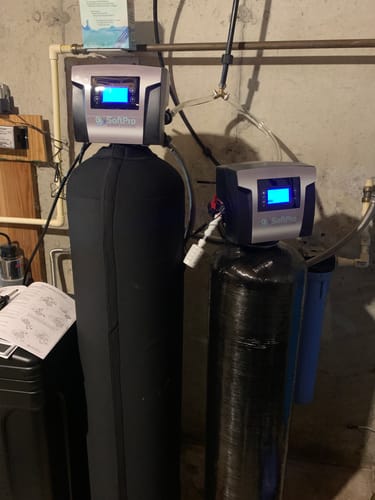
Both systems tackle iron and manganese, but they don't perform equally across every contaminant profile.
AIO systems handle iron and manganese up to 30 ppm while simultaneously eliminating sulfur odors—all without chemicals. That makes them exceptionally capable when you're dealing with complex, multi-contaminant well water.
Chemical feed systems shine when contaminant levels exceed what air injection alone can manage. Potassium permanganate and peroxide-based systems aggressively target stubborn iron and sulfur odors, but they're narrower in scope and require ongoing chemical inputs to stay effective.
Here's the key distinction: if your water has layered contamination and you want a cleaner, simpler solution, AIO wins.
If you're chasing extreme contamination levels and don't mind the maintenance trade-off, chemical feed earns its place.
What Your Water Test Results Tell You About Which to Choose
Knowing which system fits your contamination profile is one thing—but confirming it with a water test is what turns guesswork into a smart buying decision.
Here's what your results actually tell you:
- High ferrous iron only? AIO Air Injection likely wins—it oxidizes and filters efficiently.
- High iron and manganese? You'll probably need both systems, though AIO often outperforms in standard well conditions.
- Elevated sulfur? Chemical feed systems target hydrogen sulfide more precisely.
- Low pH? Add a neutralizer—chemical feed systems can compound acidic water problems.
- Improving water quality over time? Consider switching from chemical feed to the more cost-effective AIO solution.
Test regularly. Contaminant levels shift, and your system choice should shift with them.
The Real Cost of AIO vs. Chemical Feed Iron Filters Over 10 Years
Two systems that look similar on paper can tell very different financial stories over a decade. AIO systems run about $40 annually in maintenance costs, totaling roughly $400 over ten years.
Chemical feed systems? You're looking at $1,000 to $4,000 over the same period once you factor in chemical refills, media replacement, and ongoing maintenance.
Here's what makes that gap significant: AIO units don't require potassium permanganate or chlorine purchases, and their media outlasts chemical systems considerably.
AIO units eliminate chemical purchases entirely — and their media lasts far longer than competing systems.
Chemical systems typically need media replacement every five to ten years, adding costs that quietly compound.
While installation costs start similarly for both, AIO's lower operating expenses create real, measurable savings. If you're thinking long-term, that financial advantage is hard to ignore.
Which System Is Right for Your Well Water
Choosing the right iron filter comes down to what's actually happening in your well. Before you decide, test your water and your flow rate.
Here's what to match your system to:
- Low-to-moderate iron + septic system: AIO air injection wins—no chemicals, lower maintenance
- High iron concentrations: Chemical feed handles what AIO can't
- Low pH levels: Address acidity first, or iron removal gets complicated
- Uncertain flow rate: Run a 5-gallon bucket test before sizing anything
- Stubborn contaminants: Pair AIO with a pre-filter for stronger results
We've seen homeowners overcomplicate this decision. Your water chemistry tells you everything.
Get a full analysis covering iron, sulfur, and pH—then let the numbers guide your choice, not guesswork.
Frequently Asked Questions
What Is the Best Water Filter for Iron?
We recommend the SoftPro Iron Master for heavy iron situations—it removes up to 30 PPM without chemicals. Test your water first, though, since your iron type determines which system truly works best for you.
Do Air Injection Iron Filters Work?
Yes, they work exceptionally well! We've seen air injection filters remove up to 30 ppm of iron, plus manganese and sulfur, without chemicals—delivering clean, fresh water consistently for over 15 years of proven performance.
What Is the Correct Order for Water Treatment?
We'll start with sediment filtration, then move to an iron filter, followed by manganese removal if needed, a pH neutralizer, and finally a post-filter to polish your water before it reaches your fixtures.
What Is the Difference Between ACF and DMF?
ACF systems use oxygen to oxidize iron and manganese without chemicals, while DMF systems rely on additives like potassium permanganate. We find ACF safer, more cost-effective, and better at eliminating odors long-term.






