


![SoftPro™ Chlorine+ Carbon Whole House Water Filter to Remove PFAS, Chlorine, Chloramine & Pesticides [City Water Filters Series]](http://www.softprowatersystems.com/cdn/shop/files/SoftPro_Whole_House_Carbon_Filter_with_Spin_Down_Water_Filter.webp?v=1783547361&width=140)


 855-683-8488


AIO Iron Filter vs. Potassium Permanganate System: Honest Pros, Cons, and Cost Breakdown

When comparing AIO iron filters and potassium permanganate systems, both remove iron effectively, but they work very differently. AIO filters use air injection with zero chemicals, handle up to 30 PPM, and cost just $300–$500 to maintain over 10 years. Potassium permanganate tackles extreme iron levels above 5 mg/L but demands ongoing chemical monitoring and higher long-term costs. Choosing wrong means years of frustration. Stick with us, and we'll break down exactly which system fits your water.
Key Takeaways
- AIO iron filters cost $450–$1,000 upfront with ~$300–$500 in lifetime maintenance, making them significantly cheaper than potassium permanganate systems long-term.
- Potassium permanganate systems cost $1,000–$3,000 initially, plus $50–$100 annually in chemical replenishment, increasing total ownership costs considerably.
- AIO filters handle up to 30 PPM without chemicals, while potassium permanganate outperforms at extreme iron concentrations above 5 mg/L.
- AIO systems require only periodic backwashing; potassium permanganate demands precise chemical dosing and consistent monitoring for optimal performance.
- Potassium permanganate may cause a pinkish water tint, whereas AIO systems consistently maintain crystal clear water clarity.
How AIO Iron Filters and Potassium Permanganate Systems Remove Iron

When it comes to removing iron from your water, both AIO iron filters and potassium permanganate systems get the job done—but they take very different approaches.
AIO filters harness air injection to naturally oxidize dissolved ferrous iron into solid ferric particles, which are then filtered out—no chemicals required. It's an elegant, self-sustaining process.
Potassium permanganate systems, however, rely on a chemical oxidizing agent to trigger that same ferrous-to-ferric conversion. The chemistry works, but it demands precise dosing and consistent monitoring to stay effective.
Miss that balance, and performance suffers.
Both methods can eliminate iron efficiently, but understanding how they operate helps you choose the right system for your specific water chemistry, usage patterns, and long-term maintenance preferences.
AIO vs. Potassium Permanganate: Which Removes More Iron at Higher Concentrations?
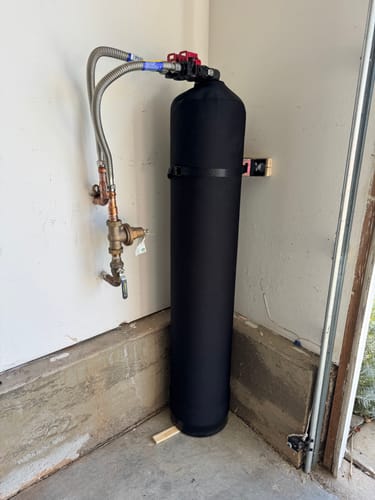
How well each system handles high iron concentrations is where the real differences start to emerge. AIO filters tackle up to 30 PPM without chemicals, making them a powerhouse for moderate-to-high iron levels. But when concentrations climb considerably above 5 mg/L, potassium permanganate's aggressive oxidation process takes the lead.
| Factor | AIO System | Potassium Permanganate |
|---|---|---|
| Max Iron Capacity | Up to 30 PPM | Best above 5 mg/L |
| Chemical Use | None | Requires replenishment |
| Water Clarity | Crystal clear | Risk of pinkish tint |
| Maintenance Needs | Minimal | Ongoing monitoring |
| Media Replacement | Infrequent | Every 4–6 years |
We'd recommend AIO for most households, but if you're battling extreme iron levels, potassium permanganate's chemical muscle becomes harder to ignore.
True Cost of AIO Iron Filters vs. Potassium Permanganate Over 10 Years
Two numbers define this decision more than any other: upfront cost and what you'll spend over the next decade. AIO systems start between $450–$1,000, while potassium permanganate systems run $1,000–$3,000 upfront.
But here's where it gets interesting. Over 10 years, AIO maintenance costs roughly $300–$500 every 4–6 years.
Potassium permanganate systems rack up $150–$300 annually in chemicals alone—before factoring in higher water waste during chemical regeneration and the labor-intensive monitoring they demand.
AIO media also tends to last longer when properly maintained, while potassium permanganate media degrades faster under shifting water conditions.
When you do the math, AIO systems typically deliver a lower total cost of ownership, making them the sharper long-term investment for most households.
Backwashing, Replenishment, and Upkeep: What Each System Actually Requires
Those long-term cost differences don't materialize on their own—they're driven by what each system actually demands from you week to week and year to year.
AIO filters require backwashing every 4–6 weeks, flushing out solid ferric particles to prevent clogging. Potassium permanganate systems need chemical replenishment, but only every 4–6 years.
| Maintenance Task | AIO Filter | Potassium Permanganate |
|---|---|---|
| Backwashing Frequency | Every 4–6 weeks | Periodic |
| Chemical Replenishment | None | Every 4–6 years (~$50–$100/yr) |
| Water Usage Per Cycle | 1–5 gallons | 1–5 gallons |
Both systems consume water during backwashing—a quiet but real cost. AIO wins on chemical-free simplicity, while permanganate systems trade lower monitoring demands for occasional replenishment costs. Know your tolerance for each before deciding.
AIO Iron Filter or Potassium Permanganate System: Which Fits Your Water?
Choosing between these two systems comes down to what's actually in your water and how much you're willing to manage.
If your iron levels sit below 10 mg/L and you'd rather skip chemicals entirely, an AIO filter's your cleaner, lower-maintenance option. You'll pay more upfront—$1,000 to $3,000—but you're fundamentally buying simplicity.
If your iron runs above 5 mg/L, potassium permanganate handles that heavier load more effectively. The initial cost is lower, but you're committing to chemical replenishment every four to six years, averaging $50 to $100 annually.
Both systems address manganese and hydrogen sulfide, so the real deciding factors are your iron concentration, your household's water demand, and your honest appetite for ongoing upkeep.
Test your water first—then decide.
Frequently Asked Questions
What Are Common Problems With Iron Filters?
We've found that iron filters commonly struggle with regular backwashing needs, media replacement every 4-6 years, orange staining from insufficient regeneration, clogging at high iron levels, pH sensitivity, and pressure drops when undersized for peak household flow.
What Is the Healthiest Water Filter to Use?
We'd recommend AIO systems as the healthiest option—they remove up to 99% of iron and manganese without chemicals, ensuring cleaner, safer water while requiring less maintenance and wasting less water than chemical treatment alternatives.
What Is the Best System to Remove Rust From Well Water?
For most well water, we'd recommend an AIO iron filter—it's chemical-free, low-maintenance, and handles iron up to 10 mg/L. If your levels exceed that, we'd consider a potassium permanganate system instead.
How Much Does It Cost to Install an Iron Filter?
We're looking at $1,000–$3,500 total for installation—that's $800–$3,000 for the system itself, plus $200–$500 for plumbing connections. Choosing the right size upfront prevents costly inefficiencies down the road.






