


![SoftPro™ Chlorine+ Carbon Whole House Water Filter to Remove PFAS, Chlorine, Chloramine & Pesticides [City Water Filters Series]](http://www.softprowatersystems.com/cdn/shop/files/SoftPro_Whole_House_Carbon_Filter_with_Spin_Down_Water_Filter.webp?v=1783547361&width=140)


 855-683-8488


Best Combined Iron Filter and Water Softener Combination System for High Iron and Hard Well Water

When your well water carries both high iron and stubborn hardness, the best combined iron filter and water softener systems handle both problems in one unit. Top picks like the SpringWell SS, Genesis 2 Iron Pro Max, and Fleck Iron Pro tackle up to 10 PPM iron while slashing hardness simultaneously. They cut maintenance, reduce salt waste, and protect your plumbing long-term. Stick with us and we'll help you find the perfect match for your home.
Key Takeaways
- The Fleck Iron Pro handles up to 10 PPM iron and costs under $1,000, making it ideal for high-iron well water.
- SpringWell SS delivers a 20 GPM flow rate with 97.5% hardness reduction, suiting larger homes with high demand.
- Combined systems reduce maintenance and save families up to 32,400 gallons of water annually during regeneration cycles.
- For most households, match grain capacity between 32,000–80,000 grains and ensure iron levels stay under 7 PPM.
- Efficient combo systems average just $60–$100 yearly in operating costs, providing affordable whole-home water treatment.
Iron Filter and Water Softener Combo Systems for Well Water: Top Picks Ranked

When it comes to tackling well water's toughest challenges—high iron levels, stubborn hardness, and unreliable flow—having the right combo system makes all the difference.
The right combo system transforms well water struggles into clean, reliable flow straight from your tap.
We've ranked the top performers so you can cut through the noise and invest wisely.
Our picks span a range of needs and budgets. The Genesis 2 Iron Pro Max handles up to 7 PPM iron for larger homes. The SpringWell SS delivers a powerful 20 GPM flow rate with 97.5% hardness reduction.
The budget-friendly Fleck Iron Pro tackles up to 10 PPM under $1,000—perfect for DIY installs. And the SpringWell WSSS Combo uses metered regeneration to precisely manage up to 3 PPM iron.
Most come backed by lifetime warranties, ensuring lasting protection.
Why One System Beats Running an Iron Filter and Softener Separately
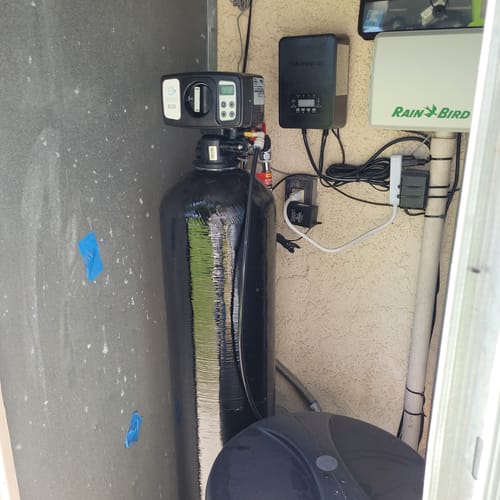
Running two separate systems sounds logical until you see what it actually costs you—in space, money, and headaches. Managing two devices means double the maintenance, double the salt consumption, and double the frustration when either unit underperforms.
A combined system like the Genesis 2 Iron Pro Max changes everything. It tackles iron levels up to 7 PPM while simultaneously softening your water—one unit, one footprint, one streamlined process. Families of four can save up to 32,400 gallons annually just during regeneration cycles. That's real money staying in your pocket.
Advanced features like automatic reserves and precise metering eliminate the guesswork entirely, adapting intelligently to your household's actual usage patterns.
You're not just simplifying your setup—you're upgrading your water quality across the board.
How to Size the Right Combo System for Your Home
Sizing a combo system comes down to four key factors: your water's hardness, iron levels, your household's flow rate, and grain capacity.
Start by testing your water — you're aiming for hardness between 3–10 grains and iron levels under 7 PPM. From there, match your grain capacity to your household size, typically 32,000–80,000 grains for families of four or more, while ensuring your system handles peak flow rates between 2.4–5 GPM.
Don't overlook regeneration demands. Depending on system size and usage, salt consumption ranges from 12–45 lbs per cycle.
But here's the payoff — proper sizing delivers real savings: up to 8,280 lbs of salt and 32,400 gallons of water annually. Precision sizing isn't optional; it's where efficiency and savings actually begin.
Iron PPM Ratings, Flow Rate, and Specs That Decide the Right Combo System
Every spec on a combo system tells a story — and knowing how to read it separates a smart purchase from an expensive mistake.
Start with iron PPM capacity. Systems like the Genesis 2 Iron Pro Max and Fleck Iron Pro handle up to 7 PPM, which covers most well water situations.
Next, check flow rate. The SpringWell SS pushes 20 GPM, keeping pressure strong even in larger homes.
Grain capacity matters too — ranging from 32,000 to 80,000 grains, it determines how aggressively the system tackles simultaneous hardness and iron.
Finally, look at regeneration efficiency. Metered systems like Genesis use 12 to 45 lbs of salt depending on size, eliminating waste.
Read these specs together, and the right system becomes obvious.
Salt Use, Maintenance Costs, and Installation Realities for Combo Systems
Specs tell us what a system can do — but salt use, maintenance costs, and installation realities tell us what it costs to live with one.
The Genesis 2 Iron Pro Max uses between 12–45 lbs of salt per regeneration cycle, yet its efficiency saves families of four up to 8,280 lbs of salt and 32,400 gallons of water annually.
Each regeneration cycle uses 12–45 lbs of salt — yet saves families 8,280 lbs annually.
That efficiency translates to roughly $60–$100 yearly in operating costs — remarkably lean for whole-home protection.
Soft Water Recharge Mode keeps performance consistent during peak demand without waste.
Installation won't intimidate you either. The Quick Pro Connector kit reduces setup to a straightforward 1-2-3 process.
We're talking about a system you can confidently own, operate, and maintain without ongoing professional intervention.
Frequently Asked Questions
Does a Water Softener Help With Iron in Well Water?
Yes, a water softener can tackle iron in your well water! We've seen it effectively remove up to 3 PPM using ion exchange technology, replacing iron with sodium ions, giving you cleaner, better-tasting water.
Is There a Filter to Remove Iron From Well Water?
Yes, there are iron filters specifically designed to tackle well water iron problems! We recommend systems like manganese greensand or catalytic carbon filters, which effectively remove dissolved iron concentrations up to 10 PPM, transforming your water quality dramatically.
What Are Common Problems With Iron Filters?
We've seen iron filters fail when capacity's exceeded, maintenance gets neglected, or mixed iron types confuse the system. Manganese and sulfur compound these issues, while undersized units waste water and drive up your utility bills unnecessarily.
Are There Water Softeners That Will Take Too Much Iron Out of Your Water?
No water softener removes too much iron—but we've seen undersized systems struggle with high iron levels, causing clogs and inefficiency. That's why we recommend matching your system's iron removal rating precisely to your water's iron concentration.






