


![SoftPro™ Chlorine+ Carbon Whole House Water Filter to Remove PFAS, Chlorine, Chloramine & Pesticides [City Water Filters Series]](http://www.softprowatersystems.com/cdn/shop/files/SoftPro_Whole_House_Carbon_Filter_with_Spin_Down_Water_Filter.webp?v=1783547361&width=140)


 855-683-8488


Best UV System to Pair With an Iron Filter for Safe, Clean Well Water: Top Options Compared

If you've got an iron filter, you're already ahead of the game — but bacteria and viruses are still slipping through. Pairing your system with a UV sterilizer downstream eliminates up to 99.99% of harmful microorganisms. We recommend units delivering at least 30 mJ/cm², with top picks like the VIQUA VH410 and Luminor LB7 leading the pack. Stick with us, and we'll walk you through everything you need to choose and set up the perfect match.
Key Takeaways
- Iron filters remove iron and sediment but not pathogens, making a UV system essential for comprehensive well water safety.
- Match UV flow rate to household demand: 8 GPM for 1 bathroom, 12 GPM for 2–3, and 20 GPM for 4–5.
- Choose a UV system delivering at least 30 mJ/cm²; NSF Class "A" certified systems offer 40 mJ/cm² for added assurance.
- Top options include the VIQUA VH410, Luminor Blackcomb, Luminor LB7, VIQUA D4 Premium, and VIQUA VH200.
- Always install the UV sterilizer downstream of the iron filter to prevent iron particles from shielding microorganisms.
Why Your Iron Filter Needs a UV System After It

While iron filters do a great job of clearing out iron and sediment, they leave one critical job unfinished—killing bacteria and viruses.
That's a serious gap. Pathogens like E. coli and Giardia can still flow freely through your taps, completely undetected and untreated.
That's where a UV system becomes essential. Installed directly after your iron filter, it inactivates up to 99.99% of harmful microorganisms—including chlorine-resistant pathogens that other treatment methods simply can't handle.
Most quality systems deliver at least 30 mJ/cm² of UV dose, well above the 10 mJ/cm² minimum needed for effective disinfection.
Together, these two systems tackle every major threat in well water—iron staining and invisible biological risks—giving you thorough protection you can actually trust.
How to Match UV Flow Rate to Your Well Water Demand
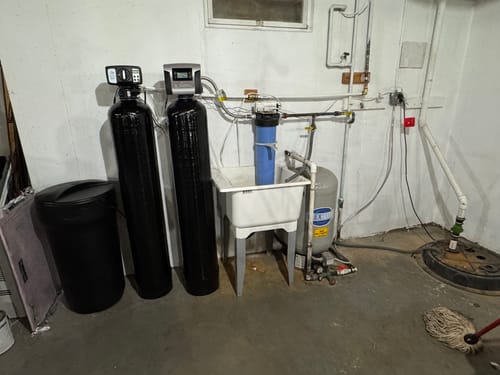
Now that we've covered why a UV system belongs after your iron filter, let's talk about picking the right one for your home—specifically, making sure its flow rate can actually keep up with your water demand.
Match your bathrooms to GPM requirements, then size up:
| Bathrooms | Minimum GPM | Recommended UV Capacity |
|---|---|---|
| 1 | 6 GPM | 8 GPM |
| 2–3 | 9 GPM | 12 GPM |
| 4–5 | 15–18 GPM | 20 GPM |
Always oversize—never undersize. A undersized UV unit rushes water through too quickly, reducing UV dose exposure below that critical 30 mJ/cm² threshold needed to neutralize E. coli and Giardia. Pair your UV system with a 5-micron sediment pre-filter, and test your well water regularly to confirm your setup stays effective.
UV Dose and NSF Certification for Iron Filter Setups
Getting the flow rate right is only half the battle—you also need your UV system to deliver enough UV dose to actually kill pathogens.
Getting the flow rate right is only half the battle—your UV system must also deliver enough dose to kill pathogens.
We recommend targeting a minimum of 30 mJ/cm², which effectively inactivates the harmful microorganisms commonly found in well water.
For stronger peace of mind, look for NSF Class "A" certified systems, which are rated at 40 mJ/cm². That extra margin matters, especially in commercial settings or homes with higher contamination risks.
Here's where the iron filter becomes critical: iron particles shield microorganisms from UV light, dramatically reducing the dose your water actually receives.
The Best UV Systems to Run After an Iron Filter
Once your iron filter is doing its job, pairing it with the right UV system is what separates truly safe water from water that just looks clean. We've narrowed it down to systems that deliver at least 30 mJ/cm², work seamlessly after iron filtration, and protect against threats like E. coli and Giardia.
| UV System | UV Dose | Best For |
|---|---|---|
| VIQUA VH410 | 40 mJ/cm² | High-flow households |
| VIQUA D4 Premium | 30 mJ/cm² | Standard well systems |
| Luminor Blackcomb | 40 mJ/cm² | Budget-conscious buyers |
| VIQUA VH200 | 30 mJ/cm² | Small families |
| Luminor LB7 | 50 mJ/cm² | Maximum protection |
Each option installs after your iron filter, ensuring zero iron interference with UV penetration.
How to Install a UV System After an Iron Filter
Installing a UV system after your iron filter is straightforward if you follow the right sequence. First, confirm your iron filter is removing particulate matter effectively—sediment creates shadows that block UV rays, reducing disinfection power.
Then position the UV sterilizer downstream in the flow pathway, so water arrives clean and ready for treatment.
Place the UV sterilizer downstream, where water arrives already filtered and ready for effective treatment.
Mount the unit, connect your input and output tubing, and secure all clamps according to the manufacturer's instructions.
Don't underestimate accessibility—allow double the clearance around the system for annual maintenance like lamp replacement and quartz sleeve cleaning.
Once everything's connected, test your water immediately. Confirming pathogen elimination isn't optional; it's your proof the system's working.
Follow this sequence, and you've built a disinfection setup that genuinely protects your household.
Frequently Asked Questions
What Is the Best Filter to Remove Iron From Well Water?
We recommend oxidizing filters like manganese greensand or birm—they're your best bet for eliminating dissolved iron by converting it into filterable particles, giving you consistently clean, odor-free well water throughout your entire home.
What Are Common Problems With Iron Filters?
We've seen iron filters struggle with high iron concentrations, bacterial contamination, sediment buildup, and clogging over time. They also can't disinfect water alone, so pairing them with a UV sterilizer is essential for truly safe well water.
What Are the Disadvantages of UV Water Purifiers?
UV purifiers don't remove heavy metals or chemicals, require clear water to work effectively, need regular maintenance, and offer zero residual protection—meaning once water leaves the system, it's vulnerable to recontamination.
Do You Need a UV Filter for Well Water?
We strongly recommend a UV filter for well water. It destroys 99.99% of harmful bacteria and viruses that often go undetected, giving you a critical layer of protection—especially when paired with an iron filter.






