


![SoftPro™ Chlorine+ Carbon Whole House Water Filter to Remove PFAS, Chlorine, Chloramine & Pesticides [City Water Filters Series]](http://www.softprowatersystems.com/cdn/shop/files/SoftPro_Whole_House_Carbon_Filter_with_Spin_Down_Water_Filter.webp?v=1783547361&width=140)


 855-683-8488


Calculate Your Iron Filter ROI in 5 Minutes: Is It Worth It?

Calculating your iron filter's ROI is simpler than you'd think, and the numbers tell a compelling story. Budget systems run $800–$1,500, while premium models cost $3,000–$5,000, plus $500–$2,000 for installation. But untreated iron quietly destroys appliances, costing $4,500+ annually in repairs alone. Premium filters typically break even within 2–3 years and save $400–$2,100 long-term. Stick with us, and we'll walk you through every number that matters.
Key Takeaways
- Premium iron filters break even within 2–3 years, making them worthwhile investments compared to budget models costing $3,800–$6,800 long-term.
- Untreated iron causes $4,500+ in cumulative appliance and plumbing damage annually, far exceeding filtration system costs of $1,200–$5,800.
- Budget filters require media replacements every 6–12 months, totaling up to $3,600 over a decade in maintenance costs.
- Premium systems save $400–$2,100 over 10–15 years despite costing $1,500–$4,200 more upfront than budget alternatives.
- Calculate ROI by comparing installation costs ($1,300–$5,000) against annual repair savings from prevented appliance and plumbing damage.
What Does an Iron Filter Actually Cost Upfront?

When shopping for an iron filter, the price tag can swing wildly depending on what you're dealing with. Budget systems start around $800–$1,500, while premium units climb to $3,000–$5,000.
Then installation adds another $500–$2,000 on top.
Installation costs don't stop at the unit—budget an extra $500–$2,000 before the first drop of clean water flows.
Here's where it gets interesting: the severity of your iron problem dictates your tier. Mild contamination? A basic system runs $500–$1,500. Severe conditions demand advanced systems at $1,500–$3,000. Whole-house solutions typically land between $1,000–$3,000.
We know the sticker shock is real. But here's what most homeowners miss—choosing underpowered filtration to save money upfront almost always costs more later through maintenance headaches and appliance damage.
Your initial investment isn't just a purchase; it's the foundation of your long-term savings strategy.
How Much More Does a Premium Filter Cost Than a Budget Model?
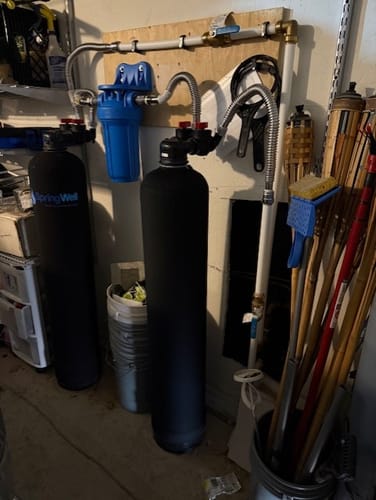
How much more are you actually paying for a premium system? Let's break it down honestly.
When you stack premium models ($3,000–$5,000) against budget alternatives ($800–$1,500), the gap becomes clear:
- Upfront cost difference: $1,500–$4,200 more for premium systems, including installation
- Contaminant removal: Premium filters hit 95%+ efficiency versus just 70–80% for budget models
- Budget media replacements: Every 6–12 months, accumulating up to $3,600 over a decade
- Long-term savings: Premium systems save $400–$2,100 in maintenance over 10–15 years
- Real cost question: It's not what you pay today—it's what you pay over time
That performance gap isn't just a spec sheet number. It's the difference between solving your iron problem and managing it indefinitely.
What Does Untreated Iron Actually Cost You Each Year?
Comparing premium versus budget filters tells only half the story—the other half lives in what untreated iron quietly destroys while you're not looking. Let's follow the money.
| Damage Category | Annual Cost |
|---|---|
| Appliance damage | $1,500+ |
| Plumbing repairs | $3,000+ |
| Water heater/softener failure | $2,000+ |
| Cumulative decade impact | $4,500+ |
| Filtration system (installed) | $1,200–$5,800 |
Those numbers aren't hypothetical—they're what homeowners absorb silently through shortened appliance lifespans, corroded pipes, and failed water heaters. Iron doesn't announce itself; it just chips away at infrastructure. When you stack a $5,800 filtration investment against $4,500+ in annual damage potential, the math stops being complicated. Prevention isn't an expense—it's leverage.
How Do You Calculate Your Iron Filter ROI in 5 Minutes?
Grab a napkin—this calculation takes less time than your morning coffee. Here's your five-minute ROI formula:
- Initial cost: System price ($800–$3,000+) plus installation ($500–$2,000)
- Annual maintenance savings: Premium systems run $40–$100 yearly versus $300–$500 for budget options
- Appliance protection: Untreated iron risks $4,500+ in plumbing and appliance repairs
- Media replacement: Budget filters need replacement every 6–12 months ($200–$600 each); premium systems last 10–15 years
- Total ownership comparison: Add your 10-year maintenance and replacement costs, then subtract potential repair savings
Now subtract your total ownership costs from what untreated iron would've cost you.
That difference is your ROI. Most homeowners discover premium systems pay for themselves well before year five.
When Does a Premium Iron Filter Pay for Itself?
Most homeowners wonder when their investment actually starts working in their favor—and with premium iron filters, that crossover happens faster than you'd expect. Despite upfront costs of $3,000–$5,000, the math becomes compelling quickly.
Here's why: budget systems bleed $300–$500 annually in maintenance, while premium systems cost just $40–$100. That gap alone recovers thousands over a decade.
Add the $4,500 in damage prevention from untreated iron, plus $2,000+ saved on premature appliance failures, and the picture sharpens considerably.
Most premium systems reach their break-even point within 2–3 years. Over their lifespan, they total roughly $4,500 in costs—compared to $3,800–$6,800 for budget models.
When you factor in what you're protecting, premium isn't just affordable—it's the smarter calculation.
Frequently Asked Questions
How Often Should Your Iron Filter Regenerate?
Your iron filter's regeneration frequency depends on your system. Budget models need it every 6–12 months, while premium systems can go 10–15 years. We'd recommend testing your water to nail the perfect schedule.
Will a 5 Micron Filter Remove Iron?
A 5-micron filter won't effectively remove iron. Since dissolved ferrous iron measures under 0.5 microns, it'll pass right through. We recommend specialized iron filters rated at 1 micron or smaller for real results.
Will an Iron Filter Remove Iron Bacteria?
Iron filters won't remove iron bacteria — they can actually make things worse by feeding bacterial growth. We'll need to pair our iron filter with chlorination or UV treatment to effectively eliminate these stubborn microorganisms.
How Much Iron Will a Water Softener Take Out?
We've found that water softeners typically handle iron levels below 1-2 ppm effectively. Beyond that threshold, they'll struggle, and you'll need a dedicated iron filter to protect your appliances and water quality.






