


![SoftPro™ Chlorine+ Carbon Whole House Water Filter to Remove PFAS, Chlorine, Chloramine & Pesticides [City Water Filters Series]](http://www.softprowatersystems.com/cdn/shop/files/SoftPro_Whole_House_Carbon_Filter_with_Spin_Down_Water_Filter.webp?v=1783547361&width=140)


 855-683-8488


Chemical Feed vs. AIO Air Injection Iron Filter: True Cost, Maintenance Burden, and Performance

When comparing chemical feed and AIO air injection iron filters, we've found that AIO systems win on almost every front. They remove over 95% of iron without chemicals, cost $1,000–$2,000 over five years versus $1,500–$3,000 for chemical systems, and require far less maintenance. Chemical feed systems demand constant monitoring and replenishment, while AIO handles regeneration automatically. If you want cleaner water, lower costs, and fewer headaches, stick with us and we'll break it all down.
Key Takeaways
- AIO air injection filters remove over 95% of iron using no chemicals, while chemical feed systems rely on potassium permanganate or chlorine additives.
- Over five years, AIO systems cost $1,000–$2,000 compared to chemical feed systems costing $1,500–$3,000 total.
- AIO annual maintenance averages $40–$150, whereas chemical feed systems require $300–$500 yearly in upkeep and chemical replenishment.
- AIO systems use automatic backwashing for regeneration, eliminating constant chemical monitoring required by chemical feed systems.
- Chemical feed systems suit complex water chemistry, while AIO filters excel in high-iron scenarios requiring minimal long-term maintenance.
How Chemical Feed and AIO Iron Filters Actually Work

When it comes to tackling iron in your water, these two systems couldn't take more different approaches.
Chemical feed filters rely on injecting potassium permanganate or chlorine directly into your water, forcing oxidation before filtering out the resulting iron particles. It works, but you're fundamentally fighting iron with chemistry.
AIO systems flip the script entirely. Instead of chemicals, they inject air into your water supply, triggering natural oxidation that converts dissolved iron into solid particles your filter can capture.
No chemical additives, no mixing tanks, no worrying about dosage precision.
Think of it this way: chemical feed systems are the sledgehammer, and AIO is the precision tool.
Both oxidize iron effectively, but the how behind each approach shapes every cost and maintenance decision downstream.
Which System Removes More Iron From Your Water?
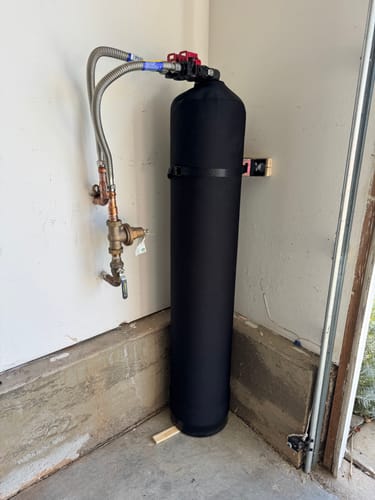
Here's why it matters: iron that slips through accumulates in your pipes, stains your fixtures, and compromises your appliances over time.
Chemical feed systems fight iron with additives, but they're working against a ceiling.
Chemical feed systems can only do so much — additives have limits, and iron doesn't care about your workarounds.
AIO systems oxidize iron using air, driving precipitation more completely and consistently.
When you're chasing mastery over your water quality, settling for "mostly treated" simply isn't good enough.
True Cost Breakdown: Chemical Feed vs. AIO Over 5 Years
Removing more iron from your water is only half the battle—what you pay to get there matters just as much. Over five years, chemical feed systems typically cost between $1,500 and $3,000, driven by annual chemical expenditures and maintenance fees reaching $300–$500 yearly.
That's a significant financial burden.
AIO systems tell a different story. Expect to spend $1,000–$2,000 over the same period, with annual maintenance averaging just $40–$150 and chemical costs around $200 yearly compared to chemical feed's $600.
The math is straightforward: AIO systems deliver superior iron removal—over 95%—while keeping your long-term costs measurably lower.
When you're investing in water treatment, choosing a system that performs better AND costs less isn't a compromise; it's the smarter decision.
Which AIO or Chemical Feed System Is Harder to Maintain?
Maintaining your iron filter shouldn't feel like a part-time job—and with an AIO system, it won't.
Chemical feed systems demand constant attention—monitoring chemical levels, replenishing potassium permanganate or chlorine, and adjusting dosages regularly. That complexity adds up fast.
Here's what sets AIO apart:
- Automatic backwashing handles regeneration without manual intervention
- No chemical replenishment means fewer recurring tasks and lower annual costs ($40–$150 vs. $100–$200)
- Less operational oversight translates to simpler, more predictable maintenance
Chemical feed systems aren't impossible to manage, but they require discipline and ongoing vigilance.
AIO systems let you focus elsewhere while the system quietly does its job. If you value efficiency and simplicity, the maintenance burden comparison alone makes AIO the smarter long-term choice.
Which Iron Filter Fits Your Water and Budget?
The right iron filter comes down to two things: your water's unique chemistry and what you're willing to spend.
Choosing the right iron filter starts with two questions: What's in your water, and what's in your budget?
If your water has high iron levels and you want consistent, hands-off performance, an AIO air injection filter delivers up to 95% contaminant removal with annual costs of just $40–$150. That's a compelling case for long-term savings.
Chemical feed systems, however, offer flexibility when water chemistry is complex or unpredictable—though you'll pay $100–$200 annually in chemical additives plus more hands-on monitoring.
Both systems run $200–$600 to install, so the real differentiator is ongoing cost and effort.
If you want lower maintenance and predictable expenses, AIO wins. If your water demands chemical precision, a feed system earns its keep.
Frequently Asked Questions
How Much Does It Cost to Maintain an RO System?
We'll typically spend $30–$100 annually on RO maintenance, covering filter replacements every 6–12 months ($50–$150) and inspections ($25–$75). Every 2–5 years, we'll budget $100–$300 for membrane replacements.
How Often Should an Iron Filter Run?
We recommend running your iron filter daily, with backwash cycles every few days. Chemical feed systems often run multiple times daily, while AIO systems need less frequent cycles—making them easier to maintain long-term.
Does a 0.2 Micron Filter Remove Air?
No, a 0.2 micron filter won't remove air. It's designed to capture particles and microorganisms, not gases. For true air removal, you'll need specialized air separation or injection technology instead.
Which of the Following Is Used Most Often to Monitor the Filtration Process?
We'll find that pressure gauges and flow meters are most often used to monitor the filtration process, tracking air and water flow in real-time to help us optimize performance and maintain consistent iron removal efficiency.






