


![SoftPro™ Chlorine+ Carbon Whole House Water Filter to Remove PFAS, Chlorine, Chloramine & Pesticides [City Water Filters Series]](http://www.softprowatersystems.com/cdn/shop/files/SoftPro_Whole_House_Carbon_Filter_with_Spin_Down_Water_Filter.webp?v=1783547361&width=140)


 855-683-8488


Choosing the Right UV Lamp for Well Water Iron Bacteria Removal: What You Need to Look For

When choosing a UV lamp for iron bacteria in well water, don't get distracted by wattage — what actually matters is UV dose, measured in mJ/cm², with 30 mJ/cm² being the minimum for effective treatment. Iron bacteria hide inside protective biofilms that standard filters can't touch, so you need a properly sized system with pre-filtration to guarantee water clarity. Get these factors right, and you'll have a system that actually works — keep going and we'll show you exactly how.
Key Takeaways
- Ensure the UV system delivers a minimum dose of 30 mJ/cm² to effectively neutralize iron bacteria in well water.
- Choose a UV system sized correctly for your home's flow rate, with each bathroom requiring approximately 3 additional GPM.
- Select systems with stainless steel chambers, as they offer superior UV reflection and resist corrosion from well water minerals.
- Install sediment pre-filtration at 5 microns or finer, since cloudy water blocks UV light from reaching iron bacteria.
- Look for systems with end-of-life lamp indicators and automatic sleeve wipers to maintain consistent UV performance over time.
What Iron Bacteria Do to Well Water: and Why Standard Filters Miss Them

If you've ever noticed a reddish-brown slime coating your toilet tank or a musty, swampy smell coming from your faucets, iron bacteria are likely the culprit.
These organisms consume iron and manganese, leaving behind stubborn biofilms that clog pipes, corrode fixtures, and wreck appliances over time.
Here's what makes them particularly frustrating: standard filters can't touch them.
Sediment filters and activated carbon work well against many contaminants, but iron bacteria wrap themselves inside a protective biofilm that standard filtration simply can't penetrate.
Worse, their presence fluctuates with environmental conditions, so a single test won't tell the whole story.
Regular water quality testing is essential.
Understanding what you're dealing with is the first step toward choosing a treatment that actually works.
Why UV Dose Matters More Than Lamp Wattage for Iron Bacteria
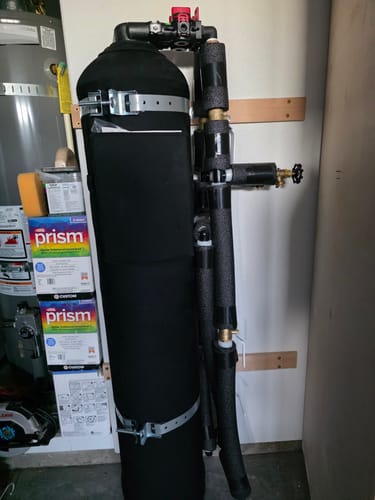
Once you know iron bacteria are hiding inside biofilms that standard filters can't reach, the next logical question is: what actually kills them? The answer isn't wattage—it's UV dose, measured in mJ/cm².
A 55W lamp sounds powerful, but wattage only tells you how much electricity the lamp consumes. What matters is how much UV energy actually reaches the bacteria. That number depends on flow rate and water clarity—not the lamp's power rating.
Wattage tells you how much electricity a lamp uses. UV dose tells you how much bacteria actually die.
We recommend targeting at least 30 mJ/cm² for residential systems, well above the 16 mJ/cm² minimum threshold.
If your water carries turbidity or particulates, pre-filtration isn't optional—it's essential. Cloudy water absorbs UV energy before it ever reaches iron bacteria, rendering even a high-wattage lamp ineffective.
Why Cloudy or Iron-Rich Water Defeats UV Before It Starts
There are 3 invisible threats that can quietly sabotage your UV system before it ever gets the chance to work: cloudy water, sediment, and excess iron.
When water clarity drops below 75% UV transmittance, UV light simply can't penetrate deeply enough to neutralize pathogens. It's like trying to shine a flashlight through mud.
Iron compounds make this worse. Once iron exceeds 0.2 mg/l, it clouds your water, blocks UV rays, and creates shadowed zones where iron bacteria survive untouched.
Sediment particles do the same — they shield microorganisms from the light entirely.
That's why pre-treatment isn't optional. Installing a quality sediment filter before your UV unit removes the interference, restores water clarity, and lets your UV system actually do its job.
Features Worth Paying For in a UV System Targeting Iron Bacteria
Now that we've handled the pre-treatment side, let's talk about what actually separates a UV system worth buying from one that'll let you down.
First, confirm the unit delivers over 30 mJ/cm² — anything less, and you're reducing bacteria, not eliminating them.
Choose stainless steel chambers over plastic; they resist corrosion and reflect UV light more efficiently.
Built-in sediment pre-filtration at 5 microns or finer keeps iron particles from blocking UV penetration before it reaches your water.
Look for end-of-life countdown displays and LED indicators so you're never guessing about lamp performance.
Finally, prioritize automatic sleeve wipers.
Iron-rich well water leaves mineral deposits fast, and a dirty quartz sleeve kills UV transmission. That single feature protects everything else you've invested in.
Matching UV System Size to Your Well's Flow Rate
Getting the size wrong is the fastest way to waste money on a UV system that looks capable but quietly underperforms. Match your system to your well's actual flow rate, measured in gallons per minute, and account for peak simultaneous usage—not just average demand.
Here's a practical starting point: one bathroom needs at least 6 GPM, two bathrooms require around 9 GPM (think Viqua VH200), three bathrooms need 12 GPM, and four bathrooms call for 15 GPM (think Luminor Blackcomb 6.1).
When in doubt, size up. Oversizing protects you during high-demand moments without sacrificing sterilization effectiveness.
Undersizing, however, means water moves too fast for adequate UV exposure—and iron bacteria slips through untreated. Don't let capacity be your system's weakness.
Frequently Asked Questions
Is 365NM or 395NM Better?
Neither's effective for disinfection. We recommend UV-C lamps at 254 nm—they're the industry standard for inactivating iron bacteria by damaging their DNA. Don't waste money on 365 nm or 395 nm wavelengths; they won't protect your water.
What to Look for When Buying an UV Light?
When buying a UV light, we'd recommend looking for NSF/ANSI Class A certification, stainless steel construction, a UV dose of at least 30 mJ/cm², adequate flow rate capacity, and built-in maintenance alerts to keep your water safe.
Which Is Better, RO UF or RO UV?
For iron bacteria, we'd recommend RO UV over RO UF. RO UF handles particles but misses dissolved contaminants. RO UV destroys iron bacteria while RO handles dissolved solids—giving you thorough, targeted protection where it matters most.
Is 395 or 365 Better for Cat Urine?
We recommend 395 nm for cat urine—it's more effective at breaking down organic compounds, enhancing odor elimination, and photodegrading urine components compared to 365 nm, which excels at disinfection but falls short on odor control.






