


![SoftPro™ Chlorine+ Carbon Whole House Water Filter to Remove PFAS, Chlorine, Chloramine & Pesticides [City Water Filters Series]](http://www.softprowatersystems.com/cdn/shop/files/SoftPro_Whole_House_Carbon_Filter_with_Spin_Down_Water_Filter.webp?v=1783547361&width=140)


 855-683-8488


Does the Iron Filter Go Before or After the Water Softener? The Definitive Installation Answer

The iron filter always goes before the water softener — no exceptions. Iron levels above 1.0 ppm will coat your softener's resin beads with deposits, killing its ion-exchange capacity and causing premature failure. Think of the iron filter as your softener's bodyguard. Get the sequence wrong, and you're looking at costly repairs within months. Stick around, because we're breaking down exactly how to install both systems correctly and protect your investment long-term.
Key Takeaways
- The iron filter must always be installed before the water softener to prevent iron from fouling the resin bed.
- Iron levels above 1.0 ppm rapidly coat resin beads, reducing ion-exchange capacity and causing premature softener failure.
- Water softeners are only rated to handle iron levels between 0.3 and 1.0 ppm, making pre-filtration essential.
- Treated water from the iron filter flows directly into the softener, ensuring both systems operate effectively together.
- Warning signs of incorrect installation include rusty water, reduced softening output, and declining filtration efficiency.
Why Iron Destroys Your Water Softener's Resin Bed

Iron doesn't just pass through your water softener harmlessly — it actively destroys it. When iron levels exceed 1.0 ppm, it rapidly fouls the resin bed, the core component responsible for removing hardness minerals like calcium and magnesium.
Iron doesn't just pass through your water softener — it destroys it, fouling the resin bed fast.
Iron bonds to the resin beads, coating them with deposits that suffocate their ion-exchange capacity. Over time, your softener loses effectiveness, works harder, and fails prematurely.
What makes this worse? Acidic water accelerates the damage considerably. Low pH combined with elevated iron fundamentally fast-tracks resin degradation, turning a costly investment into an expensive replacement.
Your softener simply wasn't engineered to handle high iron concentrations — it's designed for hardness, not heavy iron loads. Understanding this distinction is exactly why installation order matters so much.
Does Your Well Water Actually Need Both an Iron Filter and Softener?
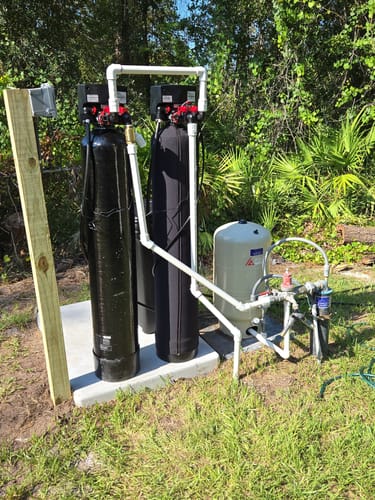
Whether your well water actually needs both systems comes down to one thing: what's in it. Test first—always. You're looking for two key numbers: iron concentration and hardness level.
If iron exceeds 1 ppm, a softener alone won't cut it. The iron will foul the resin bed, and you'll be replacing an expensive system far too soon. High pH compounds the problem further, stripping your softener of its iron-removal capability entirely.
Here's what the data consistently shows: most well water with iron problems also carries significant hardness. That means you're almost certainly dealing with both issues simultaneously.
The smart move? Test, confirm, then install both systems in the right order—iron filter upstream, softener downstream. That sequence protects your investment and maximizes water quality.
Why the Iron Filter Has to Come Before the Softener
Once we've confirmed that both systems are necessary, the next question is where each one goes—and the order isn't arbitrary. The iron filter must come first, protecting the softener's resin bed from iron fouling before water ever reaches it.
Here's why sequence matters:
| Installation Position | What It Accomplishes |
|---|---|
| Iron filter first | Removes ferrous and ferric iron before softening |
| Water softener second | Treats hardness without iron interference |
| Wrong order (softener first) | Resin bed exposed to damaging iron levels |
| Correct order (filter first) | Both systems operate efficiently, lifespan extended |
Softeners handle iron poorly—they're only rated for 0.3 to 1.0 ppm. Exceed that threshold and you're accelerating resin breakdown. Getting the sequence right isn't just smart; it's protective.
How to Plumb an Iron Filter and Softener in the Correct Sequence
Plumbing these two systems in the right sequence is straightforward once you understand the flow path. Start at your main water supply line, then route water through the iron filter first. From there, the treated water flows directly into the softener's inlet. This sequence lets the iron filter strip out ferrous and ferric iron before that water ever touches the softener's resin bed.
We recommend following your manufacturer's guidelines precisely here — they're designed around real-world performance outcomes. Use bypass valves on both units so you can isolate either system during maintenance without disrupting your water supply.
Label your inlet and outlet connections clearly. Getting this sequence right protects your resin investment, extends equipment lifespan, and delivers noticeably cleaner water throughout your home.
Warning Signs Your Iron Filter and Softener Are Installed in the Wrong Order
If your iron filter and softener are installed in the wrong order, your water system will tell you — you just need to know what to look for.
| Warning Sign | Likely Cause | Consequence |
|---|---|---|
| Rusty water or stains | Iron bypassing filter | Softener resin fouling |
| Reduced softening output | Resin bed contamination | Shortened system lifespan |
| Declining filtration efficiency | Incorrect sequencing | Costly repairs or replacements |
These symptoms aren't random — they're your system signaling a sequencing failure. When iron reaches the softener's resin bed unchecked, it compromises the entire treatment chain. A pH above 7 accelerates this damage, making early detection critical. Regular maintenance inspections will expose these inefficiencies before they become expensive problems, reinforcing why proper installation order isn't optional — it's essential.
Frequently Asked Questions
Do You Install Iron Filter or Softener First?
We always install the iron filter first, before the softener. This protects your resin bed from iron fouling, extends both systems' lifespans, and guarantees you're getting the cleanest, softest water possible.
What Is the Correct Order for Water Treatment?
We recommend installing your iron filter first, then your water softener. This sequence protects the softener's resin bed from iron fouling, guarantees both ferrous and ferric iron are removed, and maximizes your system's longevity.
Does the Water Filter Go Before or After Softener?
We recommend installing your iron filter before the water softener. This sequence protects the resin bed from iron fouling, maximizes both systems' efficiency, and extends their lifespan—especially when iron levels exceed 1 ppm.
Where Does an Iron Filter Go?
We install the iron filter before the water softener. This sequence lets it strip out ferrous and ferric iron first, protecting your softener's resin bed and maximizing both systems' performance and longevity.






