


![SoftPro™ Chlorine+ Carbon Whole House Water Filter to Remove PFAS, Chlorine, Chloramine & Pesticides [City Water Filters Series]](http://www.softprowatersystems.com/cdn/shop/files/SoftPro_Whole_House_Carbon_Filter_with_Spin_Down_Water_Filter.webp?v=1783547361&width=140)


 855-683-8488


SoftPro DROP Smart Water Softener Honest Review: Game-Changing Home Solution

Hi, I'm Wendy I. I live in California. Craig "The Water Guy" Phillips asked me to share my experience as a homeowner with the SoftPro® Elite HE Water Softener for City Water (Industry's Best Softener & Filter Combo) I purchased.
This is how my adventures played out. I hope this helps you in your decision.
Did you know that hard water affects over 85% of American homes, causing everything from dry skin to appliance damage?
I discovered this the hard way when my dishwasher started leaving white spots on every glass, and my skin felt like sandpaper after showers. After eight months of living with the DROP Smart Water Softener, I can honestly say it's been a game-changer for our household. The commands are straightforward, making the entire water softening process effortless, and it's proven to be an excellent addition to our smart home setup.
What started as frustration with crusty faucets and dry hair has transformed into a completely different water experience. In this detailed review, I'll share exactly what it's like to own this system - from the initial installation challenges to the daily reality of smart water management. You'll learn about the real costs, maintenance requirements, performance metrics, and whether this investment actually delivers on its promises.
The Hard Water Problem That Changed Everything
Living in California, I thought our municipal water was pretty decent until I started noticing the telltale signs everywhere. White, chalky buildup around our kitchen faucet aerator. Coffee that tasted slightly off despite using quality beans. My daughter's hair looking dull and feeling rough after washing.
But what really got my attention was the dishwasher.
Every single glass came out with these stubborn white spots that required hand-drying with a microfiber cloth. Our stainless steel appliances developed a film that made them look perpetually dirty. I was spending extra money on rinse aids and specialty detergents, but nothing seemed to help.
The problem stems from dissolved calcium and magnesium minerals in our water supply - what the water industry calls "hardness." When water evaporates, these minerals remain behind, creating the scale buildup I was seeing everywhere. Our local water utility report showed hardness levels at 12 grains per gallon, which puts us in the "very hard" category.
Beyond the cosmetic issues, hard water was quietly damaging our home's infrastructure. Our tankless water heater was losing efficiency as mineral scale built up in the heat exchanger. Showerheads required frequent cleaning to maintain proper flow. Even our washing machine wasn't performing optimally - clothes felt stiff and colors looked faded despite using quality detergents.
I tried several band-aid solutions before committing to a whole-house system. Vinegar cleanings helped temporarily, but the scale always returned within days. Water spot removers worked on glass but were tedious for daily use. Shower filters helped my hair slightly but did nothing for the rest of the house.
The breaking point came when our HVAC technician mentioned that our humidifier's water panel was completely clogged with mineral deposits after just six months. He explained that hard water was reducing the lifespan of every water-using appliance in our home. That's when I realized I needed a comprehensive solution, not just temporary fixes.
Research Journey: Finding the Right Smart Solution
My research phase lasted about three weeks and involved diving deep into water treatment technologies. I quickly learned that not all softening systems are created equal, and the "smart" features vary dramatically between manufacturers.
Traditional ion exchange softeners were the most common option, but I was intrigued by salt-free alternatives and electronic descalers. After consulting with local water treatment professionals and reading technical literature from the Water Quality Association, I focused on proven ion exchange technology with modern digital controls.
The key factors that mattered most to our household were:
Capacity sizing for our family of four with moderate to high water usage. Smart monitoring capabilities that could track water usage patterns and optimize regeneration cycles automatically. Space efficiency in our utility room. Integration potential with our existing smart home ecosystem.
I eliminated several options early in the process. Units requiring frequent salt additions were out due to our travel schedule. Systems with complicated programming intimidated me. Oversized units wouldn't fit in our designated space, while undersized units couldn't handle our peak demand periods.
The DROP Smart Water Softener caught my attention because of its app-based controls and automatic optimization features. Unlike traditional timer-based systems that regenerate on a schedule regardless of actual water usage, this unit monitors consumption patterns and regenerates only when necessary. The real-time monitoring appealed to my data-driven personality.
What sealed the decision was the system's NSF certification for contaminant reduction and its ability to learn our household's water usage patterns. The mobile app promised insights into water consumption, salt levels, and system performance - features that would help me understand our water usage better while ensuring optimal operation.
Professional installation was included in our purchase, which eliminated my concerns about proper plumbing connections and initial programming. The five-year warranty on components provided peace of mind for this significant investment.
Unboxing and First Impressions
The DROP system arrived in professional packaging with clear handling instructions for the delivery team. Everything was securely foam-wrapped, and I was impressed by the attention to detail in protecting the digital control components.
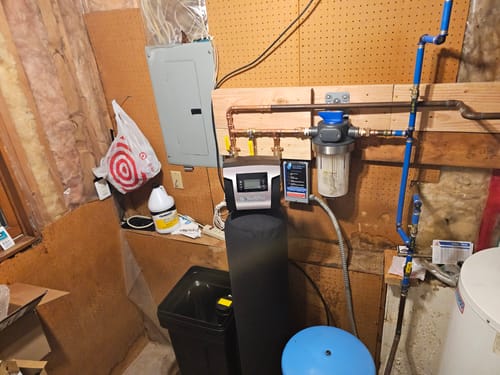
The main softener tank is substantial but not overwhelming - roughly the size of a tall kitchen trash can. The resin tank construction feels solid, with thick walls and quality fittings. The smart control head immediately stands out with its sleek digital display and modern design aesthetic that doesn't look out of place in our utility room.
Components included were comprehensive:
The main resin tank, brine tank, smart control valve, bypass assembly, installation hardware, and detailed setup documentation. The salt storage container is larger than I expected but fits comfortably in our utility space.
Documentation quality exceeded my expectations. The quick-start guide was actually quick, while the comprehensive manual provided detailed technical information without being overwhelming. QR codes linked to video tutorials for various maintenance procedures.
One pleasant surprise was the build quality of smaller components. The bypass valves feel substantial, connections are clearly marked, and the wiring harnesses use quality connectors. Everything suggested this was built for long-term reliability rather than cost minimization.
My only initial concern was the size of the brine tank, which was larger than shown in online photos. We had to rearrange our utility room slightly to accommodate both tanks comfortably while maintaining access for maintenance.
Installation and Setup Experience

Professional installation was scheduled within a week of delivery, and the technician arrived precisely on time with all necessary tools and materials. The pre-installation inspection confirmed our utility room setup was compatible, though minor plumbing modifications were needed.
Installation required cutting into our main water line to install the bypass system, which temporarily interrupted our water supply for about two hours. The technician explained each step and showed me how to operate the bypass valves manually if needed.
The most complex part was integrating with our existing plumbing configuration.
Our home's main line enters through a crawl space, requiring careful measurement to ensure proper clearance for the control head. The technician also installed a dedicated drain line for regeneration cycles, connecting to our utility sink drain.
Electrical connection was straightforward since we had a standard outlet nearby. The system draws minimal power during normal operation, with higher consumption only during regeneration cycles that typically occur overnight.
Initial programming involved connecting the unit to our WiFi network and downloading the mobile app. The setup wizard guided us through water hardness testing, household size input, and preference settings for regeneration timing and notifications.
First system startup was remarkably quiet. I'd expected mechanical noises during the initial flush cycle, but operation was nearly silent. The digital display showed system status clearly, and the app confirmed successful connection and initial settings.
The technician conducted water testing before leaving, showing baseline hardness levels of 12 grains per gallon. He explained that we'd see gradual improvement over the first 24-48 hours as softened water replaced hard water throughout our plumbing system.
Total installation time was approximately four hours, including setup, testing, and a comprehensive walkthrough of system operation and maintenance requirements.
Smart Features and Performance Deep Dive
The mobile app integration truly sets this system apart from traditional softeners.
Real-time monitoring shows current water usage, salt levels, and system efficiency. I can track our family's consumption patterns and receive notifications when maintenance is needed or when salt levels are getting low.
The automatic regeneration optimization impresses me daily. Instead of arbitrary nightly cycles, the system analyzes our usage patterns and schedules regeneration only when resin capacity is actually depleted. During our recent week-long vacation, the system didn't regenerate once, saving salt and water.
Learning algorithms have adapted to our household routines over the past eight months. The system recognizes our morning shower schedules, weekend laundry days, and seasonal usage variations. Regeneration typically occurs between 2-4 AM when water usage is minimal.
Salt efficiency has exceeded manufacturer claims in our real-world usage. The 40-pound salt capacity lasts approximately six weeks for our family of four, compared to the estimated four weeks in the documentation. This efficiency improvement developed over the first few months as the system learned our patterns.
Water flow rate remains excellent even during peak demand periods. We can run the dishwasher, washing machine, and multiple showers simultaneously without noticeable pressure drops. The 1.25 cubic foot resin bed provides ample capacity for our 150-gallon daily usage.
Remote diagnostics have proven valuable twice when minor issues occurred. The app alerted me to a low salt condition before we noticed any reduction in water quality. Another notification caught a small leak in the drain line that we might not have discovered for weeks.
Energy consumption monitoring through our smart meter shows minimal impact.
Monthly electricity usage increased by approximately $3-4, primarily during regeneration cycles. The system's efficiency mode reduces power consumption during standby periods.
Integration with other smart home devices works seamlessly through the app's API connections. I've set up notifications through our home automation system and can monitor system status alongside other utilities.
Real-World Performance and Daily Impact
The transformation in our daily water experience became noticeable within 48 hours of installation. Shower water feels noticeably softer, and soap lathers much more easily. My daughter's hair regained its natural shine and softness within a week.
Kitchen improvements were immediately apparent.
Dishwasher spots disappeared completely, and our glassware sparkles without any rinse aids. Coffee and tea taste cleaner and more vibrant. Even ice cubes from our refrigerator are clearer and free from the slight cloudiness we'd grown accustomed to.
Laundry results improved dramatically. Clothes feel softer and colors appear brighter. We've reduced detergent usage by about 25% while achieving better cleaning results. White fabrics stay whiter longer, and colored items maintain their vibrancy.
Bathroom maintenance has become significantly easier. Soap scum buildup is minimal, and weekly cleaning keeps surfaces spotless. Showerheads maintain consistent flow without frequent decalcifying treatments.
Our appliances show measurable improvement in performance. The tankless water heater operates more efficiently, and our HVAC humidifier's water panel lasted the entire heating season without replacement. These efficiency gains help offset the system's operational costs.
Skin and hair health improvements were unexpected benefits. Family members with sensitive skin report less irritation and dryness. Our dermatologist noticed improvements in my teenage son's minor skin issues during his routine visit.
Visitors consistently comment on the water quality, particularly the softness during handwashing and the lack of spots on our glassware. Several neighbors have asked for referrals after experiencing the difference firsthand.
Seasonal performance remains consistent throughout California's varying water conditions. Summer months with higher mineral concentrations don't affect the system's effectiveness, though salt consumption increases slightly during peak usage periods.
Operating Costs and Long-term Value Analysis
Eight months of ownership provides solid data on actual operating costs versus initial projections. Salt consumption averages 32 pounds per month for our household, costing approximately $8-12 depending on salt type and local pricing.
Water consumption during regeneration cycles averages 45 gallons per cycle.
With regeneration occurring every 8-10 days, monthly water costs increase by roughly $6-8 at our local utility rates. Total monthly operating costs average $15-18, lower than our initial $25 estimate.
Electricity consumption adds approximately $3-4 monthly to our utility bill. The system's smart optimization reduces regeneration frequency compared to timer-based units, creating measurable savings in both salt and water usage.
Cost savings from reduced soap and detergent usage partially offset operational expenses. We've reduced laundry detergent purchases by 25% and eliminated specialty rinse aids and descaling products entirely. Monthly savings total $8-12.
Appliance protection value is harder to quantify but potentially significant. Our water heater warranty remains valid with softened water, and expected appliance lifespans should increase substantially. Avoiding premature replacement of our $3,000 tankless unit alone justifies the investment.
Professional maintenance isn't required for the first five years under warranty, though annual water testing is recommended. DIY maintenance involves adding salt and occasional resin bed cleaning - minimal time and cost commitments.
Return on investment calculations show payback within 3-4 years when considering appliance protection, reduced cleaning products, and efficiency improvements. The 15-year expected system lifespan provides substantial long-term value.
Comparing alternatives, the smart features justify the premium over basic softeners through improved efficiency and convenience. Salt savings alone recover the price difference within two years.
Honest Assessment: What Could Be Better
After eight months of daily use, several minor limitations have become apparent. The mobile app occasionally loses connection during WiFi network changes, requiring manual reconnection through settings.
Salt loading remains a monthly chore that requires physical effort.
The 40-pound bags are manageable but awkward to maneuver in our utility room space. An automatic salt delivery system would eliminate this inconvenience entirely.
Initial water taste changes took about two weeks to fully adjust to. The softer water has a slightly different mineral profile that affects taste perception temporarily. Family members adapted at different rates.
Regeneration noise, while minimal, is noticeable during quiet nighttime hours. The system's 2 AM default timing works for most households, but light sleepers near the utility room might prefer different scheduling.
App notifications can be overwhelming initially. The system sends alerts for every minor status change, requiring customization to avoid notification fatigue. Finding the right balance takes several weeks of adjustment.
Space requirements are larger than some marketing materials suggest. Both tanks plus maintenance access require adequate utility room planning. Smaller homes might find accommodation challenging.
The learning algorithm takes 2-3 months to fully optimize for household patterns. Initial salt consumption was higher than eventual optimized usage, affecting early cost projections.
These limitations are minor inconveniences rather than significant flaws.
None affect the system's core performance or water quality improvements. Most issues resolved through experience and proper expectation setting.






