


![SoftPro™ Chlorine+ Carbon Whole House Water Filter to Remove PFAS, Chlorine, Chloramine & Pesticides [City Water Filters Series]](http://www.softprowatersystems.com/cdn/shop/files/SoftPro_Whole_House_Carbon_Filter_with_Spin_Down_Water_Filter.webp?v=1783547361&width=140)


 855-683-8488


From Iron Water Test Results to the Right Filter Selection: A Complete Decision-Making Framework

Your iron water test results reveal three critical pieces of information: iron concentration in ppm, iron type, and pH level. Together, these determine exactly which filter technology you need, what size system fits your household, and whether you'll need one filter or two. Getting this wrong means wasted money and persistent staining. Get it right, and you've got clean, clear water for years—and we'll show you precisely how to do that.
Key Takeaways
- Iron test results reveal ppm concentration, iron type, and pH level, forming the foundation of every effective filter selection decision.
- Ferrous iron requires air injection oxidation filters, while ferric iron needs greensand filters; iron bacteria demands specialized biological treatment.
- pH level determines compatible filtration technology; FOBS/FOC requires pH above 6.8, while FOK systems handle levels as low as 6.0.
- Household size and flow rate determine filter size; larger households or iron above 3 ppm require a 2.0 cubic foot system minimum.
- Iron concentrations above 3 ppm or signs of manganese and bacteria indicate the need for a two-stage filtration system.
What Your Iron Test Results Tell You About Ppm, Type, and pH

Before choosing a filter, you'll need to know what's actually in your water — and an iron test gives you exactly that. It reveals three critical data points: concentration in ppm, iron type, and pH level.
Concentration matters immediately. Levels above 0.3 ppm produce metallic tastes and fixture staining. Exceed 3 ppm, and you're looking at multi-system treatment solutions.
Iron type shapes your urgency. Ferrous iron appears clear but later causes rust stains, while ferric iron discolors water on contact.
pH determines which filtration technology actually works. FOBS/FOC systems need a minimum pH of 6.8, while FOK systems handle conditions as low as 6.0.
Together, these three variables tell us precisely which filter you need — and why guessing wastes both time and money.
Match Your Iron Type to the Right Iron Filter
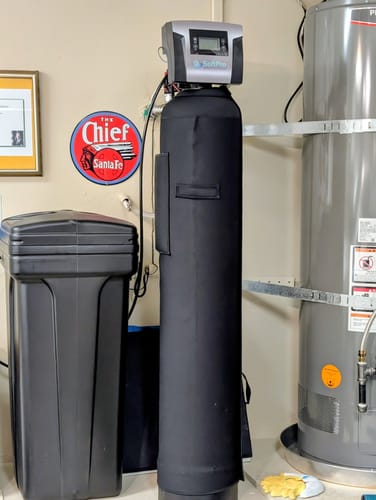
Now that we recognize what's in our water, we can match the problem to the right solution. Each iron type demands a specific approach—using the wrong filter wastes money and leaves problems unsolved.
Each iron type demands a specific solution—using the wrong filter wastes money and leaves the real problem unsolved.
Here's what the science tells us:
- Clear water (ferrous) iron responds best to air injection filters, which oxidize dissolved iron on contact.
- Red water (ferric) iron requires oxidation filters like greensand to capture already-oxidized particles effectively.
- Iron bacteria need specialized biological treatments—standard filtration simply won't work.
When concentrations exceed 3 ppm, we're likely dealing with multiple iron types simultaneously, making combination systems essential.
This is precisely why accurate testing matters—it eliminates guesswork and positions us to choose confidently, treating the actual problem rather than a symptom.
How Flow Rate and Household Size Determine Iron Filter Size
Choosing the right filter size comes down to 2 critical factors: flow rate and household size.
Start with a simple 5-gallon bucket test to measure your flow rate. If you're hitting 5 GPM with iron levels below 2 ppm, a 1.0 cubic foot filter handles 4-6 people comfortably.
Larger households of 6-8 people, or those dealing with higher iron concentrations, need a 2.0 cubic foot system.
Here's where most people get it wrong: they forget about peak demand. When showers, laundry, and kitchen use overlap simultaneously, undersized systems lose pressure fast.
For robust performance across all scenarios, we recommend ensuring your system supports a minimum 12 GPM flow rate.
Size it right the first time, and you'll never compromise on water pressure.
What a Properly Sized Iron Filter System Should Cost
Most homeowners are shocked to discover there are really just 2 price tiers for whole-house iron filters. Understanding where your money actually goes changes everything about this decision.
Here's what you're actually choosing between:
- Tier 1 (Online/Direct Wholesale): $800–$2,195, including premium systems with Katalox Light media built to last
- Tier 2 (Local Dealer): $5,000–$10,000, where markups, not quality, drive the price
- The sweet spot: A properly sized 2.5 cubic foot direct wholesale system runs $1,795–$2,195 and handles 5 GPM wells effectively
We've seen homeowners spend three times more through dealers for comparable performance.
When you factor in installation, media longevity, and maintenance, that middle-ground direct wholesale system consistently delivers the strongest total cost of ownership.
When Iron Bacteria or Manganese Requires a Second Filter Stage
Sometimes a single iron filter isn't enough. If your water shows signs of iron bacteria—that telltale orange slime and buildup—a standard iron filter won't fully solve your problem.
Similarly, if manganese exceeds 0.05 ppm, you'll need a solution specifically targeting that mineral.
Here's what works: a two-stage system. Start with an air injection or oxidation filter to tackle high iron and manganese concentrations, then follow it with a secondary stage designed to eliminate bacteria and remaining contaminants.
Each stage handles what the other can't.
Yes, two filters cost more upfront. But consider what you're protecting—your plumbing, your appliances, your water quality.
The long-term savings in reduced maintenance and extended equipment lifespan make the investment straightforward to justify.
Frequently Asked Questions
What Are the 4 Types of Water Filters?
Based on our background information, there are actually 5 types we recommend exploring: Air Injection, Oxidation, Catalytic Birm Filters, Reverse Osmosis Systems, and Water Softeners—each targeting iron removal differently depending on your water's specific conditions.
What Is the Best Water Filtration System for Well Water With Iron?
We recommend the Katalox Light system — it's a powerhouse that tackles ferrous and ferric iron, manganese, and hydrogen sulfide simultaneously, giving your household thorough, low-maintenance protection for consistently clean, great-tasting well water.
What Is the Conclusion of a Water Filter?
A water filter's primary conclusion is its ability to effectively reduce contaminants like iron, delivering cleaner, better-tasting water. We've found that matching filter capacity to your specific water quality needs guarantees lasting, measurable results.
What Is the Best Water Filter for Giardia?
For removing Giardia, we recommend reverse osmosis systems or hollow fiber membrane filters rated at 0.1 microns. They're proven workhorses that trap these parasites reliably, and pairing them with UV treatment gives you unbeatable protection.






