


![SoftPro™ Chlorine+ Carbon Whole House Water Filter to Remove PFAS, Chlorine, Chloramine & Pesticides [City Water Filters Series]](http://www.softprowatersystems.com/cdn/shop/files/SoftPro_Whole_House_Carbon_Filter_with_Spin_Down_Water_Filter.webp?v=1783547361&width=140)


 855-683-8488


How Greensand Iron Filter Regeneration Differs From AIO Air Injection Backwashing

Greensand filters use manganese dioxide-coated media to chemically oxidize iron, and they need potassium permanganate or chlorine to stay active. AIO systems take a completely different approach — they inject air directly into the tank, physically oxidizing iron on contact without any chemicals. That means no chemical inventory, no rigid regeneration schedules, and far less hands-on upkeep. If you're wondering how these differences play out in real-world costs and maintenance demands, we've got a lot more to unpack.
Key Takeaways
- Greensand regeneration uses potassium permanganate or chlorine to recharge manganese dioxide-coated media, while AIO backwashing relies solely on injected air.
- AIO backwashing is triggered by water usage, whereas greensand regeneration follows a rigid, scheduled chemical replenishment cycle.
- Greensand requires ongoing chemical inventory management; AIO systems eliminate this need entirely through air-based oxidation.
- During regeneration, greensand media must contact potassium permanganate to restore oxidizing capacity; AIO simply flushes accumulated iron particles.
- AIO backwashing demands less labor and no chemical handling, making it fundamentally simpler than greensand's chemical regeneration process.
How Do Greensand and AIO Iron Filters Actually Remove Iron?

Both greensand and AIO iron filters tackle the same core problem — converting dissolved ferrous iron into a solid, filterable form — but they take very different routes to get there.
Greensand filters use a manganese dioxide-coated media that chemically oxidizes iron as water passes through. That coating needs potassium permanganate or chlorine to stay active, which is why regeneration is part of the process.
AIO systems skip the chemicals entirely. They inject air into the water before it reaches the media bed, using oxygen to physically oxidize iron on contact.
The result is the same — ferrous iron becomes insoluble ferric iron — but the mechanism is fundamentally different.
Understanding that distinction shapes everything about how you'll maintain each system long-term.
Which Water Conditions Favor Greensand and Which Favor AIO?
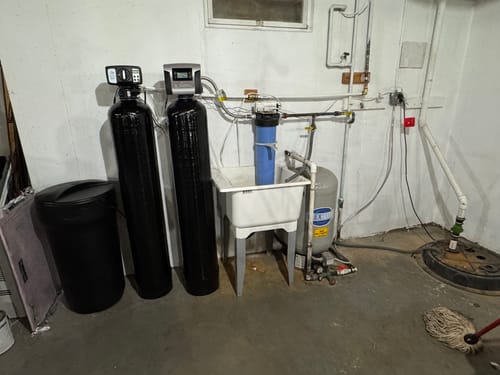
The water coming out of your well tells you a lot about which system will actually work for you. If your pH sits between 6.8 and 7.5 and you're battling both iron and manganese, greensand's your stronger match. It targets both contaminants effectively under those stable conditions.
But if your pH dips toward 6.2, or your water carries high sediment and organic matter, AIO handles those swings far better. It doesn't rely on dissolved oxygen levels or chemical additives—just ambient air—making it resilient where greensand struggles.
AIO thrives where greensand falters—handling low pH, sediment, and organics with nothing but ambient air.
Hydrogen sulfide present? AIO again. Greensand falters in low-oxygen, sulfur-heavy water.
We'd also lean toward AIO for anyone prioritizing minimal maintenance, since greensand demands weekly backwashing and consistent potassium permanganate replenishment to stay effective.
Does Potassium Permanganate or Air Injection Demand More From You Weekly?
Greensand filters ask more of you every single week—backwashing on schedule, checking potassium permanganate levels, and replenishing the chemical before it runs low.
That's consistent labor and chemical handling built into your routine.
Air injection flips that dynamic entirely. It pulls oxidation power straight from ambient air, meaning you're not managing chemical inventories or rigid schedules.
Backwashing triggers based on actual water usage, not arbitrary timetables.
Here's what separates the two weekly realities:
- Greensand: Scheduled backwashing plus potassium permanganate monitoring and replenishment
- Air injection: Usage-driven backwashing with no chemical additives required
- Net result: Air injection consistently delivers lower weekly demands on your time and attention
If minimizing hands-on maintenance matters to you, air injection wins that comparison decisively.
Which System Is Harder to Maintain Over Months and Years?
When you zoom out from weekly routines to the full lifespan of these systems, the maintenance gap between them becomes even harder to ignore.
Greensand filters demand chemical monitoring, periodic media replacement every few years, and consistently higher annual costs for labor and supplies. That's a sustained commitment, not just a weekly chore.
AIO air injection systems, by contrast, are engineered for longevity. Premium units last 10–20 years with minimal intervention—no chemicals to track, no media to swap, and far less frequent monitoring overall.
We're talking about two fundamentally different ownership experiences. One system keeps pulling your attention and budget over the long haul. The other largely runs itself.
For anyone pursuing mastery over their water quality, that distinction matters enormously.
What Will Each Iron Filter Actually Cost You Over 5 to 10 Years?
Numbers don't lie, and once we break down the real 5-to-10-year costs of each system, the choice becomes a lot clearer. Both systems carry similar installation prices, but long-term expenses tell a different story.
Here's where greensand costs quietly stack up:
- Weekly backwashing plus potassium permanganate replenishment adds hundreds in chemical costs annually
- Media replacement every few years introduces recurring expenses AIO systems largely avoid
- Cumulative maintenance over a decade can push greensand totals noticeably higher than AIO alternatives
AIO air injection systems sidestep chemical regeneration entirely, keeping maintenance predictable and lean.
Over 5-10 years, that chemical-free operation compounds into real savings. If long-term cost efficiency matters to you, AIO's lower maintenance demands make it the sharper financial choice.
Frequently Asked Questions
How Often Should an Iron Filter Backwash?
We recommend backwashing your iron filter every 4-14 days, depending on your system type. Greensand filters need weekly backwashing, while Birm, Manganese Dioxide, and Pro-OX systems often require less frequent cycles based on usage.
What Is a Greensand Iron Filter?
A greensand iron filter's coated with manganese dioxide, letting it pull iron, manganese, and hydrogen sulfide from your water. It works best at a pH between 6.8 and 7.5 and needs weekly backwashing with potassium permanganate.
How Long Does Greensand Media Last?
Greensand media typically lasts 3 to 7 years, but we've seen water quality, pH levels, and iron or manganese concentrations dramatically shorten that window. Regular backwashing and potassium permanganate replenishment help us maximize its lifespan.
Why Can Rapid Sand Filters Handle Higher Filtration Rates Compared to Slow Sand Filters?
Rapid sand filters handle higher filtration rates because they use larger sand particles, gravel drainage layers, and physical straining instead of biological processes. Backwashing regularly clears trapped particles, keeping flow rates consistently fast and efficient.






