


![SoftPro™ Chlorine+ Carbon Whole House Water Filter to Remove PFAS, Chlorine, Chloramine & Pesticides [City Water Filters Series]](http://www.softprowatersystems.com/cdn/shop/files/SoftPro_Whole_House_Carbon_Filter_with_Spin_Down_Water_Filter.webp?v=1783547361&width=140)


 855-683-8488


High-Flow Iron Filters Built for Large Families: The Key Features You Need to Look For

When your household runs on well water with six or more people, high iron levels hit harder than you'd think. Rust stains, metallic-tasting water, and damaged appliances pile up fast. You'll need a filter handling at least 20-30 GPM, quality backwash cycles, and high-performance media like Katalox Light. But flow rate alone won't save you—iron type, pH, and concentration all shape which system actually works. Stick with us, and we'll show you exactly what to prioritize.
Key Takeaways
- Large families need high-flow iron filters with at least 15–20 GPM flow rates to prevent pressure drops during peak usage.
- Regular backwash cycles are essential to maintain filter performance and extend the lifespan of your filtration system.
- High-quality filter media, like Katalox Light, removes iron more effectively and handles higher contaminant loads efficiently.
- Valve quality directly impacts system reliability, ensuring smooth operation when multiple appliances run simultaneously.
- Water testing identifies iron type, pH, and manganese levels, helping you select the most effective filtration system.
Why High Iron Levels Strain Large Family Households More

When you've got a house full of people, high iron levels in your well water don't just become a minor inconvenience—they become a full-blown daily battle.
A house full of people and high iron in your well water isn't an inconvenience—it's a daily battle.
More family members mean more water consumption, and that translates directly into accelerated iron buildup across every faucet, appliance, and pipe in your home.
You're looking at rust-stained fixtures, metallic-tasting drinking water, and pipes silently clogging while your family pushes through their daily routines.
Repair bills pile up fast when iron damages multiple appliances simultaneously.
And let's be honest—that reddish-brown discoloration spreading across your sinks isn't something a large, active household can simply ignore.
The stakes are higher, the damage compounds faster, and the pressure to fix it properly is absolutely real.
Iron Type, pH, and Concentration: What Your Water Test Must Reveal
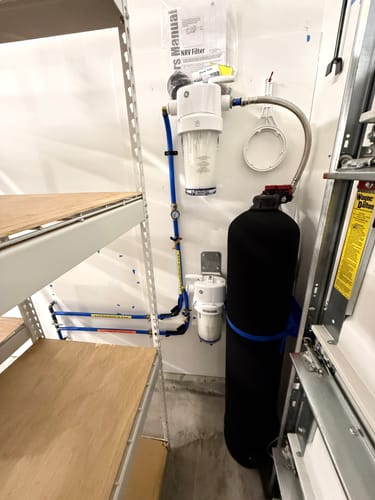
Before you invest in any filtration system, you need to know exactly what you're dealing with—and that starts with a proper water test. Not all iron is the same. Ferrous iron dissolves invisibly, ferric iron stains everything rust-colored, and iron bacteria create a whole different problem requiring specialized treatment.
Your water's pH matters just as much. Low pH levels make iron harder to remove, so certain filtration systems simply won't perform without first addressing acidity.
Then there's concentration. Safe iron levels sit below 0.3 mg/L, and manganese below 0.05 mg/L. Exceed those thresholds, and you're dealing with metallic-tasting water, stubborn stains, and clogged pipes.
Regular testing keeps you ahead of these issues—and guarantees you're choosing the right system from the start.
The Minimum Flow Rate Your Large Household Actually Needs
How much water does your household actually move at peak demand? If you're running two showers, a dishwasher, and a washing machine simultaneously, you'll need serious flow capacity. We recommend starting at 15 GPM minimum, with 20–30 GPM being the sweet spot for larger families.
Use the 5-gallon bucket test at your main water source to measure your actual flow rate before selecting a filter.
| Household Size | Recommended GPM | Typical Simultaneous Outlets |
|---|---|---|
| 2–3 people | 10–15 GPM | 1–2 outlets |
| 4–5 people | 15–20 GPM | 3–4 outlets |
| 6+ people | 20–30 GPM | 5+ outlets |
Insufficient flow creates pressure drops and compromises filtration—exactly what we're trying to avoid.
Backwash Cycles, Media Type, and Valve Quality: What to Prioritize in a High-Flow Iron Filter
Once you've locked in your flow rate requirements, the next decisions—backwash cycles, media type, and valve quality—will make or break your system's long-term performance.
For large families, backwash cycles aren't optional maintenance—they're your filter's self-preservation mechanism, flushing trapped iron and preventing media clogging before it tanks your pressure.
Media selection matters just as much. Advanced options like Katalox Light outperform standard media in both contaminant removal and lifespan, meaning fewer replacements and more consistent results under heavy daily demand.
Don't overlook valve quality. A high-grade valve keeps your system running smoothly when usage spikes, minimizes leak risks, and simplifies any maintenance you'll eventually face.
Prioritize all three features together—they're interdependent, and cutting corners on any one compromises the entire system.
When One Iron Filter Cannot Solve Every Problem in Your Home
Even the best iron filter has its limits, and for many large families, iron isn't the only problem lurking in the water. Acidity, sulfur, and manganese often coexist with iron, and a single filter simply can't tackle all of them effectively.
That's why we recommend testing your well water thoroughly before committing to any system. Knowing exactly what you're dealing with lets you build a targeted, multi-system approach rather than guessing.
Yes, combination systems cost more upfront. But they prevent premature equipment breakdowns, reduce service calls, and deliver consistent water quality across every tap in your home.
Over time, that investment pays for itself in fewer repairs and less frustration. Addressing everything at once is always smarter than solving problems one crisis at a time.
Frequently Asked Questions
How Do I Choose the Right Iron Filter?
We'll start by testing your water's iron levels and type. From there, we match your flow rate needs, filtration capacity, and choose durable media and valves that'll keep your system running long-term.
What Are Common Problems With Iron Filters?
We've seen iron filters struggle with clogging, incomplete iron removal, rising maintenance costs, and complications from contaminants like sulfur or manganese. Improper sizing makes everything worse—that's why we always recommend professional consultation before installation.
What Are the Top Considerations When Selecting a High Quality Water Filter?
When selecting a high-quality water filter, we'll want to prioritize flow rate, filtration media quality, daily capacity, durability of components, and warranty support—each factor guarantees your system performs reliably while meeting your household's demands.
What Are the Benefits of Using an Iron Filter?
We'll enjoy cleaner, better-tasting water, fewer stains on fixtures and laundry, and longer-lasting plumbing. Iron filters also reduce health risks by keeping iron levels below the recommended 0.3 mg/L safety threshold.






