


![SoftPro™ Chlorine+ Carbon Whole House Water Filter to Remove PFAS, Chlorine, Chloramine & Pesticides [City Water Filters Series]](http://www.softprowatersystems.com/cdn/shop/files/SoftPro_Whole_House_Carbon_Filter_with_Spin_Down_Water_Filter.webp?v=1783547361&width=140)


 855-683-8488


High Iron in Your Well Water? Here's How the Greensand vs Birm Iron Filter Comparison Plays Out

If your well water has high iron, choosing the wrong filter makes everything worse—stained sinks, wrecked appliances, and wasted money. Greensand filters use potassium permanganate to tackle tough contamination, including iron bacteria and organic iron. Birm filters work chemical-free, handling straightforward ferrous iron efficiently. Both convert dissolved iron into filterable solids, but your water's pH and iron concentration determine which actually works. Stick with us, and we'll break down exactly which filter wins for your situation.
Key Takeaways
- Greensand filters oxidize ferrous iron using potassium permanganate, effectively handling concentrations up to 10 mg/L and addressing iron bacteria.
- Birm filters use manganese dioxide without chemicals, efficiently managing ferrous iron levels between 5 and 15 mg/L.
- Greensand suits water with higher manganese, organic iron, or severe contamination requiring chemical-assisted oxidation.
- Birm works best for straightforward ferrous iron problems but underperforms when pH drops below 6.8.
- Testing water for pH and iron concentration before choosing either filter prevents costly filtration mistakes.
Why High Iron Demands the Right Well Water Filter

When iron levels in your well water run high, the consequences show up fast — murky water, that telltale metallic taste, and stubborn rust stains spreading across your sinks, laundry, and pipes.
High iron in your well water means murky water, metallic taste, and rust stains — fast.
Left unaddressed, excess iron quietly erodes your plumbing, shortens appliance lifespans, and keeps your water above the WHO's recommended threshold of 0.3 mg/L.
That's why choosing the right filtration system isn't just about taste — it's about protecting your home and your health long-term.
The wrong filter won't just underperform; it'll cost you more in maintenance and repairs down the line.
We're breaking down exactly how greensand and Birm filters stack up so you can make the smartest, most informed choice for your specific water conditions.
How Greensand Filters Remove Iron From Well Water
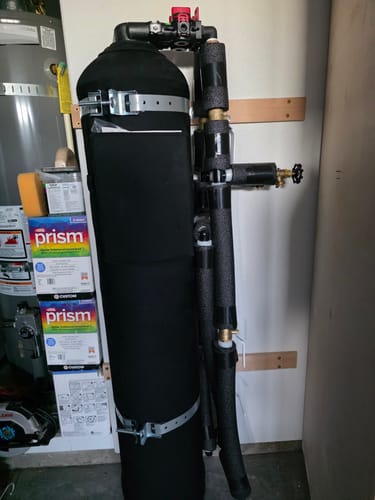
Greensand filters work by turning the problem — dissolved iron — into the solution. The media itself oxidizes ferrous iron (Fe²⁺), converting it into ferric iron (Fe³⁺) — an insoluble form that's easy to filter out.
Think of it as forcing iron to reveal itself so you can trap it.
We'd also point out that potassium permanganate plays a key supporting role here. It regenerates the media, keeping oxidation capacity strong even under sustained demand.
That's why these filters handle ferrous iron concentrations up to 10 mg/L effectively.
There's another advantage worth noting: greensand doesn't just target dissolved iron. It also tackles iron bacteria and organic matter — problems that quietly degrade water quality even when iron levels seem manageable.
How Birm Filters Remove Iron Without Chemicals
Birm filters take an invigoratingly simple approach — no chemicals required. Instead, the media's manganese dioxide coating does the heavy lifting, naturally oxidizing dissolved ferrous iron and converting it into solid ferric particles that the filter traps and removes.
No chemicals, no complexity — just manganese dioxide doing what it does naturally: turning dissolved iron into something filterable.
What's impressive here is the self-sufficiency of the process. Birm filters handle ferrous iron levels between 5 and 15 mg/L — a range that covers most residential well water scenarios — without introducing anything artificial into your water supply.
Maintenance stays minimal, too. The media regenerates itself through simple backwashing with untreated water, keeping the system running efficiently.
And because ferric iron buildup gets intercepted before it reaches your plumbing, you're protecting appliances and reducing long-term maintenance costs simultaneously. It's an elegantly practical solution.
Greensand vs. Birm: Which Filter Fits Your Well Water?
How do you choose between two filters that both get the job done? It comes down to your water's specific chemistry.
If you're dealing with higher manganese levels, organic iron, or heavier contamination, Greensand's the stronger performer—it handles tougher water profiles that would overwhelm Birm. But you'll need to budget for potassium permanganate and routine regeneration.
If your water tests show lower contaminant levels and straightforward ferrous iron, Birm delivers clean results without the chemical upkeep. It's leaner, cheaper to maintain, and eco-friendly.
Here's what we always recommend: test your water first.
pH, iron concentration, and suspended solids all influence which system wins for your situation. Choosing without that data is just guessing—and guessing gets expensive fast.
When Greensand or Birm Alone Won't Fix Your Iron Problem
Sometimes even the right filter isn't enough on its own. Certain water conditions push greensand and birm beyond their limits, and recognizing those scenarios saves you time and money.
Watch for these red flags:
- Iron bacteria present – Biofilm requires disinfection, not just filtration
- High ferrous iron – Greensand struggles without pre-oxidation in place
- pH below 6.8 – Birm simply won't perform effectively
- Elevated organic iron or tannins – Both filters lose efficiency fast
- Exceptionally high iron concentrations – Complex chemistry demands layered solutions
When these conditions exist, we recommend pairing your filter with chlorination or oxidation systems.
When filters hit their limits, pairing them with chlorination or oxidation systems is the smarter path forward.
Think of greensand or birm as one powerful layer—not the entire strategy. Combining treatments consistently delivers the best long-term results.
Frequently Asked Questions
How Do You Treat High Iron in Well Water?
We treat high iron in well water using oxidation filtration methods. Filters like greensand or Birm oxidize and remove iron effectively, and choosing between them depends on your iron levels and maintenance preferences.
Is Well Water With High Iron Safe?
Well water with high iron isn't typically hazardous, but we shouldn't ignore it. Levels above 0.3 mg/L cause metallic taste, staining, and bacterial growth, while exceeding 2.5 mg/L risks iron overload in vulnerable individuals.
Does Shocking a Well Help With Iron?
Yes, shocking your well helps with iron! It oxidizes dissolved ferrous iron, converting it into filterable ferric iron. It'll also eliminate iron bacteria causing slimy buildup. We recommend testing your water afterward to confirm reduced iron levels.
Can Well Water Cause Hemochromatosis?
Well water can't cause hemochromatosis—it's a genetic disorder. However, if you've already got it, high iron in your well water can worsen your iron overload, potentially accelerating organ damage.






