


![SoftPro™ Chlorine+ Carbon Whole House Water Filter to Remove PFAS, Chlorine, Chloramine & Pesticides [City Water Filters Series]](http://www.softprowatersystems.com/cdn/shop/files/SoftPro_Whole_House_Carbon_Filter_with_Spin_Down_Water_Filter.webp?v=1783547361&width=140)


 855-683-8488


How Iron Destroys Your Water Softener Resin Bed — And Why an Iron Filter Is the Only Real Protection

When iron enters your water softener, it coats the resin beads with rust, slowly strangling their ability to capture hardness minerals. Even 1.0 ppm of iron starts causing damage — and most homeowners don't notice until their softener stops working entirely. Standard softeners aren't built to fight iron; they're designed for calcium and magnesium. An iron filter intercepts dissolved iron before it ever reaches the resin bed. Stick with us, and we'll show you exactly how to protect your system.
Key Takeaways
- Iron above 1.0 ppm coats resin beads with rust, reducing their ability to capture hardness minerals like calcium and magnesium.
- Dissolved ferrous iron oxidizes when exposed to air, forming rust particles that progressively clog and degrade the resin bed.
- At 3.0 ppm iron, a dedicated iron filter becomes critical; above 10 ppm, a two-stage system is required.
- Iron filters intercept dissolved iron before it reaches the resin bed, handling up to 15 ppm of iron effectively.
- Softener systems are designed for hardness minerals only and cannot protect themselves against iron contamination without a dedicated filter.
How Iron Destroys Your Softener's Resin Bed

When iron levels in your water climb above 1.0 ppm, your softener's resin bed is quietly fighting a losing battle. Here's what's actually happening beneath the surface.
Above 1.0 ppm, iron doesn't just challenge your softener — it silently dismantles it from the inside out.
Dissolved ferrous iron enters the system looking harmless enough — it's invisible, fully dissolved. But the moment it contacts air, it oxidizes into ferric iron, forming rust particles that coat your resin beads like a slow-moving plague.
Those beads can no longer grab calcium and magnesium effectively.
We've seen this pattern repeatedly: iron builds up, resin capacity shrinks, softening efficiency drops, and eventually the system fails prematurely — demanding costly repairs or full replacement.
Here's the hard truth — your softener wasn't designed to fight iron. It was built for hardness minerals. Throwing iron at it's like asking the wrong specialist to treat the wrong disease.
At What Iron Level Does a Softener Fail?
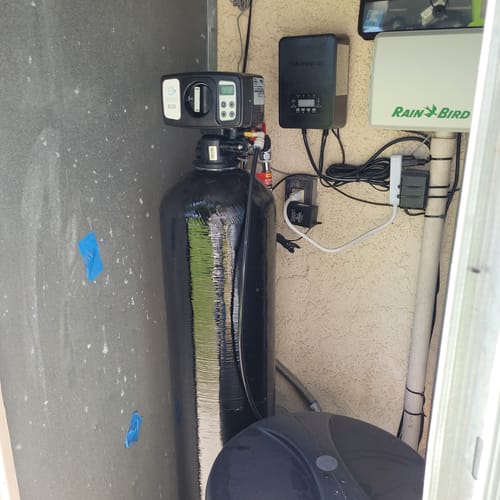
How much iron does it actually take to break a softener? Less than you'd think. At just 1.0 ppm, the resin bed starts struggling.
By 3.0 ppm, you've crossed a critical threshold — salt-based softeners can't keep up, and you'll need a dedicated iron filter in the fight.
Push past 10 ppm, and a single-stage system won't cut it at all. You're looking at a two-stage setup: an iron filter working upstream, followed by the softener.
Here's what makes this dangerous — most homeowners never test their water. They install a softener, assume it's working, and watch it silently degrade.
Ferric iron coats the resin beads, efficiency drops, and suddenly a fixable problem becomes an expensive replacement.
The 3 Types of Iron Threatening Your Water Softener
Not all iron is created equal — and misidentifying which type you're dealing with is how a simple water problem turns into a plumbing nightmare.
We've identified three distinct culprits, each requiring a different approach.
Clear water iron sneaks up on you — no visible signs until those stubborn stains appear.
Systems like Katalox Light handle it well.
Red water iron announces itself immediately through its reddish tint, demanding specialized filtration designed for oxidized iron removal.
Iron bacteria is the most sinister of the three.
It produces foul odors, creates slime buildup inside tanks and pipes, and requires aggressive intervention — chlorine injection, UV disinfection, professional treatment.
Knowing which type you're fighting isn't optional.
It's the difference between choosing the right protection and destroying your softener entirely.
How an Iron Filter Protects Your Resin Bed
Once dissolved iron slips past your intake and reaches your water softener unfiltered, your resin bed starts absorbing it — and that's where the real damage begins.
An iron filter intercepts it first, and here's exactly how:
An iron filter intercepts dissolved iron before it ever reaches your resin bed — and that changes everything.
- It removes dissolved ferrous iron before oxidation converts it into ferric iron — the rust that coats and permanently fouls your resin beads.
- It handles up to 15 ppm of iron, protecting softeners that would otherwise collapse under high-iron well water conditions.
- It converts dissolved iron into filterable solids through oxidation, ensuring nothing reaches your resin bed except clean, treatable water.
We're talking about preserving a resin bed that's expensive to replace and impossible to fully restore once fouled.
How to Choose the Right Iron Filter for Well Water
Choosing the right iron filter starts with knowing exactly what's in your water — and that means testing it first. Not all iron is the same. Ferrous iron dissolves invisibly, while ferric iron floats as visible particles. Each demands a different approach.
If your iron exceeds 3 ppm, a single filter won't cut it. You'll need a two-stage system — an iron filter paired with a water softener — to handle both problems effectively.
Look for filters using catalytic carbon or greensand. These oxidizing media convert dissolved iron into a filterable form, making removal far more reliable.
Also check your water's pH. Iron filters perform best between 6.7 and 8.0. Outside that range, even premium systems underperform.
Test regularly. Adjust accordingly. Your resin bed depends on it.
Frequently Asked Questions
Do I Need an Iron Filter if I Have a Water Softener?
If your iron levels exceed 1 ppm, we'd strongly recommend adding an iron filter. Your softener wasn't built to handle iron—it'll foul the resin bed, spike maintenance costs, and shorten your system's lifespan.
Why Are States Banning Water Softeners?
States are banning water softeners because the salt they discharge raises sodium levels in groundwater and local waterways, harming ecosystems. Regulators see traditional softeners as incompatible with sustainable water management goals.
What Is the Life Expectancy of a Resin Tank on a Water Softener?
We'd expect our resin tank to last 10–15 years — but if we're dealing with high iron levels, that lifespan can collapse dramatically, sometimes failing within just a few short years.
What Are Common Problems With Iron Filters?
Iron filters face clogging from ferric buildup, pH sensitivity that weakens performance, iron bacteria creating stubborn slime, and chemical oxidant requirements that raise costs. We're also looking at higher installation expenses compared to traditional softeners.






