


![SoftPro™ Chlorine+ Carbon Whole House Water Filter to Remove PFAS, Chlorine, Chloramine & Pesticides [City Water Filters Series]](http://www.softprowatersystems.com/cdn/shop/files/SoftPro_Whole_House_Carbon_Filter_with_Spin_Down_Water_Filter.webp?v=1783547361&width=140)


 855-683-8488


How Iron Filters Remove Manganese From Well Water — And the Limits You Need to Know

Iron filters remove manganese by oxidizing it first — converting invisible dissolved manganese into solid particles that can actually be caught and filtered out. The right pH, usually above 7, makes this process work. But here's what most people miss: standard iron filters hit a hard limit around 10 mg/L. Go above that, and you'll need a more aggressive approach. Stick with us, and we'll show you exactly where those limits are — and what to do when you hit them.
Key Takeaways
- Iron filters oxidize dissolved manganese, converting invisible manganous manganese into solid particles that can be physically filtered from well water.
- Effective manganese removal requires a pH above 7, as lower levels significantly hinder oxidation and overall filter performance.
- Manganese greensand and Birm filters handle moderate manganese concentrations up to 10 mg/L under consistent maintenance and proper conditions.
- Concentrations exceeding 10 mg/L surpass standard filter capacity, requiring stronger oxidants and multi-step filtration for complete removal.
- Filter failure signs include black staining, metallic-tasting water, and test results above the EPA standard of 0.05 mg/L.
How Iron Filters Remove Manganese From Well Water

When tackling well water quality, iron filters do double duty by also targeting manganese — a metal that causes its own share of headaches, from black staining to bitter-tasting water.
Here's how it works: iron filters oxidize dissolved manganese, converting it into solid particles that filtration media can capture and remove.
Iron filters oxidize dissolved manganese, transforming it into solid particles that filtration media can then capture and remove.
What makes this even more effective is the relationship between iron and manganese. Iron actually assists in co-precipitating manganese during oxidation, meaning the two metals fundamentally work against each other in your favor.
However, there's a critical variable — pH. Your water needs to stay above 7 for oxidation to occur efficiently. Without the right pH, even the best filter struggles to do its job properly.
Why Manganese Must Be Oxidized Before Any Filter Can Catch It
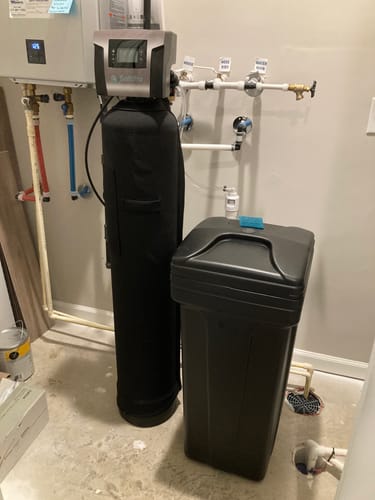
Manganese pulls a clever trick — it hides in water as a dissolved, colorless form called manganous manganese, making it completely invisible and impossible for filters to catch. Filters can only trap particles, and dissolved manganese simply slips right through.
That's why oxidation comes first. By introducing an oxidizer — chlorine, ozone, or even air — we force manganese to transform into its solid, precipitated form called manganic manganese. Now it's physical, catchable, filterable.
There's another variable we can't ignore: pH. Higher pH levels dramatically reduce manganese's solubility, accelerating precipitation.
Without managing pH alongside oxidation, we're leaving removal efficiency on the table.
Oxidize first, filter second — skip that sequence, and no filter performs as promised.
Which Iron Filters Work Best for Manganese Removal?
Now that we recognize oxidation is the critical first step, which filters actually do the job best? It depends on your manganese levels and system goals.
For moderate manganese up to 10 mg/L, manganese greensand filters deliver reliable results through oxidation and filtration — though they demand consistent maintenance.
Birm filters offer a compelling alternative: they leverage dissolved oxygen for oxidation, require no regeneration, and keep operating costs low when manganese levels stay consistent.
When concentrations exceed 10 mg/L, standard filters won't cut it. You'll need advanced oxidation systems using strong oxidants like chlorine or hydrogen peroxide before filtration.
One critical variable across all systems? pH. Manganese demands higher pH levels for effective removal than iron does — overlook this, and even the best filter underperforms.
Why Manganese Above 10 Mg/L Requires More Than an Iron Filter
Once manganese climbs past 10 mg/L, standard iron filters simply can't keep up. At those concentrations, you're dealing with chemistry that demands more firepower than typical filtration can deliver.
Here's why: iron filters rely on specific conditions — adequate pH, sufficient dissolved oxygen — to oxidize manganese before capturing it. When levels spike, those conditions become nearly impossible to maintain consistently.
That's where oxidizing agents like chlorine or hydrogen peroxide enter the picture. They force the oxidation your filter can't achieve alone.
But oxidation is only half the battle — you'll also need multi-step filtration to finish the job completely.
Without this combination, you're looking at stained fixtures, metallic-tasting water, and a treatment system that's quietly failing you. Higher manganese demands a thorough strategy, not a single-point solution.
Signs Your Iron Filter Isn't Keeping Up With Manganese
Knowing when your system is failing you matters just as much as knowing what to do about it.
Recognizing the warning signs of a failing system is half the battle — the other half is acting on them.
Watch for brown or black staining on fixtures and laundry — that's manganese slipping through your filter. A metallic taste in your water is another red flag, since even trace concentrations affect flavor noticeably.
If you're spotting black sediment or sludge building up inside appliances or plumbing, your iron filter isn't keeping pace. Regular testing tells the clearest story: manganese levels exceeding 0.05 mg/L mean your system isn't meeting the EPA's secondary standard.
Often, the culprit is pH — manganese filtration demands higher pH levels than iron removal alone requires. Identifying these signs early puts you back in control before the problem compounds.
Frequently Asked Questions
What Is the Best System to Remove Manganese From Well Water?
We recommend oxidation followed by filtration as your best solution. Using chlorine or hydrogen peroxide converts dissolved manganese into a filterable solid. For concentrations between 3–10 mg/L, Manganese Greensand filters deliver exceptional, targeted results.
What Is the Acceptable Level of Manganese in Well Water?
The EPA's secondary standard sets acceptable manganese levels at 0.05 mg/L for aesthetic concerns, but we shouldn't let levels exceed 0.3 mg/L—that's the Health Advisory threshold linked to potential neurological effects.
Is It Safe to Drink Water With Iron and Manganese?
Drinking water with iron and manganese is generally safe, as they're classified as secondary contaminants. However, exceeding EPA limits can cause metallic tastes, staining, and long-term neurological risks from high manganese exposure.
How to Flush Out Manganese?
We'll flush out manganese by backwashing filtration systems regularly, raising pH above 7.0, and using oxidizing agents like chlorine or potassium permanganate. Always monitor manganese levels before and after flushing to confirm concentrations stay below 0.05 mg/L.






