


![SoftPro™ Chlorine+ Carbon Whole House Water Filter to Remove PFAS, Chlorine, Chloramine & Pesticides [City Water Filters Series]](http://www.softprowatersystems.com/cdn/shop/files/SoftPro_Whole_House_Carbon_Filter_with_Spin_Down_Water_Filter.webp?v=1783547361&width=140)


 855-683-8488


How Much Does Iron Damage Really Cost Your Plumbing? (Full Breakdown)

Iron damage can cost you far more than you'd expect. Minor repairs run $150 to $500, but moderate damage jumps to $4,500–$15,000. Full pipe replacement averages $33,000–$43,000, and hidden fees like permits, landscaping, and drywall repairs can push totals past $50,000. The real problem? Most of these costs compound quietly over time before you ever spot a reddish-brown stain. Stick with us, and we'll break down exactly where every dollar goes.
Key Takeaways
- Minor plumbing repairs from iron damage cost $150–$500, while full replacements can average $33,000–$43,000 or exceed $50,000 with hidden costs.
- Iron corrosion narrows pipes, damages appliances like water heaters and dishwashers, and compounds repair costs significantly over time.
- Full pipe replacement costs $375–$1,800+, with additional ceiling, drywall, and landscaping repairs adding thousands more to the total.
- Hidden costs including permit fees ($50–$500), sewer inspections ($250–$1,600), and landscaping restoration ($1,250–$6,000) can dramatically inflate project budgets.
- Trenchless repair methods reduce excavation costs to $80–$200 per foot, offering a more affordable alternative to traditional full replacement.
What Iron Damage Does to Pipes, Drains, and Fixtures

When iron damages your plumbing, it doesn't just create an eyesore—it sets off a chain reaction that affects everything from your pipes to your wallet.
Here's what's actually happening inside your system: iron corrosion creates mineral scale that narrows your pipes, restricts water flow, and eventually causes blockages. Meanwhile, those reddish-brown stains spreading across your fixtures aren't just ugly—they're signals that your appliances are quietly losing efficiency and lifespan.
Every connected appliance, from your water heater to your dishwasher, pays a price. The damage compounds over time, turning manageable maintenance into costly repairs and replacements.
Understanding this chain reaction early is the difference between a simple fix and an expensive overhaul. Let's break down exactly what that costs you.
The Full Cost of Replacing Iron-Damaged Plumbing
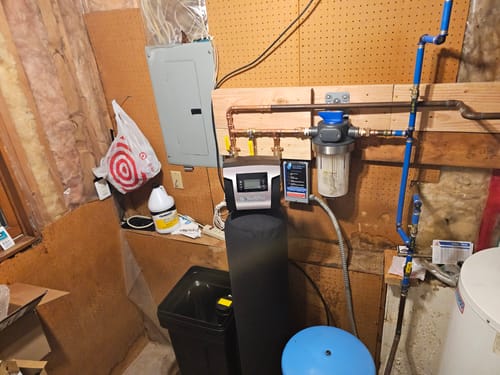
Once iron damage pushes your plumbing past the point of simple fixes, you're looking at full replacement—and that's where costs get serious. We've broken down every expense tier so you can anticipate the full financial picture—not just the pipe swap itself.
| Cost Factor | Low Estimate | High Estimate |
|---|---|---|
| Pipe Replacement | $375 | $1,800+ |
| Per Linear Foot | $12.50 | $30 |
| Ceiling/Drywall Repair | $300 | $1,700 |
| Sewer Line Inspection | $250 | $1,600 |
| Landscaping Restoration | $1,250 | $6,000 |
Notice how ancillary costs—inspections, drywall, landscaping—can dwarf the pipe replacement itself. Understanding these layers helps you budget accurately, negotiate smarter, and avoid the sticker shock that catches most homeowners completely off guard.
Repair vs. Replacement: Which Option Saves You More?
How do you know when a repair is throwing good money after bad? Minor fixes cost between $150 and $500, and partial section replacements run $125 to $175 per linear foot—reasonable for isolated damage.
But moderate repairs climb to $4,500 to $15,000, and if you're facing multiple problem areas, those costs stack fast.
Moderate sewer repairs can run $4,500 to $15,000—and multiple problem areas mean those costs stack up fast.
Here's the critical calculation: full replacement averages $33,000 to $43,000, but trenchless methods cut that to $80 to $200 per foot, dramatically reducing excavation expenses.
Meanwhile, ignoring deteriorating pipes risks water damage cleanup bills of $10,000 to $30,000.
We recommend mapping your pipe's overall condition before committing to repairs. When cumulative repair costs approach replacement pricing, replacement wins—especially when you factor in catastrophic damage risk.
Hidden Fees That Blow Most Cast Iron Budgets
Even after you've settled the repair-versus-replacement debate, the final invoice can still catch you off guard. Hidden costs routinely ambush homeowners who didn't plan beyond the pipe itself.
Start with sewer line inspections—they run $250 to $1,600 and frequently expose deeper problems. Permits add another $50 to $500 depending on your municipality.
Once crews pull old pipes, expect ceiling and drywall repairs costing $300 to $1,700. If excavation's required, landscaping restoration alone can run $1,250 to $6,000.
Stack these expenses together and you'll see why total replacement projects can reach $50,000. We've watched budgets collapse not because the pipe work was mispriced, but because nobody accounted for everything surrounding it.
Plan for the full scope—not just the headline number.
How to Stop Iron Damage Before It Becomes a Gut Job
Prevention is always cheaper than demolition—and when it comes to iron damage, catching problems early can mean the difference between a $200 fix and a $20,000 gut job. Start by inspecting fixtures regularly for reddish-brown stains and reduced water flow—these are your earliest warning signs.
Catching iron damage early can mean the difference between a $200 fix and a $20,000 gut job.
Next, invest in a high-quality iron filtration system like the Fleck 2510AIO Advanced Iron Filter to actively reduce iron levels before they compromise your pipes.
Consider scheduling video camera inspections ($250–$1,600) to spot internal scaling and blockages early. Pair that with a water softener to combat hardness and slow corrosion buildup.
Finally, establish a proactive maintenance plan. Regular servicing of fixtures and appliances keeps performance efficient and repair costs manageable—before minor buildup becomes a full-scale replacement nightmare.
Frequently Asked Questions
Does Homeowners Insurance Cover Cast Iron Pipe Replacement?
Homeowners insurance can cover cast iron pipe replacement, but only for sudden damage—not gradual wear. We recommend reviewing your policy carefully, documenting everything, and maintaining your pipes to strengthen any claim you'll file.
What Is the Most Expensive Plumbing Issue?
We'll find that cast iron pipe replacement tops the list as the most expensive plumbing issue, costing between $8,000 and $50,000—a staggering range that's driven by damage extent and home size.
How Much Does It Cost to Replace Cast Iron to PVC?
Replacing cast iron with PVC typically costs $4,500 to $15,000, but we're looking at $8,000 to $50,000 when factoring in labor, accessibility challenges, and damage severity. PVC materials run just $2–$10 per linear foot.
Should I Buy a House With Cast Iron Plumbing?
We'd say yes, but only if you've done your homework. Get a sewer inspection first—it'll reveal the pipes' condition and help you negotiate repair costs, potentially saving thousands on your purchase price.






