


![SoftPro™ Chlorine+ Carbon Whole House Water Filter to Remove PFAS, Chlorine, Chloramine & Pesticides [City Water Filters Series]](http://www.softprowatersystems.com/cdn/shop/files/SoftPro_Whole_House_Carbon_Filter_with_Spin_Down_Water_Filter.webp?v=1783547361&width=140)


 855-683-8488


How Much Household Water Pressure Drop Should You Actually Expect From an Iron Filter?

Most iron filters will cost you somewhere between 7 and 12 PSI of water pressure, and knowing that number upfront can save you from a disappointing installation. Single-stage filters typically drop pressure by 20–30%, while multi-stage systems can exceed 0.5 bar of loss. Once you cross that 7–10 PSI threshold, you'll notice sluggish showers and weak faucets. Iron concentration, filter type, and media resistance all play a role — and there's a lot more to unpack here.
Key Takeaways
- Single-stage iron filters typically cause a 20–30% pressure drop, reducing pressure from around 4.0 bar down to approximately 3.2 bar.
- Multi-stage systems generally exceed a 0.5 bar pressure drop, making them more restrictive than simpler single-stage filters.
- Pressure drops below 7–10 PSI are usually unnoticeable, but higher drops cause sluggish showers and faucets.
- High iron concentrations worsen pressure drops, potentially reducing flow rates from 60+ LPM down to just 20 LPM.
- Maintaining inlet pressure between 50–60 PSI and installing monitoring gauges helps manage and identify excessive pressure drops early.
Why Iron Filters Restrict Flow: Venturi, Oxidation, and Media Resistance

When water moves through an iron filter, it's fighting against three main forces that can seriously eat into your home's water pressure.
First, the Venturi mechanism injects air to oxidize dissolved iron—a clever process, but one that can alone cause pressure drops exceeding 0.5 bar.
Second, the oxidation reactions required to neutralize both iron and manganese add layered complexity, creating additional resistance throughout the system.
Third, media resistance varies greatly depending on filtration media type and particle size, directly affecting how freely water passes through.
Together, these forces compound into meaningful flow restrictions.
Even well-sized filters advertised at 20 LPM can underperform considerably under severe iron contamination conditions.
Understanding these three culprits puts you in the right position to diagnose pressure problems accurately.
Typical PSI Drop Ranges by Filter Type
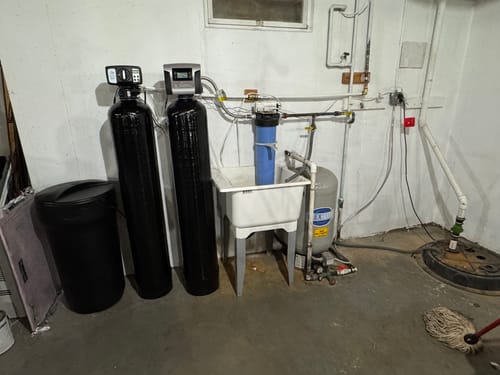
Not all iron filters hit your pressure the same way, and knowing the typical drop ranges by filter type can save you a lot of troubleshooting headaches.
Single-stage filters typically cause a 20-30% pressure drop—think 4.0 bar dropping to around 3.2 bar. That's manageable for most households.
Single-stage iron filters typically drop pressure 20-30%—a 4.0 bar system settling around 3.2 bar is completely normal.
Multi-stage systems, however, push resistance higher, often exceeding 0.5 bar beyond what simpler filters generate.
If you're running oxidizing agents alongside filtration media, expect even more complexity in your pressure dynamics.
Real-world data consistently shows an 0.8 bar drop across iron filter setups, regardless of how many faucets you're running simultaneously.
Flow rates also dip 7-15% compared to traditional filters.
Proper sizing isn't optional—it's what separates acceptable performance from frustrating pressure loss.
The PSI Threshold Where Pressure Drop Affects Fixtures
Knowing the typical drop ranges is only half the battle—what really matters is where those drops start hurting your fixtures. Small drops of 2–3 PSI are virtually unnoticeable in daily use.
Once you cross the 7–10 PSI threshold, though, you'll start seeing real consequences: sluggish shower flow, weak faucet pressure, and frustrating performance when multiple fixtures run simultaneously.
Here's what we've found most telling: a drop from 58 PSI to 46 PSI—roughly what a poorly sized iron filter can cause—pushes you well past that threshold.
That's a 12 PSI reduction that genuinely compromises household performance. Keeping inlet pressure between 50–60 PSI and monitoring with gauges before and after your filter lets you catch problematic drops before they quietly erode your water system's reliability.
How Iron Concentration Multiplies Pressure Drop Severity
Iron concentration doesn't just add to your pressure drop problem—it multiplies it.
Here's what that means practically: once iron levels climb past manageable thresholds, your filter's oxidation process creates compounding resistance that standard pressure calculations simply don't account for.
We're talking about flow rates collapsing from 60+ LPM down to 20 LPM—not a minor inconvenience, but a two-thirds reduction.
Meanwhile, pressure drops routinely exceed that critical 0.5 bar threshold during peak demand.
Iron deposits worsen things further by accumulating inside fixtures, creating secondary restriction points throughout your plumbing.
The result? Your filtration system fights battles on multiple fronts simultaneously.
This is precisely why proper filter sizing matters so much.
An undersized system doesn't just underperform—it actively amplifies the severity of every pressure problem you're already experiencing.
How to Pick an Iron Filter That Won't Kill Your Water Pressure
Choosing the right iron filter starts with matching it to your household's actual water demand—not just the iron concentration levels.
Here's what we recommend prioritizing:
- Pressure range compatibility – Select filters optimized for 50-60 psi operation to avoid significant pressure drops right from installation.
- Strategic positioning – Install your filter after the pressure tank to maintain consistent flow rates and eliminate bottlenecking before it starts.
- Advanced oxidizing systems – Look for filtration units using oxidizing agents that remove iron effectively without sacrificing flow rates.
We'd also suggest installing pressure gauges before and after the filter—this lets us monitor changes in real time.
Combined with regular backwashing, we'll prevent sediment buildup that quietly steals pressure over time.
Frequently Asked Questions
How Much Water Does an Iron Filter Discharge?
We've found iron filters discharge between 20–25 liters per minute under typical conditions, though Venturi components can restrict flow. Properly sized systems maintain stronger rates, but higher iron concentrations'll reduce overall discharge performance noticeably.
Is 40 Psi Water Pressure Too Low?
Yes, 40 psi is too low. We'd consider anything below 50 psi suboptimal for comfortable daily use. You'll notice weaker showers, sluggish fixtures, and real struggles running multiple appliances simultaneously.
Is 10 Gpm Enough for a House?
For most homes, 10 GPM isn't enough. We'd recommend aiming for 20-25 GPM to handle peak demand comfortably. Running multiple fixtures simultaneously with only 10 GPM will cause frustrating pressure drops throughout your home.
Can a Whole House Filter Cause Low Water Pressure?
Yes, a whole house filter can absolutely cause low water pressure. We've seen iron filters alone drop pressure by 20-30%, reducing flow from 4.0 bar to roughly 3.2 bar under heavy demand.






