


![SoftPro™ Chlorine+ Carbon Whole House Water Filter to Remove PFAS, Chlorine, Chloramine & Pesticides [City Water Filters Series]](http://www.softprowatersystems.com/cdn/shop/files/SoftPro_Whole_House_Carbon_Filter_with_Spin_Down_Water_Filter.webp?v=1783547361&width=140)


 855-683-8488


How Much Iron in Well Water Is Too Much for a Water Softener's Resin Bed to Handle?

Once iron levels in your well water climb past 3.0 ppm, your softener's resin bed is fighting a losing battle. Fouling actually begins around 1.0 ppm, gradually coating resin beads with rust-like deposits that choke performance. Standard softeners can technically exchange ferrous iron up to 10 mg/L, but reliable softening becomes unlikely well before that threshold. Understanding the difference between iron types, damage signs, and real solutions can help you protect your system before it's too late.
Key Takeaways
- Resin bed fouling begins when iron levels exceed 1.0 ppm, reducing the softener's ion exchange efficiency noticeably.
- Above 3.0 ppm, reliable softening becomes nearly impossible without additional iron filtration installed beforehand.
- Ferrous iron can be exchanged by softeners, but concentrations beyond 3.0 ppm overwhelm regeneration cycles completely.
- Ferric iron, appearing as red or yellow deposits, clogs resin beds and cannot be effectively removed by standard softeners.
- Ion exchange systems can tolerate ferrous iron up to 10 mg/L, though clogging accelerates well before that threshold.
How Iron Fouls a Water Softener's Resin Bed

Iron is sneaky — it doesn't just pass through your water softener harmlessly. Instead, it latches onto your resin beads, forming a rust-like coating that slowly suffocates their ability to exchange calcium and magnesium ions.
That's the core problem: resin beds aren't designed to handle iron, so when iron accumulates, it clogs the bed and kills efficiency.
Here's what we've learned about the thresholds that matter. Once iron exceeds 1.0 ppm, fouling begins.
Push past 3.0 ppm, and you're looking at a system that's practically ineffective. Acidic water accelerates this damage further, making pH balance critical — aim for around 8.0.
Understanding these mechanics helps you intervene early, before fouling forces costly maintenance or full resin replacement.
How Much Iron Your Water Softener Can Actually Handle
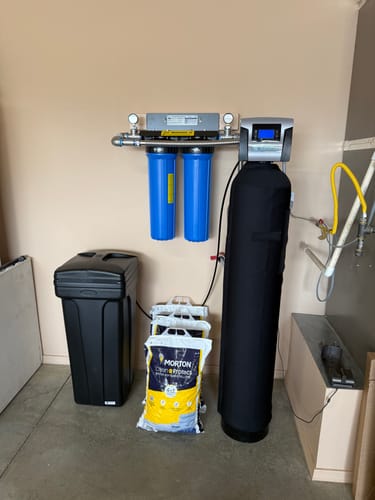
Now that we acknowledge how iron damages resin beds, the next logical question is: how much can your softener actually tolerate before things go sideways?
Standard softeners typically handle ferrous iron up to 1.0 ppm before performance drops noticeably. Ion exchange-equipped systems push that ceiling to around 10 mg/L, but you'll see resin clogging accelerate well before that threshold.
Here's the practical takeaway: once iron exceeds 3 ppm, you're likely beyond what any standard softener handles reliably.
At that point, specialized iron filtration becomes necessary. Watch for a telltale warning sign—water that runs clear but turns rusty when exposed to air. That discoloration signals iron levels your softener probably can't manage alone.
Testing your well water accurately before selecting a system isn't optional; it's essential.
Ferrous vs. Ferric Iron: Which Type Damages Softeners More?
Not all iron behaves the same way inside your softener, and that distinction matters more than most people realize.
Ferrous iron stays dissolved and runs clear from your tap, making it deceptively easy to ignore—until it starts fouling your resin bed above 1.0 ppm. Your softener can technically exchange it, but concentrations above 3.0 ppm overwhelm the resin faster than regeneration cycles can recover.
Ferrous iron runs clear from your tap—and quietly destroys your resin bed before you ever notice it.
Ferric iron is a different problem entirely. It's already oxidized, showing up as those red or yellow deposits you've likely noticed. Standard softeners can't remove it effectively—it simply clogs the system instead of exchanging through it.
Both types damage your resin, but through different mechanisms. That's why testing for each separately isn't optional—it's essential.
Signs Iron Is Already Destroying Your Water Softener
If your softener is already struggling with iron, your water and fixtures will tell you before the system fails completely.
Watch for reddish or brown discoloration coming from your taps—that's iron escaping treatment and signaling your resin bed's losing the battle. Staining on sinks, toilets, and tubs confirms the same problem.
A metallic taste in your water means iron concentrations are overwhelming your system's capacity.
If you're pulling filters and finding black or brown residue coating the media, your resin bed is fouled and working harder for diminishing results.
These aren't minor inconveniences—they're warnings that maintenance is overdue.
Catching these signs early lets you intervene before you're facing full system replacement rather than a straightforward resin bed restoration.
Why High Iron Levels Require More Than a Softener
Standard softeners cap out at handling roughly 1.0 ppm of iron—push past that threshold, and you're asking one system to do a job that demands two. Once iron exceeds 3.0 ppm, resin beds foul fast, maintenance costs climb, and untreated iron flows freely through your plumbing.
The fix isn't replacing your softener—it's pairing it with a dedicated iron filter like manganese greensand or an oxidation-based system.
| Iron Level (ppm) | Problem Created | Solution Required |
|---|---|---|
| Below 1.0 | Minimal resin strain | Softener alone |
| 1.0–3.0 | Gradual resin fouling | Softener + monitoring |
| Above 3.0 | Rapid system failure | Dedicated iron filter |
| Any ferric iron | Sediment buildup | Oxidation filtration |
| Mixed iron types | Complex contamination | Multi-stage treatment |
We recommend treating hardness and iron as separate battles requiring separate weapons.
Frequently Asked Questions
Can a Water Softener Remove Iron From Well Water?
Yes, we can remove ferrous iron up to 1.0 ppm with a water softener. Beyond that threshold, you'll need a dedicated iron filtration system to protect your resin bed and guarantee effective treatment.
What Are the Symptoms of Too Much Iron in Well Water?
We'll notice reddish-brown stains on sinks, bitter-tasting water, clogged fixtures, reduced water flow, and slimy plumbing buildup. Iron bacteria can also produce foul odors, signaling it's time to test and treat your well water.
How Much Iron Can a Water Softener Handle?
We've found that most water softeners can handle up to 10 mg/L of ferrous iron, but we'd recommend staying below 3 ppm to protect your resin bed's long-term performance and efficiency.
What Is the Best Water Softener for Well Water With High Iron?
For well water with high iron, we recommend twin-tank systems like Kinetico®. They're built to handle iron levels above 3 ppm, keeping your resin bed protected and your water consistently clean.






