


![SoftPro Chlorine+ Carbon Whole House Water Filter to Remove PFAS, Chlorine, Chloramine & Pesticides [City Water Filters Series]](http://www.softprowatersystems.com/cdn/shop/files/SoftPro_Whole_House_Carbon_Filter_with_Spin_Down_Water_Filter.webp?v=1780515157&width=140)
![SoftPro Iron Filter - Iron Master AIO - Best Iron Filter for Well Water [Air Injected Water Filter / Katalox]](http://www.softprowatersystems.com/cdn/shop/files/SoftPro_AIO_Iron_Master_Iron_Filter_Main.webp?v=1772123747&width=140)


 855-683-8488


How to Accurately Calculate Your Well Pump Flow Rate for Proper Iron Filter Sizing

To calculate your well pump flow rate, we'll use just a 5-gallon bucket and a stopwatch. Close all faucets, open a hose bib, fill the bucket, and time it. Then divide gallons by seconds and multiply by 60 to get your GPM. You'll want at least 6 GPM for iron filtration and double that for backwashing. Stick with us — there's a lot more to uncover about sizing your system correctly.
Key Takeaways
- Close all faucets to isolate your well pump, then open a hose bib and time how long it takes to fill a 5-gallon bucket.
- Calculate GPM using this formula: divide gallons by seconds elapsed, then multiply by 60 for your flow rate.
- An effective iron filter requires a minimum service flow rate of 6 to 12 GPM for proper filtration.
- Backwashing demands at least double your service flow rate, meaning a 5 GPM system needs 10 GPM minimum.
- Flow rates under 6 GPM signal potential pump wear, blockages, or well depth issues requiring professional evaluation before filter sizing.
What Is Well Pump Flow Rate and Why Does It Matter for Iron Filters?

Well pump flow rate measures how many gallons of water your pump delivers per minute (GPM), and it's the foundation for choosing the right iron filter.
Get this number wrong, and you're either over-filtering or letting iron slip through untreated.
Here's why it matters specifically for iron filters: these systems require backwashing to flush trapped contaminants, and backwash flow rates often demand double your normal service rate.
If your filter can't handle that demand, it underperforms and deteriorates faster.
Most households operate effectively between 6 and 12 GPM, and knowing exactly where you fall within that range lets you select a filter sized precisely for your water volume and iron load.
Accurate measurement isn't optional—it's the difference between a system that works and one that wastes money.
Tools and Setup Required to Test Your Well Pump Flow Rate
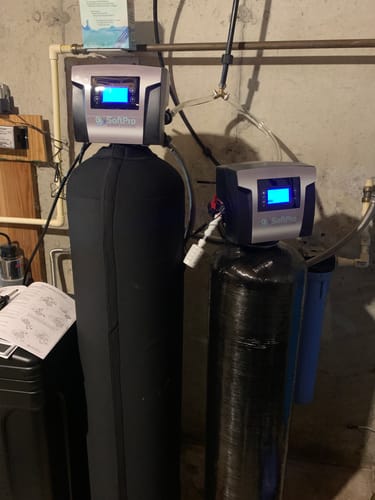
Testing your well pump flow rate doesn't require expensive equipment—just a 5-gallon bucket, a stopwatch, and the right setup.
Before you begin, close every faucet and eliminate all water usage inside the house. This guarantees your pump operates under isolated conditions, giving you accurate, reliable data.
Next, locate a hose bib near your well pump—this is where you'll conduct the test. Once you've confirmed no water is running elsewhere, open the hose bib fully and let the pump activate and reach operating pressure before you start timing.
When you're ready, time exactly how long it takes to fill the bucket completely. That single number reveals your flow rate calculation: (Gallons Drawn ÷ Seconds) × 60 = GPM.
How to Measure Your Well Pump Flow Rate Step by Step
Now that we've got our tools ready, let's put them to work. Measuring your well pump's flow rate is straightforward when you follow the right sequence.
- Close all faucets and appliances to isolate the pump and eliminate variables.
- Open the hose bib below the pressure tank, letting the pump build full pressure before collecting water in your 5-gallon bucket.
- Time the fill until the pump activates, recording both gallons collected and seconds elapsed.
Then apply this formula: (Gallons ÷ Seconds) × 60 = GPM.
For example, 5 gallons collected in 60 seconds yields exactly 5 GPM.
That single number determines whether your iron filter can keep pace with your household's demand—precision here prevents costly undersizing.
How to Size an Iron Filter Using Your Well Pump Flow Rate
Once you've got your GPM number in hand, sizing an iron filter becomes a straightforward matching exercise. Your ideal service flow rate sits between 6 to 12 GPM—that's your sweet spot for effective filtration.
Here's what most people miss: backwashing demands at least double your service flow rate. Running at 5 GPM? Your system needs to deliver 10 GPM during backwash cycles. If your pump can't support that, your filter won't clean itself properly.
Use this formula to confirm your numbers: (Gallons Drawn Down ÷ Seconds for Recovery) × 60.
Different filter media types also carry unique backwash requirements, so we'd strongly recommend consulting a water technician before finalizing your selection.
Matching your pump's actual performance to your filter's specifications protects your entire investment.
When Is Your Well Pump Flow Rate Too Low for Iron Filtration?
Knowing your filter's requirements is only half the battle—your pump also has to hold up its end of the deal. If your pump's delivering under 6 GPM, you're already in trouble.
Here's why that threshold matters:
The 6 GPM threshold isn't arbitrary—it's the line between water that's actually treated and water that isn't.
- Effective iron filtration demands a minimum of 6 GPM to properly treat your water.
- Backwashing requires at least double your service flow rate—meaning 8–10 GPM for ideal performance.
- Flow fluctuations below acceptable ranges cause iron pass-through, making filtration completely ineffective.
A pump producing only 5 GPM can't sustain adequate backwash cycles, leaving iron in your water. Pump wear, blockages, or well depth limitations often cause these shortfalls.
Regular flow rate testing isn't optional—it's essential for maintaining a system that actually works.
Frequently Asked Questions
How to Size an Iron Filter?
To size an iron filter, we'll measure our well pump's flow rate using a 5-gallon bucket and stopwatch. We then match our filter tank diameter to guarantee backwash rates hit 10-12 GPM minimum.
What Is the Flow Rate of a 4.5 x10 Water Filter?
A 4.5 x 10 water filter's flow rate typically ranges from 4 to 5 GPM. We'll want to guarantee our backwash flow rate doubles that to maintain peak filtration performance and prevent iron contamination.
Is 12 Gpm Good for a Well?
Yes, 12 GPM's a solid flow rate for most wells! It'll comfortably handle multiple fixtures simultaneously, support effective iron filter backwashing, and maintain consistent water quality throughout your home without frustrating pressure drops.
Is 2.5 Gpm a Good Flow Rate?
No, 2.5 GPM isn't a good flow rate for most homes. It's too low to support multiple fixtures simultaneously and won't effectively maintain an iron filter's backwash cycle, which typically requires double your service flow rate.



