


![SoftPro™ Chlorine+ Carbon Whole House Water Filter to Remove PFAS, Chlorine, Chloramine & Pesticides [City Water Filters Series]](http://www.softprowatersystems.com/cdn/shop/files/SoftPro_Whole_House_Carbon_Filter_with_Spin_Down_Water_Filter.webp?v=1783547361&width=140)


 855-683-8488


How to Get Iron Filter Sizing Right the Very First Time: A Homeowner's No-Guesswork Guide

Getting iron filter sizing right starts with knowing exactly what's in your water and how much of it your household demands each day. Test for iron type, pH, and flow rate before you buy anything. A family of four with iron levels above 2 ppm needs a completely different setup than a couple with clean, low-iron water. Skip these steps and you'll overpay for underperformance. Stick with us and we'll walk you through every measurement that matters.
Key Takeaways
- Test your water for iron type and concentration, and measure pH, as both directly affect which filter works and how well it performs.
- Calculate daily water usage by multiplying the number of household members by 80–100 gallons to determine your minimum filtration capacity.
- Measure your well's flow rate using a 5-gallon bucket during peak hours to prevent undersizing and pressure drop issues.
- Choose a filter rated to handle 2–3 times your highest measured iron level to account for fluctuations and maintain consistent performance.
- Low pH below 6.8 reduces iron removal efficiency, so factor pH correction into your sizing plan alongside iron concentration and demand.
What's Actually in Your Water Before You Size an Iron Filter?

Before we size an iron filter, we need to know exactly what we're dealing with in the water.
Iron isn't just iron—it shows up as ferrous (dissolved) or ferric (particulate), and each type demands a different filtration approach.
Those reddish-brown stains on your fixtures? That's your water telling you iron's likely exceeding 2 ppm.
pH matters too.
Some systems need a minimum of 6.8 to work effectively, while others operate at 6.0.
Get the pH wrong, and even a correctly sized filter underperforms.
We also recommend testing annually, since water chemistry shifts over time.
Manganese often tags along with iron, complicating your sizing decisions.
Test first, size second—there's no shortcut that works better than accurate data.
How to Measure Your Home's Flow Rate in Under 5 Minutes
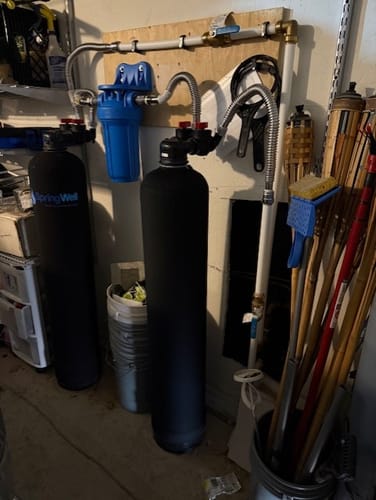
Once we grasp what's in the water, we need to know how fast it moves through your pipes—because even the best iron filter fails if it can't keep up with your household's demand.
Here's all you need:
- Grab a 5-gallon bucket and let your well pump run continuously while you fill it completely.
- Time the fill—if it takes 1 minute, you're working with 5 GPM.
- Test during peak usage hours to capture your home's true maximum demand, not an optimistic baseline.
That number drives everything. A 5 GPM flow rate typically calls for a 1.0 cubic foot filtration system.
Nail this measurement, and you'll sidestep clogging, pressure drops, and the costly mistake of undersizing your filter.
How to Match Iron Filter Size to Your Household and Iron Levels
Now that you've clocked your flow rate, let's put that number to work—because matching filter size to your household isn't guesswork, it's math.
Start with daily usage: multiply your household size by 80-100 gallons per person. A standard 1.0 cubic foot system handles 4-6 people comfortably when iron stays below 2 ppm.
Here's where most homeowners stumble—they ignore iron concentration. Your filter must handle 2-3 times your highest measured iron level, so test your water before sizing anything. Higher concentrations demand larger systems, period.
Don't forget pH. If your water tests below 6.0-6.8, iron removal efficiency drops drastically, meaning your perfectly sized filter suddenly underperforms.
Factor pH into your selection alongside household demand and iron levels, and you'll size it right the first time.
Why One Iron Filter Rarely Solves the Whole Problem
Even after you've nailed your filter size, there's a harder truth to face—iron rarely shows up alone. It brings friends: acidity, sulfur, bacteria, and low pH. One filter simply can't fight that whole crew.
Iron never travels alone—it brings sulfur, bacteria, and acidity along for the ride.
Here's what typically complicates things:
- Co-occurring contaminants like sulfur and acidity require separate treatment stages that a standalone iron filter can't address.
- Iron bacteria create slimy buildup that standard filtration won't eliminate, demanding specialized intervention.
- Fluctuating flow rates and mixed iron types reduce single-filter performance over time, compromising water quality unpredictably.
We recommend thinking in systems, not single units. Combination treatment setups tackle iron alongside every co-occurring problem simultaneously—delivering cleaner water, longer equipment life, and fewer frustrating surprises down the road.
What Makes an Iron Filter Worth the Cost: and What Doesn't?
So what actually separates a worthwhile iron filter investment from an expensive regret? It comes down to three things: media quality, valve durability, and honest cost accounting.
High-quality filter media lasts longer and cuts replacement frequency dramatically. That alone changes your total ownership math.
A durable valve system means fewer service calls and consistent performance you can actually depend on.
Where homeowners get burned is chasing the lowest upfront price. A cheaper, incomplete system often costs more through repairs, replacements, and frustration than a thorough one would've upfront.
Here's our rule: balance initial investment against long-term maintenance realities before committing.
And don't overlook warranties and manufacturer support. When something goes wrong—and eventually something will—that coverage determines whether your investment holds its value or quietly bleeds it away.
Frequently Asked Questions
How to Size an Iron Filter?
We'll size your iron filter right by testing your GPM, calculating daily household usage, measuring iron levels, then choosing media that handles 2-3x your highest iron concentration for lasting, worry-free performance.
What Are the Symptoms of Too Much Iron in Water?
We've seen it all: reddish-brown stains on fixtures, metallic-tasting water, slimy orange pipe buildup, and constant plumbing clogs. If your pH's below 6.8, these symptoms hit even harder.
Can a Water Softener Be Too Big for a House?
Yes, a water softener can absolutely be too big! When it's oversized, we're looking at incomplete brine flushing, wasted salt and water, and even that dreaded salty taste—costing you more money unnecessarily.
What Size Micron Filter for Iron?
We recommend a 20-micron filter for ferric (oxidized) iron, but if you're battling dissolved ferrous iron, go finer—5 microns gives you the precision needed to eliminate stubborn staining completely.






