


![SoftPro™ Chlorine+ Carbon Whole House Water Filter to Remove PFAS, Chlorine, Chloramine & Pesticides [City Water Filters Series]](http://www.softprowatersystems.com/cdn/shop/files/SoftPro_Whole_House_Carbon_Filter_with_Spin_Down_Water_Filter.webp?v=1783547361&width=140)


 855-683-8488


How to Install a Bypass Valve on Your Iron Filter for Safe and Easy Service Access

To install a bypass valve on your iron filter, we'll start by shutting off the main water supply and cutting into the line at a convenient service point. Choose the right valve type—manual, lever, or push-button—then secure it with Teflon tape on every threaded connection. Slowly restore pressure and inspect all joints for leaks. It's a straightforward process that makes future maintenance hassle-free, and there's plenty more to uncover ahead.
Key Takeaways
- Shut off the main water supply before cutting into the line to safely position the bypass valve for future service access.
- Use a pipe cutter for copper lines or a saw for PVC, ensuring clean cuts to prevent fitting failures.
- Wrap all threaded connections with Teflon tape before securing the bypass valve to create a watertight seal.
- Slowly restore main water pressure after installation, inspecting every joint carefully for moisture or leaks.
- Toggle the bypass valve several times after installation to confirm smooth operation and check for resistance or misalignment.
What Type of Iron Filter Bypass Valve Do You Actually Need?

Before we plunge into installation, let's make sure we're working with the right bypass valve for our iron filter. There are three main types: manual turn, push-button, and lever-operated models — each with distinct advantages worth understanding.
Manual turn valves are our simplest option, requiring just a rotation to redirect water flow.
Lever-operated valves offer the quickest access, letting us toggle between bypass and filtration modes in seconds.
Push-button models are compact but may need a rubber mallet to engage properly, so factor that into your workflow.
Here's the critical detail: always select a valve designed specifically for iron filters.
Generic valves risk compatibility issues that compromise reliable operation.
Matching the right valve to our system upfront saves us serious troubleshooting headaches later.
Tools and Fittings to Have Ready Before You Cut the Line
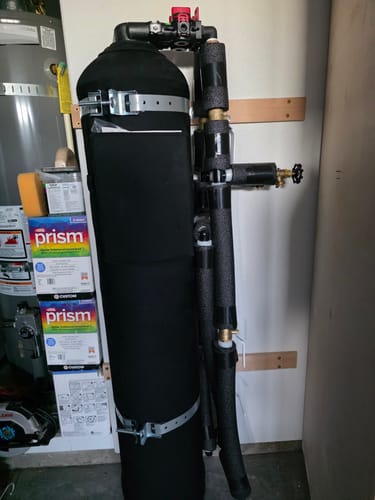
Now that we've got the right bypass valve picked out, let's make sure our toolkit is equally dialed in — because cutting into a water line with the wrong gear turns a straightforward job into a frustrating one.
For copper lines, grab a pipe cutter; for PVC, use a saw. Either way, clean cuts matter. Have Teflon tape ready to seal every threaded connection and stop leaks before they start.
Flexible connectors give us adjustability when lining everything up isn't picture-perfect — and it rarely is. A wrench or adjustable pliers lets us torque fittings down properly without guessing.
Finally, don't overlook mounting brackets and hardware; a valve that shifts or vibrates during service creates bigger headaches down the road. Prep everything now, cut once.
How to Cut In and Install Your Iron Filter Bypass Valve
The moment we shut off the main water supply is when this job officially begins — and it's the one step that keeps a manageable installation from turning into a flood.
From there, precision matters at every stage:
- Locate your cut points on the main line where the bypass valve will sit — prioritize accessibility for future servicing.
- Choose the right cutting tool — pipe cutter for copper, saw for PVC — clean cuts prevent fitting failures.
- Seat and secure the bypass valve onto the cut section, wrapping all threaded connections with Teflon tape for a leak-proof seal.
- Slowly reopen the main supply while inspecting every joint — don't rush this confirmation step.
Controlled execution here protects everything downstream.
How to Seal and Test Your Iron Filter Bypass Valve for Leaks
With the bypass valve seated and the main supply back on, we're now at the step that separates a solid installation from one that fails quietly behind a wall — sealing and leak testing.
Before tightening any fitting, wrap every threaded connection with Teflon tape. It's a small step that eliminates most leak points entirely.
Gradually restore main pressure, letting trapped air escape naturally. Then run your fingers along every joint — moisture reveals what your eyes miss. Toggle the bypass between positions; smooth operation with zero resistance confirms correct seating.
Finally, let water flow for several minutes, then inspect every connection once more. Re-tighten anything suspicious. A leak caught now costs minutes. One missed costs considerably more.
Troubleshooting Iron Filter Bypass Valve Problems After Install
Even a careful installation can throw a curveball once the system runs under real-world conditions.
Let's tackle the most common post-install issues head-on:
- Inconsistent water pressure — Check valve alignment and confirm proper positioning.
- Leaks around connections — Tighten fittings or replace worn O-rings and seals immediately.
- Stiff toggling between modes — Inspect for mineral buildup or obstructions blocking smooth movement.
- Hidden performance issues — Regularly switch between bypass and normal operation to catch problems early.
We'd also strongly recommend keeping your manufacturer's troubleshooting guide nearby.
Model-specific guidance cuts diagnostic time considerably and helps us resolve issues with precision rather than guesswork.
Mastering these checkpoints means we'll spend less time troubleshooting and more time enjoying reliable, iron-free water.
Frequently Asked Questions
Where Do You Install a Bypass Valve?
We'll install the bypass valve on the main cold water supply line, right before the iron filter unit, ideally adjacent to the control head—giving you quick access for maintenance and effortless switching between modes.
How to Bypass Ecowater System?
To bypass your Ecowater system, we'll rotate the bypass valve near the control head to the "bypass" position. If it's a lever valve, simply pull or push it to redirect water flow directly through.
What Is a Filter Bypass Valve?
A filter bypass valve lets us redirect water around your filtration system during maintenance or emergencies, keeping your supply uninterrupted. It's your safety net, ensuring you've always got water flowing when your filter needs servicing.
How to Set a Bypass Valve?
To set a bypass valve, we'll first shut off the main water supply, then move the lever, button, or turn valve to the "bypass" position, redirecting untreated water directly through your household plumbing.






