


![SoftPro™ Chlorine+ Carbon Whole House Water Filter to Remove PFAS, Chlorine, Chloramine & Pesticides [City Water Filters Series]](http://www.softprowatersystems.com/cdn/shop/files/SoftPro_Whole_House_Carbon_Filter_with_Spin_Down_Water_Filter.webp?v=1783547361&width=140)


 855-683-8488


How to Read Your Iron Water Test Report Accurately and Use It to Choose the Correct Filter

When you read your iron water test report, the first thing you check is whether you're dealing with ferrous or ferric iron, because each type demands a completely different treatment system. Next, confirm your iron levels, pH, manganese, and hardness numbers — these four values together determine exactly which filter technology works and which fails. Get these wrong, and you're wasting money. Stick with us, and we'll walk you through every number so your filter choice becomes crystal clear.
Key Takeaways
- Iron levels above 0.3 mg/L require filtration, with the iron type—ferrous or ferric—determining which treatment system you need.
- Ferrous iron causes metallic taste and staining, while ferric iron leaves rust-colored marks on fixtures and laundry.
- A pH between 6.5 and 8.5 supports effective standard iron filtration; lower pH requires correction before filtration begins.
- Manganese levels exceeding 0.05 mg/L require catalytic media or oxidation systems, often combined with iron filtration for full treatment.
- Filter sizing must match your household's GPM flow rate and daily water usage to prevent clogging and pressure loss.
Ferrous vs. Ferric Iron: Why the Type Changes Everything

Here's why this matters: misidentify the type, and you'll select the wrong system entirely.
Ferrous iron above 0.3 mg/L causes metallic taste and staining. Ferric iron leaves rust-colored marks on fixtures and laundry.
Your report should explicitly label which type is present. That label isn't a footnote — it's your blueprint for choosing a treatment system that actually works.
What Do the Numbers on Your Iron Test Report Actually Mean?
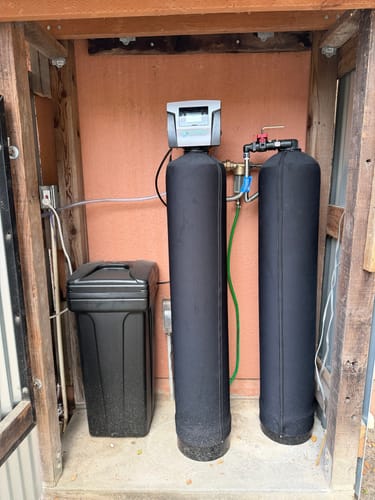
When you scan your iron test report, the first thing you'll notice is a number followed by "mg/L" — milligrams per liter. That number tells us exactly how much iron is dissolved or suspended in your water. Here's the critical threshold: anything above 0.3 mg/L signals a filtration requirement to prevent staining and taste problems.
But the number alone doesn't tell the whole story. We also need to check pH — ideal treatment ranges fall between 6.5 and 8.5 — because low pH accelerates iron problems and undermines filter performance.
Don't overlook manganese either; levels exceeding 0.05 mg/L demand specialized solutions. Reading these numbers together, rather than in isolation, gives us the complete picture we need to choose the right filtration system confidently.
How pH, Manganese, and Hardness Change Your Treatment Plan
Once we recognize our iron level, pH, manganese, and hardness readings, we can stop guessing and start building a treatment plan that actually works.
Each parameter shifts our approach considerably.
| Water Condition | Treatment Adjustment |
|---|---|
| pH below 6.5 | Add pH correction before filtration |
| Manganese above 0.05 mg/L | Use catalytic media or oxidation systems |
| High calcium/magnesium hardness | Combine iron filtration with water softening |
| pH between 6.5–8.5 | Standard iron filtration performs effectively |
When manganese and hardness both appear elevated, basic iron filters won't cut it. We'll need advanced oxidation or catalytic media to handle everything simultaneously. Think of these readings as a recipe—miss one ingredient, and the whole treatment fails.
Which Filtration Technology Fits Your Iron Test Results?
Now that we recognize what our water parameters are telling us, let's put that information to work by matching the right filtration technology to what our test results actually show.
Ferrous iron above 0.3 mg/L demands oxidation-based solutions—air injection systems or catalytic media like Katalox Light convert dissolved iron into filterable particles. If your report flags ferric iron or iron bacteria, backwashing filters and sediment systems physically remove visible particles and stubborn slime.
Dissolved iron above 0.3 mg/L? Oxidation-based filtration transforms it into removable particles before it reaches your tap.
Spotting manganese or low pH alongside iron? A multi-stage approach becomes non-negotiable for complete treatment.
And don't overlook flow rate—mismatching your household's demand against your filter's capacity causes clogging and pressure loss.
Your test results aren't just data points; they're a precise roadmap to building a system that actually solves the problem.
What Your Flow Rate and Daily Usage Tell You About Filter Size
Sizing your iron filter isn't guesswork—it starts with two numbers your test report won't hand you directly: flow rate and daily usage. Get these wrong, and even a perfect filtration match fails under real household demands.
Here's what we need to measure and calculate:
- Flow rate: Time filling a 5-gallon bucket, then convert to GPM—this determines minimum filter capacity
- Daily usage: Multiply household members by 80–100 gallons to establish total treatment demand
- Filter sizing: Match capacity to both GPM and daily volume to maintain pressure and prevent clogging
- Wear prevention: Correctly sized systems handle peak demand without prematurely degrading filter media
These two inputs tell us whether a filter performs consistently or struggles from day one.
Frequently Asked Questions
How Do I Choose the Right Iron Filter?
We'll help you nail this! Check your test report for iron type, concentration, and pH levels—then match those findings to a filter that handles your specific contaminants, flow rate, and household demands perfectly.
What Is a Good Iron Level for Drinking Water?
We'd consider anything under 0.3 mg/L ideal—that's where water tastes clean and clear. Once levels creep above that threshold, you'll notice metallic flavors and staining that signal it's time to filter.
How Do I Read My Water Test Results?
We'll start with iron levels—anything above 0.3 mg/L needs filtering. Check your pH (ideal: 6.5–8.5), manganese (below 0.05 mg/L), and flag any sulfate or hydrogen sulfide for advanced treatment.
What Are the Symptoms of Too Much Iron in Well Water?
We'll know iron's too high when we spot reddish-brown stains, taste metallic bitterness, notice slimy bacterial buildup, detect sulfur odors, or find clogged fixtures reducing water flow throughout our home.






