


![SoftPro™ Chlorine+ Carbon Whole House Water Filter to Remove PFAS, Chlorine, Chloramine & Pesticides [City Water Filters Series]](http://www.softprowatersystems.com/cdn/shop/files/SoftPro_Whole_House_Carbon_Filter_with_Spin_Down_Water_Filter.webp?v=1783547361&width=140)


 855-683-8488


Iron and Manganese Filtration for Well Water: How to Treat Both Contaminants With One System

If your well water is leaving rust stains on your fixtures and dark stains on your laundry, iron and manganese are likely showing up together—and we can treat both with one system. An oxidizing agent converts these dissolved metals into solid particles, which a manganese greensand filter then captures. But getting it right starts with proper water testing. Stick with us and we'll walk you through everything you need to know.
Key Takeaways
- A dual treatment system combining oxidation and filtration can effectively address both iron and manganese contamination in a single streamlined process.
- An oxidizing agent converts dissolved iron and manganese into solid particles, which are then captured by manganese greensand filtration.
- Before purchasing any system, test water for iron concentration, manganese form, pH, TDS, and oxidizing agents to determine proper treatment.
- Maintaining correct pH levels and dissolved oxygen is critical for successful oxidation when treating both contaminants simultaneously.
- Regular backwashing, typically weekly to monthly, prevents clogs and maintains flow rates, ensuring long-term filtration efficiency.
Why Iron and Manganese Show Up Together in Well Water

If you've ever drawn a glass of water from your well and noticed it looks perfectly clear, only to find rust-colored stains in your sink or bathtub later, you're likely dealing with dissolved iron and manganese.
Clear water doesn't mean clean water — dissolved iron and manganese hide until they leave rust stains behind.
These two metals travel together because they share the same origin story: prolonged contact with sedimentary rock deep underground. That's why deeper wells are especially vulnerable.
If you're in northern or western Pennsylvania, particularly near coal mining regions, your geology makes this combination almost inevitable.
Manganese typically appears in lower concentrations than iron, but don't let that fool you — it still stains and degrades your water quality.
Understanding why they co-exist is the first step toward treating them effectively with a single, targeted system.
What to Test Before Choosing an Iron and Manganese Treatment System
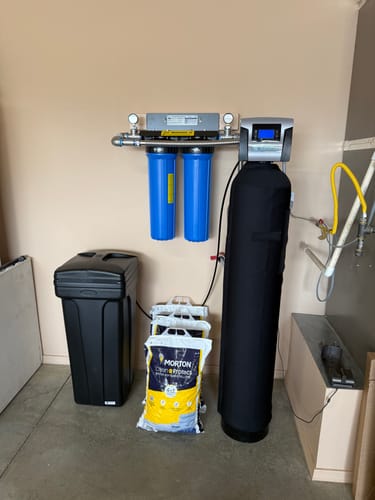
Before you spend a dollar on any filtration system, get your water tested — and not just a basic test. We're talking an extensive panel that reveals iron concentration, manganese form (dissolved vs. solid), pH, TDS, and oxidizing agent levels. Each variable directly determines which system will actually work.
| Parameter | Why It Matters | Ideal Range |
|---|---|---|
| Iron Concentration | Determines filtration capacity needed | Below 0.3 mg/L |
| Manganese Form | Dictates treatment method | Manganous vs. Manganic |
| pH Level | Higher pH required for manganese removal | Above 7.5 |
| TDS | Affects softener efficiency | Below 500 mg/L |
| Oxidizing Agents | Influences pretreatment selection | Varies by system |
Skip this step and you're guessing — and guessing gets expensive fast.
Which Treatment Method Matches Your Iron and Manganese Levels
Once you've got those test results in hand, the real decision-making begins — matching the right treatment method to what's actually in your water.
Below 2 mg/L, polyphosphate additions prevent staining effectively.
Between 3 and 10 mg/L, manganese greensand filters shine — they oxidize and filter simultaneously, handling moderate contamination without overcomplicating your system.
Above 10 mg/L, you'll need chlorine or hydrogen peroxide oxidation paired with filtration to tackle heavier loads.
If dissolved solids are low and pH stays under 8, water softeners can pull out un-precipitated manganese efficiently.
Regardless of which method you choose, consistent maintenance — backwashing filters and monitoring pH balance — keeps everything performing at its best.
Match the method to your numbers, and you'll stay ahead of the problem.
How One Treatment System Removes Iron and Manganese Together
Combining oxidation with filtration into one streamlined system is where things get elegant. We introduce an oxidizing agent—chlorine or potassium permanganate—before the water ever reaches the filter. That agent converts dissolved ferrous iron and manganous manganese into solid particles.
Then manganese greensand filtration captures those particles, handling both dissolved and oxidized forms simultaneously.
The chemistry works beautifully when conditions are right. pH levels and dissolved oxygen aren't afterthoughts—they're the engine driving successful oxidation. Get those wrong, and the whole system underperforms.
Maintenance matters too. Regular backwashing prevents clogs and keeps performance sharp. Neglect it, and efficiency drops fast.
What we're describing is a single, elegant solution targeting moderate iron and manganese concentrations common in well water—precisely engineered, not improvised.
How Often to Backwash and Maintain Your Iron and Manganese Filter
Backwashing frequency isn't one-size-fits-all—it typically ranges from once a week to once a month, depending on how much iron and manganese your water carries and how heavily your household draws from the system.
Regular backwashing flushes accumulated particulates before they clog your media and compromise flow rates.
Watch your pressure gauge closely. A notable drop signals it's time to backwash sooner than scheduled. Don't ignore it—reduced pressure means reduced performance.
Beyond backwashing, check your manufacturer's guidelines for media replacement schedules. Most iron and manganese filtration media lasts six to eight years, but your water chemistry and usage patterns ultimately determine longevity.
Staying proactive with maintenance keeps your system running efficiently and protects your household from contaminant breakthrough before it starts.
Frequently Asked Questions
What Is the Best System for Removing Iron and Manganese From Water?
We recommend combining oxidation with filtration—it's the most effective approach. Using chlorine or potassium permanganate converts dissolved metals into solid particles, making removal straightforward and giving you consistently clean, contaminant-free water.
How to Treat Iron and Manganese in Well Water?
We'll oxidize iron and manganese first, converting them into solid particles, then filter them out. Using chlorine, ozone, or manganese greensand filters lets us tackle both contaminants efficiently in one streamlined treatment system.
Which Is Not an Effective Method for Iron and Manganese Control?
We've found that water softeners, polyphosphate addition, non-oxidizing filtration, and aeration alone aren't effective standalone methods for iron and manganese control—they're incomplete without pairing oxidation with proper post-treatment filtration.
Is It Safe to Drink Water With Iron and Manganese?
We're safe drinking water with iron below 0.3 mg/L and manganese below 0.05 mg/L, but exceeding these EPA limits—especially manganese—risks neurological harm, particularly for infants and young children.






