


![SoftPro™ Chlorine+ Carbon Whole House Water Filter to Remove PFAS, Chlorine, Chloramine & Pesticides [City Water Filters Series]](http://www.softprowatersystems.com/cdn/shop/files/SoftPro_Whole_House_Carbon_Filter_with_Spin_Down_Water_Filter.webp?v=1783547361&width=140)


 855-683-8488


Iron Filter Before Water Softener: Why the Installation Order Determines Your Entire System's Performance

Installing your iron filter before your water softener is critical for protecting your entire system. Iron damages softener resin beads, causing fouling that destroys their ion exchange capability. Levels above 3 ppm create scaling, clogs, and costly repairs. The correct order starts with the iron filter at the water entry point, followed by the pressure tank, then the softener. Get the sequence wrong, and you're setting yourself up for expensive failures. Keep going to discover exactly how to protect your investment.
Key Takeaways
- Installing the iron filter first prevents iron from fouling water softener resin beads, preserving their ion exchange capability.
- Iron levels above 3 ppm cause scaling and clogs in water softeners, increasing maintenance costs significantly.
- Incorrect installation sequencing, like placing the iron filter after the pressure tank, reduces filtration effectiveness.
- Proper sequencing—iron filter, pressure tank, then water softener—ensures optimal backwashing performance and system longevity.
- Correct installation order protects control valves and can save homeowners up to $700 annually in maintenance costs.
How to Test Your Well Water Before Installing an Iron Filter or Softener?

Before investing in any water treatment system, we need to know exactly what we're dealing with in our well water. Start by identifying whether you've got ferrous or ferric iron, since that distinction directly shapes your filtration approach. Any concentration above 0.3 ppm signals you'll need an iron filter.
Don't stop there. Test for hydrogen sulfide too—that rotten egg smell means additional treatment beyond standard iron filtration.
Send your samples to a local water testing lab that measures iron levels, pH, manganese, hardness, and sulfur content together.
Schedule these tests regularly, not just once. Water chemistry shifts, and your system needs to keep pace.
Accurate data prevents costly mistakes, helps you size both your iron filter and softener correctly, and guarantees every dollar you spend actually works.
What Happens When Iron Reaches Your Water Softener First?
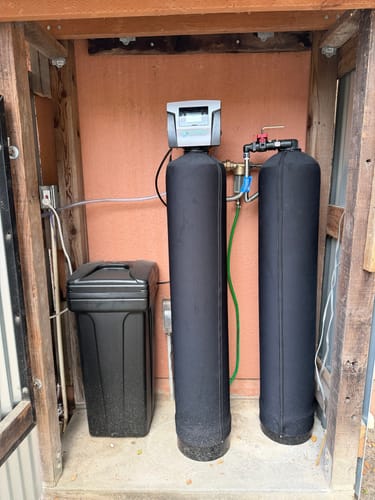
When iron hits your water softener first, it goes straight for the resin beads—and that's where the real damage begins.
Iron hits your water softener first—and the resin beads pay the price immediately.
Iron fouls those beads, stripping them of their ion exchange capability and slashing their lifespan. Once iron levels climb above 3 ppm, scaling and clogs follow fast, driving up maintenance costs considerably.
Here's what that means practically: your softener stops doing its actual job. The ion exchange process breaks down, hardness minerals slip through untreated, and you're left with the same hard water problems you were trying to solve.
Worse, you'll notice metallic tastes and stubborn staining throughout your home.
We always recommend installing an iron filter upstream—it's the only way to protect your softener and keep your entire system performing at its peak.
The Right Installation Order for Iron Filters and Softeners
Getting the installation order right makes all the difference—iron filter first, water softener second. Place the iron filter at your water's entry point, before the pressure tank, to maximize backwashing performance and maintain consistent household pressure.
| Component | Correct Position |
|---|---|
| Iron Filter | First (entry point) |
| Pressure Tank | Second |
| Water Softener | Third |
When iron levels exceed 3 ppm, skipping this sequence lets iron foul your softening resin—destroying performance and inflating maintenance costs. We've seen systems fail prematurely simply because homeowners reversed the order.
Analyzing your water chemistry before installation guarantees you're sizing each system correctly. Follow this sequence, and you'll protect every appliance downstream while extending the lifespan of both systems greatly.
Iron Filter Installation Mistakes That Cost You Later
Even small installation mistakes can quietly sabotage your iron filter's performance for years—and we've seen homeowners pay dearly for them.
The most damaging errors we encounter consistently fall into predictable patterns:
- Wrong sequencing — Placing the iron filter after the pressure tank prevents effective backwashing, leaving iron problems completely unresolved.
- Skipping water chemistry analysis — Without knowing your water's exact composition, you'll likely select an undersized or mismatched system, compounding expenses long-term.
- Poor space and drainage planning — Insufficient drainage access and cramped installation areas make routine backwashing maintenance nearly impossible, accelerating system failure.
We'd also add that underestimating necessary plumbing modifications catches many homeowners off guard financially.
These aren't minor inconveniences—they're compounding mistakes. Getting professional guidance before installation protects both your system's longevity and your wallet.
What Proper Installation Saves You in Repairs and Maintenance Costs
Those installation mistakes aren't just frustrating in the moment—they translate directly into dollars lost over time.
When we install the iron filter correctly before the softener, we protect control valves from damage, preserve system efficiency, and sidestep expensive plumbing repairs down the road.
Proper placement enables effective backwashing, which alone can eliminate up to $700 in annual maintenance costs. We're also protecting appliances and fixtures from iron staining and buildup, removing the need for constant cleaning cycles.
Underestimating plumbing modifications is another hidden expense we can avoid entirely with deliberate setup.
And when we build in adequate maintenance space from the start, routine servicing becomes faster and simpler—reducing long-term complications before they ever develop.
Smart installation isn't a detail; it's a financial decision.
Frequently Asked Questions
Do You Install Iron Filter or Softener First?
We always install the iron filter first. It captures iron particles before they reach your softener's resin, protecting it from damage and ensuring both systems perform at their absolute best long-term.
What Is the Correct Order of Water Treatment?
We recommend installing your iron filter first, then your water softener. This sequence removes harmful iron early, protecting your softener's resin and ensuring both systems perform at their peak efficiency long-term.
Do I Need an Iron Filter if I Have a Water Softener?
If your well water's iron exceeds 3 ppm, you'll need an iron filter alongside your softener. Without it, iron fouls the resin, destroying efficiency and shortening your softener's lifespan dramatically.
What Is the Correct Order of Water Filters?
We always recommend placing your iron filter first, then your water softener. This sequence protects your softener's resin from iron damage, maximizes both systems' efficiency, and guarantees you're getting the cleanest, highest-quality water possible.






