


![SoftPro™ Chlorine+ Carbon Whole House Water Filter to Remove PFAS, Chlorine, Chloramine & Pesticides [City Water Filters Series]](http://www.softprowatersystems.com/cdn/shop/files/SoftPro_Whole_House_Carbon_Filter_with_Spin_Down_Water_Filter.webp?v=1783547361&width=140)


 855-683-8488


Iron Filter Before Water Softener: The Critical Installation Order Rule That Protects Your Resin

Installing an iron filter before your water softener is one of the most critical steps you can take to protect your system. Iron oxidizes on resin beads, forming insoluble compounds that destroy performance within weeks. Even 0.3 mg/L of iron can cause damage, cutting resin life from 15 years down to just three. The correct order is sediment filter first, iron filter second, then softener. Stick around, because we're breaking down exactly how to make this work.
Key Takeaways
- Iron oxidizes on resin beads, forming insoluble compounds that clog them within weeks, even at concentrations as low as 0.3 mg/L.
- Iron-fouled resin lasts only 3 to 5 years, while proper pre-filtration extends its lifespan to 10 to 15 years.
- Always install the sediment filter first, followed by the iron filter, with the water softener positioned last in sequence.
- The iron filter converts ferrous iron into ferric iron before water reaches the softener, preventing resin contamination entirely.
- Set the iron filter to regenerate every three days and schedule both unit cycles at 2 AM for efficiency.
Why Iron Destroys Water Softener Resin (And How Fast It Happens)

When iron sneaks into your water softener, it doesn't just cause minor inefficiencies — it actively destroys the resin beads that make softening possible.
Here's what's happening at the microscopic level: ferrous iron oxidizes into ferric iron upon contact with your resin, forming insoluble compounds that coat and clog the beads within weeks.
Even concentrations as low as 0.3 mg/L can compromise softener performance and spike your maintenance costs. The long-term damage is significant — iron-fouled resin typically fails within 3 to 5 years, compared to the 10 to 15 years you'd get with proper pre-filtration in place.
That's not just a performance issue; it's a recurring replacement cost that compounds over time. The fix starts before water ever reaches your softener.
The Right Order: Sediment Filter, Iron Filter, Water Softener
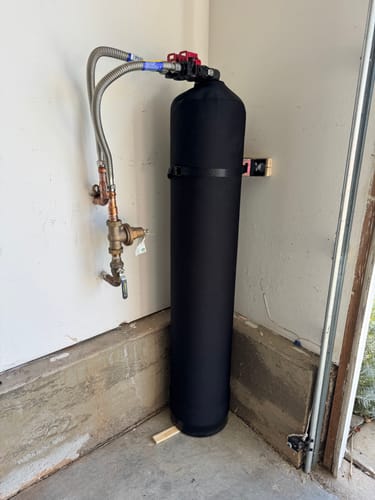
The order you install these three components isn't optional — it's the difference between a system that works and one that fails prematurely.
Installation order isn't a suggestion — it's the line between a system that lasts and one that doesn't.
Here's the sequence that protects everything downstream.
First, install the sediment filter. It captures dirt, sand, and larger particles before they clog or wear out your other components.
Next comes the iron filter, which converts ferrous iron into ferric iron — a form that's far easier to remove and won't wreak havoc on your softener's resin.
Finally, position the water softener last, where it operates cleanly without iron interference.
This sequence isn't arbitrary. It aligns with manufacturer recommendations, maximizes filtration effectiveness, and greatly extends your system's lifespan.
Get the order right once, and everything performs exactly as it should.
How to Connect an Iron Filter Before Your Water Softener
Connecting an iron filter before your water softener takes just a few key steps, and getting them right means your entire system runs efficiently for years. Start with a sediment filter, then the iron filter, then the softener—sequence matters. Use ¾ PEX piping for connections to support effective backwashing, which extends filter life considerably. Always check the flow direction arrows on your filter housing before finalizing any connection.
| Step | Action |
|---|---|
| 1 | Attach sediment filter first |
| 2 | Connect iron filter using ¾ PEX |
| 3 | Link iron filter output to softener |
Getting the flow direction right prevents costly mistakes, so double-check those arrows before you tighten anything down.
How to Test Your Installation Before Programming Anything
Once all the connections are in place, we don't want to jump straight into programming—testing first saves us from setting up a system that's quietly leaking or flowing the wrong way.
Start by inspecting every junction for leaks after full assembly, confirming a watertight seal throughout.
Next, check the arrows on your filter housing. They'll tell us immediately whether water's moving in the right direction—don't skip this step.
Then run a test cycle and watch the system operate live. We're looking for anything unusual before we lock in settings.
While we're at it, confirm the drainage is adequate and the backwash cycle flows freely—poor drainage causes real problems later.
Finally, verify that the resin tank and control valve are secured exactly as the manufacturer specifies.
How to Program Your Iron Filter and Softener to Work Together
With both units installed and tested, we can now tackle the part that actually determines how well this system performs—programming.
Get this right, and both units work as one seamless system:
- Set the iron filter to regenerate every three days, keeping ferrous iron from ever reaching your softener's resin.
- Input your exact hardness values into the softener's control panel—use your test results, not guesswork.
- Schedule both regeneration cycles at 2 AM, minimizing disruption during peak water usage hours.
- Test water quality regularly for hardness and iron levels, adjusting programming as conditions change.
Precise calibration transforms two separate units into one protective system.
Don't skip the water quality testing—it's what keeps your programming accurate long-term.
Frequently Asked Questions
Do You Install Iron Filter or Softener First?
We always install the iron filter first, then the softener. This order converts ferrous iron into ferric iron, protecting your resin beads from fouling and ensuring your entire system performs at peak efficiency.
What Is the Correct Order for Water Treatment?
We recommend installing a sediment filter first, then an iron filter, and finally the water softener. This sequence protects your resin beads, maximizes system efficiency, and extends the lifespan of every component.
Which Filter Goes First, Sediment or Carbon?
We always install the sediment filter first, then carbon. Sediment captures dirt and particles down to 5-10 microns, protecting your carbon filter so it can focus entirely on eliminating chlorine and odors more effectively.
Do I Need an Iron Filter if I Have a Water Softener?
If your water's iron levels exceed 0.3 mg/L, you'll need an iron filter before your softener. Without it, iron binds to your resin beads, destroying your softener's effectiveness and triggering costly repairs.






