


![SoftPro™ Chlorine+ Carbon Whole House Water Filter to Remove PFAS, Chlorine, Chloramine & Pesticides [City Water Filters Series]](http://www.softprowatersystems.com/cdn/shop/files/SoftPro_Whole_House_Carbon_Filter_with_Spin_Down_Water_Filter.webp?v=1783547361&width=140)


 855-683-8488


Iron Filter Bypass Valve Installation: Why You Should Always Include One in Your System Setup

A bypass valve isn't just an add-on for your iron filter — it's your safety net. It lets us isolate the filter for repairs without cutting water to the entire home, protecting filtration media from pressure damage and avoiding costly failures. Skip it, and you're risking repairs that can exceed $5,000. Choose the wrong type or install it incorrectly, and the damage compounds fast. Stick with us, and we'll show you exactly how to get this right.
Key Takeaways
- A bypass valve enables emergency repairs without shutting off water to your entire home, keeping household flow uninterrupted.
- It shields your iron filter from pressure spikes, preventing costly failures that could exceed $5,000 in repairs.
- Choosing the right valve type—turn, button, or lever—ensures efficient isolation and avoids poor water quality issues.
- Correct installation requires identifying inlet and outlet ports and wrapping threads with plumber's tape to prevent leaks.
- Skipping regular quarterly maintenance can cause leaks and water damage potentially reaching $10,000 in corrective costs.
Why Your Iron Filter Needs a Bypass Valve

When we install an iron filter without a bypass valve, we're setting ourselves up for a headache down the road. Imagine needing emergency repairs and having to shut off water to your entire home. That's the reality without a bypass valve.
Here's what a bypass valve actually does for us: it creates an isolation route, letting us pull the filter offline instantly while keeping water flowing throughout the house. No interruptions, no frustrated family members, no chaos.
Beyond emergencies, it gives us real control. We can temporarily divert water around the filter when troubleshooting issues, protecting the filter's lifespan and avoiding premature replacements.
Neglecting this simple component risks water quality degradation costing between $200 and $500. That's an avoidable expense with one smart installation decision.
Turn, Button, or Lever: Which Bypass Valve Fits Your Iron Filter
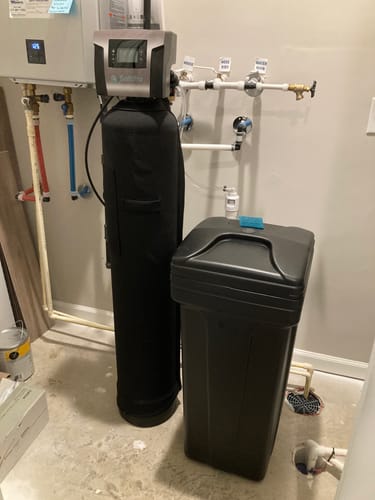
How we choose our bypass valve determines whether maintenance is a five-minute fix or a full-blown ordeal. Each valve type carries trade-offs worth understanding before committing:
- Turn valves are common and effective but demand proper pressure management before adjusting—skip that step, and we're inviting supply disruptions.
- Button valves require pressing a red button to disengage; neglect them long enough, and they'll resist us exactly when we need them most.
- Lever valves deliver the fastest isolation, making troubleshooting genuinely painless for anyone prioritizing efficiency.
Choosing wrong isn't just inconvenient—improper positioning degrades water quality and can cost us $200 to $500 in corrective measures.
Improper valve positioning doesn't just inconvenience us—it degrades water quality and triggers $200 to $500 in corrective costs.
Mastering these distinctions upfront saves us from expensive, avoidable mistakes down the line.
How to Install an Iron Filter Bypass Valve Correctly
Getting bypass valve installation right comes down to five deliberate steps that protect both our water quality and our equipment.
First, shut off the main water supply—no shortcuts here.
Next, identify inlet and outlet ports carefully; the bypass valve's inlet arrow must face the water source.
Third, wrap all threaded connections with plumber's tape, striking the balance between snug and stripped.
Fourth, test the valve immediately by turning it to confirm it isolates the iron filter without killing household water flow.
Finally, schedule quarterly inspections to clear mineral buildup before it hardens into an expensive problem.
Each step compounds the last, creating a system that's genuinely resilient.
Done right, this installation means maintenance never becomes an emergency.
How Bypass Valves Prevent Iron Filter Pressure Damage
Once our bypass valve's installed correctly, it starts doing something just as important as routing water—it's actively shielding our iron filter from pressure damage.
Pressure fluctuations are silent system killers, and without a bypass valve, we're leaving our filtration media exposed to forces that degrade performance and integrity over time.
Pressure fluctuations silently destroy filtration systems—unprotected media degrades faster than you'd ever expect.
Here's what our bypass valve's actually preventing:
- Surge damage – Unexpected pressure spikes get redirected before they strain filter components
- Maintenance risk – Isolating the filter during repairs keeps pressure from building destructively
- Costly failures – Unmanaged pressure events can trigger leaks and repairs exceeding $5,000
Bypass Valve Mistakes That Cause Expensive Iron Filter Damage
Even small bypass valve mistakes can trigger repair bills that dwarf the cost of a proper installation—and we've seen it happen more than once.
Reversing the inlet and outlet connections alone can destroy your iron filtration system, pushing repair costs past $5,000. Skip regular maintenance, and undetected leaks can escalate into $10,000 worth of water damage.
Poor valve positioning compromises filtration quality, costing $200–$500 in damages, while mislabeling or omitting the valve entirely adds $75–$200 per troubleshooting hour.
These aren't edge cases—they're predictable, avoidable outcomes. Every mistake traces back to the same root cause: underestimating how critical the bypass valve is to the entire system.
Get it right from the start, and you protect everything downstream.
Frequently Asked Questions
Why Must a Bypass Valve Be Installed?
We must install a bypass valve because it lets us isolate the iron filter during maintenance without cutting off your home's water supply, saving you time, money, and costly repair headaches down the road.
Do You Need a Bypass Valve to Install a Water Filtration System?
We don't need one, but we'd be foolish to skip it. A bypass valve protects your system during maintenance, saves thousands in potential damage, and keeps your water flowing uninterrupted.
Where Should a Bypass Valve Be Installed?
We recommend installing your bypass valve directly adjacent to your iron filter, after the main shut-off valve but before your water heater—this strategic placement guarantees filtered water reaches all fixtures while allowing effortless isolation during maintenance.
Do You Install Iron Filter or Softener First?
We always install the iron filter first. It removes iron before water reaches the softener, protecting the resin beads from damage and ensuring your softener operates at peak efficiency for years to come.






