


![SoftPro™ Chlorine+ Carbon Whole House Water Filter to Remove PFAS, Chlorine, Chloramine & Pesticides [City Water Filters Series]](http://www.softprowatersystems.com/cdn/shop/files/SoftPro_Whole_House_Carbon_Filter_with_Spin_Down_Water_Filter.webp?v=1783547361&width=140)


 855-683-8488


Iron Filter First Flush Startup Procedure: The Complete Checklist for Your New System

Starting your iron filter off right means following a precise checklist from day one. We'll walk you through confirming proper installation, running your first flush, purging trapped air, and programming your control valve correctly. Skip any step, and you risk poor filtration or lasting damage. Once complete, clear water, stable flow rates, and zero alarms confirm success. Stick with us, and we'll show you exactly how to make it happen.
Key Takeaways
- Gradually restore water pressure after installation to prevent air entrapment and stress on connections before initiating the first backwash cycle.
- Trigger a manual backwash cycle immediately after installation to flush out debris and properly redistribute the filter media.
- Run water freely for 10–15 minutes post-backwash, then document baseline iron levels, clarity, and odor for future reference.
- Program the control valve per the owner's manual, setting backwash frequency to every 2–4 weeks and duration to 10–30 minutes.
- Confirm first flush success by checking for clear water, pH above 6.8, and a minimum flow rate of 5.3 GPM.
Confirm Your Iron Filter Is Installed Correctly Before the First Flush

Before we immerse ourselves in the first flush, let's make sure your iron filter is set up correctly — catching installation mistakes now saves you from bigger headaches down the road.
Start by confirming your filter tank sits on a dry, level surface, protected from freezing temperatures, and accessible for future maintenance.
Next, verify the control valve's inlet and outlet connections align with the directional arrows — reversed flow kills performance immediately.
Reversed inlet and outlet connections silently sabotage your filter's performance — always follow the directional arrows before running your first cycle.
Check that your bypass valve system is properly installed, allowing maintenance without shutting down your entire water supply.
Inside the tank, confirm the distributor tube is center-sealed, with a gravel layer placed over the birm for maximum filtration efficiency.
Get these fundamentals right, and your system's ready for its inaugural backwash cycle.
Run the Iron Filter First Flush Step by Step
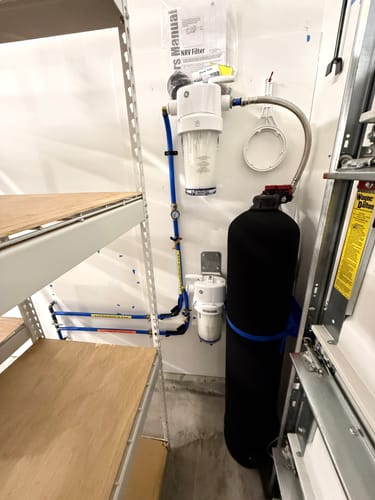
With our installation confirmed and connections tight, it's time to bring the system to life. Start by slowly restoring water pressure—rushing this step traps air and stresses your connections. Watch every joint carefully as pressure builds.
Once pressure stabilizes, trigger a manual backwash cycle following your manufacturer's guidelines. This clears installation debris from the filter media before it reaches your taps. Think of it as resetting the battlefield before your iron filter starts winning.
After backwashing completes, let the system run freely for 10-15 minutes. This final flush purges residual particulates that backwashing loosened but didn't fully evacuate.
Now test your water quality. Document what you observe—iron levels, clarity, odor. These baseline numbers become your benchmark for confirming the system's performing exactly as designed.
Purge Air Pockets and Debris During the Iron Filter Startup
Air pockets are the silent saboteurs of any new water treatment system, and we're not done until every last one's been chased out.
Air pockets don't announce themselves—they just quietly wreck your system until you hunt them down and flush them out.
Run water through the system for several minutes until you see a steady, uninterrupted stream. Then tackle debris head-on:
- Watch the flow transform from sputtering chaos to a clean, consistent current
- Lift the filter's top and visually inspect the resin for foreign materials or clogs
- Manually backwash the filter, watching debris dislodge and media redistribute evenly
- Check every connection while water flows, confirming there are zero leaks
- Monitor water color and taste post-flush, catching any residual particles before they become your problem
A clean startup means cleaner water faster—and that's exactly what we're building toward.
Program Your Iron Filter Control Valve Before the First Backwash
Now that we've chased out the air and debris, it's time to program the control valve—because without the right settings, even a clean system won't do its job. Consult your owner's manual and confirm the directional flow matches your inlet and outlet positions before touching anything else.
Use this reference to dial in your settings:
| Setting | Recommended Range |
|---|---|
| Backwash Frequency | Every 2–4 weeks |
| Backwash Duration | 10–30 minutes |
| Contaminants Targeted | Iron and sulfur |
| Adjustment Basis | Water quality and sediment levels |
Match these parameters to your actual water conditions—not generic defaults. A system programmed precisely from day one removes contaminants efficiently and extends media life, saving you costly corrections later.
How to Confirm the Iron Filter First Flush Completed Successfully
How do people understand the first flush actually worked? We look for five unmistakable signs that tell the complete story.
- Water runs clear — no orange, brown, or sulfur-tinted discharge means iron and sulfur filtering has begun correctly.
- pH reads above 6.8 — ideal chemistry confirms your filtration conditions are dialed in.
- Flow rate hits minimum thresholds — 5.3 GPM for FOB filters, higher for FO systems means everything's moving properly.
- Zero indicator lights or alarms — a silent control valve means the system accepted the flush without complaint.
- Drain line flows uninterrupted — steady discharge with zero backflow confirms your setup is mechanically sound.
When all five check out, we're confident the system's ready for real work.
Frequently Asked Questions
How to Backflush an Iron Filter?
To backflush your iron filter, we'll program the control valve for backwash frequency, keep the system in bypass mode first, then run a manual backwash cycle using roughly 40-45 gallons to flush contaminants completely out.
Do You Install Iron Filter or Softener First?
We install the iron filter first, then the softener. This sequence protects the resin beads from iron fouling, preserving the softener's efficiency and extending its lifespan considerably.
What Is the Correct Order for Water Treatment?
We recommend flowing water from your well to the pressure tank first, then through the iron filter, and finally into the softener—this sequence guarantees each stage maximizes the next's effectiveness.
How Often Should an Iron Filter Regenerate?
We recommend regenerating your iron filter every 2 to 4 weeks, but that's not set in stone. Monitor your water quality, track your usage patterns, and adjust accordingly—your system's performance will tell you exactly what it needs.






