


![SoftPro™ Chlorine+ Carbon Whole House Water Filter to Remove PFAS, Chlorine, Chloramine & Pesticides [City Water Filters Series]](http://www.softprowatersystems.com/cdn/shop/files/SoftPro_Whole_House_Carbon_Filter_with_Spin_Down_Water_Filter.webp?v=1783547361&width=140)


 855-683-8488


Iron Filter Plumbing Requirements and Pipe Size: The Complete Material and Connection Guide

For an iron filter, we recommend using ¾-inch pipe for inlet and outlet connections, with ½-inch flexible plastic piping for the drain line kept under 20 feet. Stick with PVC, CPVC, or PEX — they handle pressure and resist corrosion. Always follow the control valve's flow direction arrows and use Teflon tape on every threaded connection. Get these details right, and your system runs efficiently for years. There's plenty more to uncover about each critical step ahead.
Key Takeaways
- Use ¾-inch minimum diameter pipes for inlet and outlet connections, matching the filter's 1-inch specification to maintain adequate flow.
- PVC, CPVC, and PEX are ideal pipe materials, offering corrosion resistance and durability; avoid galvanized steel as it worsens iron problems.
- The drain line should use ½-inch inner diameter plastic pipe, kept under 20 feet to prevent flow reduction.
- Apply Teflon tape on all threaded connections and follow the control valve's inlet and outlet arrows for correct flow direction.
- Install the drain line with an air gap, positioning the discharge end at least 2 inches above the fixture's highest point.
What Pipe Size Does an Iron Filter Drain Line Need?

When it comes to iron filter drain lines, size matters — and here's what you need to know. We recommend using flexible 1/2-inch inner diameter plastic pipe — it's the sweet spot for maintaining proper drainage during backwashing cycles.
But pipe size alone won't protect your system. You'll also need to keep the drain line under 20 feet total length. Beyond that threshold, you risk reduced flow and potential clogs during backwash — two problems that compound quickly.
Keep your drain line under 20 feet — beyond that, reduced flow and clogs during backwash compound fast.
Here's what most installers overlook: the air gap requirement. Building in a minimum air gap prevents back-siphoning, which could contaminate your entire water supply.
Pair that with secured fittings and correct flow direction — always moving water away from the filter — and you've got a bulletproof drainage setup.
Which Pipe Materials Hold Up Against Iron and Pressure
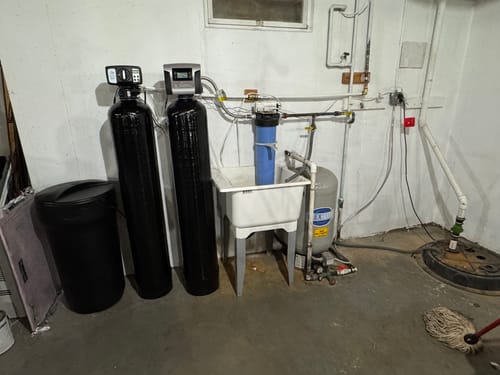
Four pipe materials dominate iron filtration installs — and each one handles iron and pressure differently.
PVC and CPVC handle pressures up to 150 psi and resist corrosion, making them workhorses for most iron filtration setups.
PEX offers flexibility and withstands temperatures up to 200°F, so iron deposits won't crack or compromise it over time.
Copper delivers durability and corrosion resistance, but here's the catch — acidic iron-laden water can corrode it, so you'll want to test your water chemistry first.
Galvanized steel seems like a solid option until rust sets in, actually worsening your iron problem rather than solving it.
Whatever material you choose, we recommend sizing connections at a minimum ¾-inch diameter to maintain flow and prevent pressure loss.
How to Connect Inlet and Outlet Lines the Right Way
Choosing the right pipe material gets you halfway there — connecting your inlet and outlet lines correctly seals the deal. Follow the control valve's inlet and outlet arrows precisely, match your pipe to the filter's 1-inch specification, and wrap every threaded connection with Teflon tape.
| Connection Detail | Requirement |
|---|---|
| Inlet arrow direction | Points toward filter |
| Outlet arrow direction | Points away from filter |
| Standard pipe diameter | 1-inch |
| Backwash drain distance | Maximum 20 feet |
| Thread sealing method | Teflon tape |
We also recommend installing a dedicated backwash drainage line with an air gap — this prevents back-siphoning and protects your whole system. Inspect every inlet and outlet connection regularly to catch leaks before they compromise performance.
How to Install the Drain Line With a Proper Air Gap
Getting the drain line right is one of those steps that protects everything downstream. We recommend three installation priorities that make all the difference:
- Keep the drain line within 20 feet of the filtration system using flexible 1/2" i.d. plastic piping for clean routing.
- Create a proper air gap by positioning the discharge end at least 2 inches above the floor or fixture's highest point, eliminating back-siphonage risk.
- Secure every connection with appropriate fittings to prevent leakage during backwashing cycles.
Once installed, we can't ignore maintenance. Regularly inspect both the drain line and air gap for obstructions that might compromise regeneration cycles.
A clear drain line means your iron filter performs exactly as it's designed to.
Bypass Valve Direction and Electrical Outlet Placement
With the drain line sorted, let's turn our attention to two details that directly affect how well your iron filter operates: bypass valve direction and electrical outlet placement.
Install the bypass valve with inlet arrows facing the filter and outlet arrows pointing away. Lubricate O-rings before connecting, and avoid over-tightening screws.
| Component | Requirement | Why It Matters |
|---|---|---|
| Bypass inlet arrow | Points toward filter | Guarantees correct flow direction |
| Bypass outlet arrow | Points away from filter | Prevents reverse flow damage |
| O-rings | Lubricated before install | Creates leak-free seals |
| Electrical outlet | Grounded 110V, within 10 feet | Meets safety standards |
| Outlet switch control | Must be switch-free | Prevents accidental shutoff |
Keep your outlet unswitched and within reach — operational continuity depends on it.
Frequently Asked Questions
What Size Pipe for Water Filter?
We recommend using 3/4-inch pipe for most residential water filter installations. It's the sweet spot for maintaining ideal flow rates and pressure. Always verify your filter manufacturer's specs to guarantee you're maximizing system performance.
How Do You Size an Iron Filter?
To size an iron filter, we'll assess your home's water demand in GPM, match it to your well's flow rate, and factor in iron concentration to select the right tank and control valve configuration.
What Are Common Problems With Iron Filters?
Common iron filter problems we'll want to watch for include clogged cartridges reducing pressure, reddish-brown water signaling media exhaustion, undersized systems failing iron removal, backwashing inefficiencies, and iron bacteria growth compromising water quality without regular maintenance logging.
How to Install a Whole House Iron Filter?
We'll walk you through it: shut off your main water valve, secure a grounded 110V outlet nearby, layer polyfill in a 5-gallon bucket housing, apply Teflon tape to all connections, and install a backwash drainage line with an air gap.






