


![SoftPro™ Chlorine+ Carbon Whole House Water Filter to Remove PFAS, Chlorine, Chloramine & Pesticides [City Water Filters Series]](http://www.softprowatersystems.com/cdn/shop/files/SoftPro_Whole_House_Carbon_Filter_with_Spin_Down_Water_Filter.webp?v=1783547361&width=140)


 855-683-8488


Iron Filter Plumbing Requirements and Pipe Size: What Every DIY Installer Must Know Before Starting

When installing an iron filter, we recommend using at least 3/4-inch pipe, though 1-inch piping works better for larger homes. Always install the filter at your main water entry point and keep temperatures between 34°F and 120°F. You'll need a bypass valve, a 1/2-inch drain line with an air gap, and Teflon tape on every threaded connection. Stick around, because what's ahead could save you from costly mistakes before you even turn the water back on.
Key Takeaways
- The minimum pipe size for iron filters is 3/4 inch, but 1-inch piping is recommended for larger households to improve flow rates.
- Install the iron filter at the main water entry point to protect the entire home's plumbing system effectively.
- Apply Teflon tape to all threaded connections and ensure the bypass valve's directional arrows align with water flow direction.
- Avoid excessive elbows and mismatched pipe diameters, as these create turbulence, pressure drops, and restricted water flow.
- Check local plumbing codes before installation, as permits, air gap requirements, and distance rules may apply in your jurisdiction.
Minimum Pipe Size Requirements for Iron Filter Systems

When it comes to iron filter systems, pipe size matters more than most people realize. We've seen countless DIY installations fail simply because the wrong pipe diameter was chosen from the start. The minimum you'll want is 3/4 inch — it maintains adequate flow while keeping pressure drops manageable.
But here's where it gets interesting: if you're in a larger household with higher demand, step up to 1-inch piping. That extra quarter-inch dramatically improves flow rates and reduces clogging risk over time.
Before you commit to anything, pull out your manufacturer's specifications. Every system has unique requirements, and matching your pipe size to those recommendations guarantees you're getting the filtration performance you're actually paying for.
Don't guess — verify.
Where to Install an Iron Filter on Your Main Line
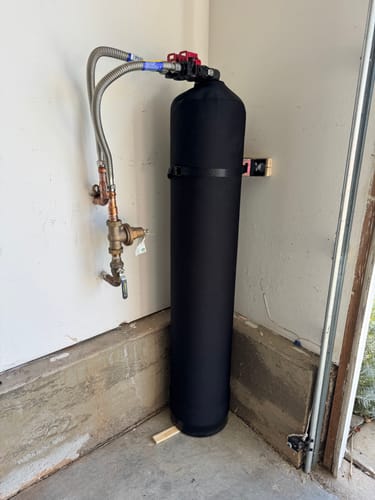
Placement is everything with an iron filter — get it wrong, and you're only protecting part of your home. Install yours at the main water entry point so every drop passing through your plumbing gets treated before reaching any fixture or appliance.
Beyond entry-point positioning, think practically. You'll need at least 2 feet of clearance around the unit for maintenance access, a hard level surface beneath it, and temperatures staying between 34°F and 120°F year-round.
Good placement means nothing without the right conditions: clearance, a level surface, and stable temperatures year-round.
Here's one detail most DIYers miss: keep at least 8 feet of pipe between the filter outlet and your water heater inlet.
Can't achieve that distance? Install a check valve and consider adding an expansion tank. Always verify your setup against local plumbing codes before committing.
Bypass Valves, Drain Lines, and Fittings for Iron Filters
Before the filter even touches your plumbing, you'll need three supporting components working together: a bypass valve, a drain line, and properly sealed fittings. The bypass valve lets you redirect water around the filter during servicing—no shutdowns, no interruptions.
When installing it, match the directional arrows to your existing flow direction; getting this wrong reverses everything.
For drain lines, we recommend flexible 1/2-inch inner diameter plastic pipe—it handles backwash discharge efficiently and resists blockages. Always install with an air gap to prevent back-siphon from contaminating your supply line.
That one detail protects your entire water system.
Finally, wrap every threaded connection—bypass valve and fittings alike—with Teflon tape. It's a small step that eliminates leaks before they start.
Pipe and Connection Mistakes That Kill Iron Filter Pressure
Even small plumbing mistakes can quietly strangle your iron filter's pressure, and most of them are completely avoidable.
Let's walk through what we see trip up DIYers most often.
First, mismatched pipe diameters restrict flow before water ever reaches your filter. Always confirm your pipe sizes match the filter's inlet and outlet specs exactly.
Second, excessive elbows and bends create turbulence and pressure drops that compound over distance—keep your routing as straight as possible.
Third, loose connections leak pressure and invite contamination, so apply Teflon tape or pipe dope to every joint.
Don't overlook bypass valve orientation either—directional arrows exist for a reason, and reversed installation misdirects water entirely.
Finally, inspect regularly for iron and sediment buildup, because clogged pipes silently erode your system's performance over time.
Local Plumbing Codes for DIY Iron Filter Installation
One thing that catches many DIYers off guard is how seriously local authorities treat iron filter installations—and ignoring that reality can cost you far more than the filter itself. Before touching a single pipe, check with your local building department about permits.
Local authorities take iron filter installations seriously—and ignoring permits can cost you far more than the filter itself.
Most jurisdictions follow either the Uniform Plumbing Code or International Plumbing Code, which govern acceptable materials and installation methods.
You'll also want to verify distance requirements—many codes mandate at least 8 feet between your filter outlet and appliances like water heaters.
Don't overlook backwash drainage, either. Many codes require an air gap on your drain line to prevent siphoning.
Skip these steps, and you're risking penalties, voided insurance, and compromised water safety—none of which are worth the shortcut.
Frequently Asked Questions
What Size Iron Filter Do I Need?
We'll need to match your filter size to your flow rate and iron levels. For most homes, a 1–1.5 cubic foot system handles moderate iron up to 30 ppm at 7–10 gallons per minute.
How Much to Install an Iron Filter?
We're looking at $800–$2,500 for professional installation, but if you've got the skills, DIY drops that to $200–$700. Don't forget annual maintenance runs $100–$300, and plumbing modifications can add 15–25% more.
How Many GPM Do I Need for a Whole House Filter?
We recommend aiming for 10-15 GPM for most homes, but if you've got multiple bathrooms and heavy appliance use, size up to 25-30 GPM—and always exceed your peak demand by at least 20%.
Can I Install a Water Filtration System Myself?
Yes, you can install a water filtration system yourself if you're comfortable with basic plumbing tasks. We recommend gathering the right tools, understanding local codes, and following manufacturer guidelines carefully to guarantee a safe, effective installation.






