


![SoftPro™ Chlorine+ Carbon Whole House Water Filter to Remove PFAS, Chlorine, Chloramine & Pesticides [City Water Filters Series]](http://www.softprowatersystems.com/cdn/shop/files/SoftPro_Whole_House_Carbon_Filter_with_Spin_Down_Water_Filter.webp?v=1783547361&width=140)


 855-683-8488


Iron Filter Pressure Drop Calculation: The Key Numbers Every Homeowner Needs to Understand

When your iron filter causes a pressure drop above 0.5 bar (about 7.25 PSI), something's wrong — either your filter's clogged or your system's simply too small for your home's demands. We're talking weak showers, struggling appliances, and rusty fixture stains that keep coming back. Your filter media type, peak flow rate, and household iron load all feed into this calculation. Stick with us, and the numbers will start making a lot more sense.
Key Takeaways
- A pressure drop exceeding 0.5 bar (7.25 PSI) signals a clogged filter or undersized system requiring immediate attention.
- Maintain minimum operational pressure of 30–40 PSI to ensure your iron filter performs effective contaminant removal.
- Peak household water demand typically ranges from 8 to 20 GPM; your filter must handle this without significant pressure loss.
- Catalytic media and birm outperform greensand by handling higher flow rates and reducing pressure-related maintenance issues.
- Monitor pressure gauges regularly, as gradual pressure decline indicates developing clogs before complete flow restriction occurs.
What Is Iron Filter Pressure Drop and Why Does It Matter?

When water passes through an iron filter, it loses some of its pressure — and that loss is what we call pressure drop.
It's a natural consequence of forcing water through filter media, but the numbers matter enormously.
Forcing water through filter media will always cost you pressure — the question is how much you can afford to lose.
Here's why you should care: if your pressure drop exceeds 0.5 bar (roughly 7.25 PSI), your system's likely clogged or undersized. That translates directly into weak showers, sluggish appliances, and frustrated household members.
We also want you to watch your gauges consistently. Gradual pressure decline isn't random — it's your system communicating that maintenance is overdue.
Ignore it long enough, and you'll face complete flow restriction.
Understanding pressure drop isn't just technical knowledge; it's the difference between a system that performs and one that fails.
What the 0.5 Bar Pressure Drop Actually Tells You
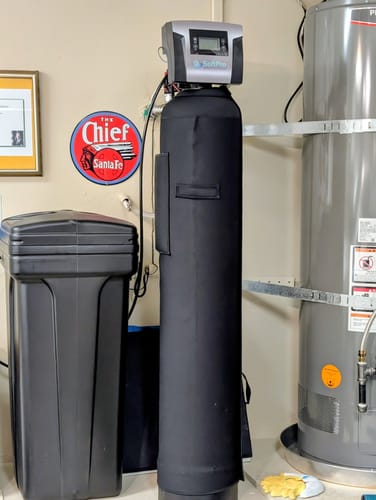
That 0.5 bar threshold isn't arbitrary — it's a diagnostic signal worth understanding.
When your system crosses that line, it's telling you one of two things: your filter's clogged, or it's simply undersized for your household's peak demand.
Both scenarios matter differently. A clogged filter signals maintenance urgency — catch it early through regular gauge monitoring, and you'll avoid complete flow restriction. An undersized system, however, means you're fighting a structural problem that backwashing won't fix.
Here's what makes this number powerful: it connects directly to operational pressure.
We need 30–40 PSI minimum for peak filtration performance. Once pressure drops erode that baseline, filtration efficiency suffers alongside water pressure.
That 0.5 bar reading isn't a warning — it's a diagnosis waiting for your interpretation.
How Iron Filter Media Type Affects Your Pressure Drop
Catalytic media and birm consistently outperform greensand in two critical ways: they handle higher flow rates and demand less frequent maintenance.
Greensand, by contrast, requires longer backwash cycles, which temporarily throttle your flow and compound pressure issues over time.
Greensand's longer backwash cycles don't just slow your flow — they quietly stack pressure problems over time.
Here's what this means practically — your media choice isn't just a filtration decision, it's a hydraulic one.
Lower flow rates improve contact time between water and media, boosting contaminant removal efficiency.
But pair the wrong media with the wrong flow rate, and you're accelerating pressure drop problems before they're even measurable.
Monitor both variables together, not separately.
Warning Signs Your Iron Filter Is Clogged or Undersized
Pressure drop numbers tell part of the story, but your home tells the rest. Watch for these red flags: pressure drops exceeding 0.5 bar signal serious flow restrictions.
During peak usage, noticeably diminished pressure throughout the house suggests your filter's undersized or overwhelmed.
Check your fixtures and laundry too. Increasing rust stains mean iron's slipping through—your filter's losing the battle. A metallic taste in drinking water confirms that iron's bypassing the system entirely.
Finally, track your maintenance costs. Frequent regeneration cycles and rising operational expenses indicate an overloaded system that's working harder than it should.
These warning signs compound quietly, costing you money and water quality simultaneously. Catching them early means avoiding expensive repairs and protecting your household's water supply long-term.
Matching Your Iron Filter Size to Peak Household Demand
Sizing your iron filter correctly starts with understanding peak household demand, which typically falls between 8 and 20 GPM depending on how many fixtures run simultaneously.
If your filter can't keep pace, you'll see pressure drop exceed 0.5 bar and flow rates dip below 20 liters per minute—both red flags we covered previously.
To match your filter properly, calculate your total iron load alongside simultaneous usage scenarios.
Think morning rush hours when showers, dishwashers, and laundry compete for flow. An undersized filter won't just underperform—it'll degrade faster under constant strain.
We strongly recommend consulting a water treatment professional who can analyze your actual usage patterns and contaminant levels.
That tailored approach eliminates guesswork and guarantees your system delivers consistent, clean water when demand peaks.
Frequently Asked Questions
What Is Filter Pressure Drop?
Filter pressure drop's the reduction in water pressure as it moves through your filtration system. We're watching for drops exceeding 0.5 bar—that's your first warning sign of clogging or an undersized system.
How to Size an Iron Filter?
We'll size your iron filter by matching peak flow rate (8-20 GPM), measuring actual iron concentration, and maintaining 30-40 PSI operational pressure—ensuring your system handles maximum demand without compromising filtration efficiency.
What Is the Pressure Drop on a H14 HEPA Filter?
We've found that H14 HEPA filter pressure drops typically range from 100 to 250 Pascals at standard airflow rates. Understanding this range helps you optimize your system's performance while preventing fan overload and unnecessary energy costs.
How Do You Calculate Pressure Drop in a Filter and Strainer?
We calculate pressure drop using ΔP = K × Q², where K is your filter's specific constant and Q is flow rate. Always factor in your liquid's specific gravity for accuracy—it'll greatly shift your results!






