


![SoftPro™ Chlorine+ Carbon Whole House Water Filter to Remove PFAS, Chlorine, Chloramine & Pesticides [City Water Filters Series]](http://www.softprowatersystems.com/cdn/shop/files/SoftPro_Whole_House_Carbon_Filter_with_Spin_Down_Water_Filter.webp?v=1783547361&width=140)


 855-683-8488


Iron Filter Rotten Egg Smell Removal Capacity: What PPM Levels of Hydrogen Sulfide Can Be Treated?

Most iron filters can handle hydrogen sulfide up to around 10 ppm, which covers the majority of homes dealing with that dreaded rotten egg smell. Standard air injection systems work well under 8 ppm, while manganese greensand filters push that limit to 10 ppm. Beyond that, you'll need more aggressive solutions like chemical oxidation or specialized systems rated for up to 30 ppm. Stick with us and we'll walk you through exactly what works at every level.
Key Takeaways
- Standard iron filters typically treat hydrogen sulfide concentrations up to 10 ppm, effectively eliminating the rotten egg smell in most residential cases.
- Iron filters begin struggling when hydrogen sulfide levels exceed 2–5 ppm, potentially causing yellow particles and returning odors.
- The Fleck SXT AIO handles up to 30 ppm through aggressive oxidation, making it ideal for severe hydrogen sulfide contamination.
- SpringWell WS filters provide chemical-free air injection treatment for H2S levels under 8 ppm reliably.
- Continuous chlorination is recommended for extreme cases, effectively treating hydrogen sulfide concentrations ranging from 6 to 75 ppm.
What PPM of Hydrogen Sulfide Can an Iron Filter Actually Remove?

How much hydrogen sulfide can an iron filter actually handle? Generally, we're looking at concentrations up to 10 ppm, though specific system design and filtration media greatly influence that ceiling. If your water tests below that threshold, a standard iron filter likely solves your rotten egg problem effectively.
Most iron filters handle hydrogen sulfide up to 10 ppm—enough to eliminate that notorious rotten egg smell effectively.
But here's where it gets interesting. Not all filtration approaches perform equally. Granular activated carbon handles hydrogen sulfide only below 0.3 ppm—strictly for odor and taste reduction.
Manganese greensand filters push further by oxidizing hydrogen sulfide into solid sulfur particles, simultaneously addressing iron and manganese.
Need even greater capacity? The Fleck SXT AIO system treats levels up to 30 ppm through combined aeration and filtration. Knowing your exact ppm guides you toward the right solution.
How Iron Filters Convert Hydrogen Sulfide Into Filterable Sulfur
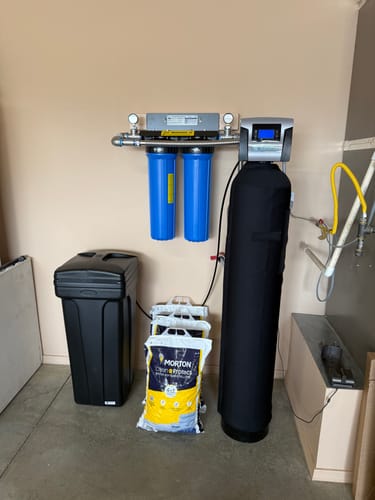
Now that we recognize what concentration levels iron filters can tackle, let's look at what's actually happening inside the system when it neutralizes that rotten egg smell.
When hydrogen sulfide enters the filter, it meets either air or a chemical oxidant like chlorine. That exposure triggers oxidation, chemically transforming dissolved H2S gas into solid sulfur particles.
Once it's a solid, the filter can physically capture and remove it from your water supply. Higher-capacity systems use catalytic media to accelerate this conversion, making the process more efficient at elevated concentrations.
What makes this elegant is the chemistry itself — we're not masking the problem, we're fundamentally changing hydrogen sulfide's molecular state, turning an invisible, odorous gas into something tangible that filtration can permanently eliminate.
When Your H2S Level Exceeds What an Iron Filter Can Handle
Even the best iron filter has its limits, and when H2S concentrations climb past 2-5 ppm, you'll start noticing the system can't keep up.
Every iron filter has a breaking point — once H2S levels surpass 2-5 ppm, even the best systems start to fail.
That rotten egg smell sneaks back through, and the water quality deteriorates fast.
Here's what exceeding capacity looks like in real life:
- The smell returns — sulfur odor persists even after filtration
- Yellow particles appear — visible sulfur deposits cloud your water
- Fixtures stain — yellow residue builds on sinks and tubs
- Laundry suffers — fabrics develop discoloration from sulfur exposure
For concentrations between 6-75 ppm, you'll need chemical oxidation or specialized treatment systems.
That's why regular water testing matters — catching rising H2S levels before they overwhelm your existing filter saves you from costly damage downstream.
Which Iron Filter Technology Works Best at High H2S Concentrations?
When H2S concentrations push past what standard iron filters can handle, the right technology makes all the difference. We've found that matching your H2S level to the correct system prevents costly mistakes.
| Technology | H2S Treatment Range |
|---|---|
| Fleck SXT AIO | Up to 30 ppm |
| Manganese Greensand | Up to 10 ppm |
| Continuous Chlorination | 6–75 ppm |
For high concentrations, continuous chlorination dominates—treating up to 75 ppm at pH 6.0–8.0. The Fleck SXT AIO handles mid-range levels while simultaneously tackling iron, making it a versatile workhorse. Manganese greensand suits moderate cases, oxidizing sulfide into filterable solid particles. Understanding your exact ppm reading lets you choose confidently rather than guessing, protecting both your water quality and your wallet long-term.
Which Iron Filter Matches Your Exact H2S Level?
Matching your filter to your exact H2S level is how you avoid buying too little—or overspending on too much.
We've seen homeowners waste money both ways. Here's how to match correctly:
- Under 8 ppm: The SpringWell WS handles this range with air injection—clean, chemical-free, and reliable.
- Up to 10 ppm: Manganese greensand filters perform excellently here, especially when your pH sits between 7.5–8.3.
- Up to 30 ppm: The Fleck SXT AIO steps in where standard filters surrender, oxidizing aggressively at higher concentrations.
- Beyond 10 ppm without ideal pH: Chemical oxidation becomes necessary—standard iron filters simply can't finish the job.
Know your number first. Then let that number choose your filter.
Frequently Asked Questions
Does an Iron Filter Remove Sulfur Smell?
Yes, we can remove that rotten egg smell with an iron filter! It oxidizes hydrogen sulfide, converting it into filterable particles, effectively treating concentrations up to 5.0 ppm for fresher, cleaner water throughout your home.
What Is the Safe Ppm for Hydrogen Sulfide?
We'd consider levels below 0.3 ppm less problematic for taste and odor. While the EPA hasn't set an official safe limit, staying under 0.5 ppm helps you avoid that notorious rotten egg smell.
At What Ppm Does H2S Gas Cause Death?
H2S gas can cause death at concentrations above 700 ppm, where you'll lose consciousness and experience respiratory failure within moments of exposure. That's why we can't stress enough how critical early detection truly is.
At What Ppm Does the H2S Alarm Go Off?
Most water quality monitoring systems we're familiar with will trigger an H2S alarm at 5 ppm, signaling it's time for immediate action or treatment to protect your water quality and plumbing.






