


![SoftPro™ Chlorine+ Carbon Whole House Water Filter to Remove PFAS, Chlorine, Chloramine & Pesticides [City Water Filters Series]](http://www.softprowatersystems.com/cdn/shop/files/SoftPro_Whole_House_Carbon_Filter_with_Spin_Down_Water_Filter.webp?v=1783547361&width=140)


 855-683-8488


Iron Filter Savings Calculator: The Numbers That Justify Every Penny

An iron filter savings calculator helps you see exactly where your money goes—and where it stops leaking away. Between annual maintenance averaging $40–$600, rust damage to appliances costing $800–$1,500 to replace, and plumbing repairs hitting $100–$500 per incident, the numbers add up fast. Premium systems pay themselves back within months while lasting 10–20 years. Stick with us, and we'll break down every figure that makes this investment impossible to ignore.
Key Takeaways
- An iron filter savings calculator uses water iron concentration, pH levels, and daily usage to estimate long-term financial benefits accurately.
- Iron damage costs homeowners over $1,000 annually through plumbing repairs, rust cleaners, and premature appliance replacements.
- Premium iron filter systems starting at $2,495 last 10–20 years, distributing maintenance costs over decades for better ROI.
- Eliminating bottled water alone generates immediate savings, often achieving positive ROI within months of installation.
- Annual maintenance for iron filters averages $40–$100, far less than recurring repair cycles from untreated iron-damaged systems.
What Iron Filter Replacement Actually Costs You Each Year

When it comes to iron filter maintenance, the costs can sneak up on you faster than you'd expect. Let's break down what you're actually spending annually.
Cartridge filters alone run $40 to $100 per year. Add greensand or catalytic carbon media replacement—averaging $33 to $67 annually when spread across its 2-to-3-year cycle—and costs climb steadily.
AIO systems demand $150 to $300 in yearly maintenance checks, and hidden media replacement costs can stack another $200 to $600 on top.
That's potentially $600+ annually before you factor in emergency repairs.
Here's the upside: regular inspections actively reduce those emergency costs, extending your system's lifespan considerably. Understanding these numbers isn't discouraging—it's empowering.
Smart budgeting now prevents the financial surprises that catch unprepared homeowners completely off guard.
How Much Iron Damage Costs Your Appliances, Fixtures, and Pipes
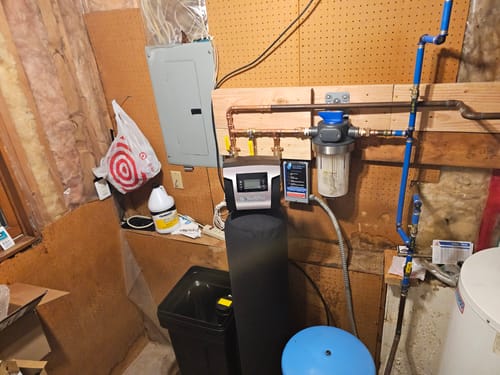
Iron doesn't just stain your sink—it quietly drains your wallet through appliance damage, fixture wear, and plumbing repairs.
Let's break down exactly where your money disappears:
- Plumbing repairs: Corrosion and blockages cost $100–$500 per incident.
- Specialty rust cleaners: Stained fixtures demand $50–$100 annually in maintenance products.
- Appliance replacement: Water heaters and dishwashers fail prematurely, costing $800–$1,500 to replace.
- Fixture lifespan reduction: High iron levels accelerate wear by 20–50%, compounding replacement frequency.
These aren't hypothetical losses—they're predictable expenses that compound silently over years.
We're talking about a potential $1,000+ savings window that an iron filter closes permanently.
Understanding these numbers transforms the filter from an expense into a calculated, high-return investment.
How to Use an Iron Filter Savings Calculator
Using an iron filter savings calculator is simpler than it sounds—we just need a few key inputs to generate a clear financial picture. Start by gathering your water's iron concentration and pH levels, then plug in your household's daily water usage. These inputs let the calculator assess filtration effectiveness, estimate media replacement schedules, and flag maintenance costs before they surprise us.
From there, we can compare budget versus premium systems side by side, evaluating total ownership costs over several years. Higher-quality systems often reveal faster ROI through fewer replacements and lower upkeep.
We can also factor in savings on cleaning supplies, appliance repairs, and bottled water reduction. The result? A precise, data-driven breakdown that transforms an abstract purchase decision into a confident, financially justified investment.
When Does an Iron Filter Actually Pay for Itself?
Once we grasp what a calculator reveals about total ownership costs, the next logical question is: how soon does that investment actually start working in our favor? The payback timeline depends on several compounding factors working simultaneously:
- Bottled water elimination generates immediate savings, often delivering positive ROI within months.
- Plumbing protection prevents rust-related repairs estimated at hundreds of dollars annually.
- Appliance longevity reduces replacement frequency, compounding savings across multiple household systems.
- Maintenance costs averaging $40–$100 yearly versus ongoing budget-system repair cycles accelerate breakeven dramatically.
Premium systems lasting 10–20 years, with media replacements costing $200–$600 total, distribute expenses across decades.
Premium systems built to last 10–20 years spread their true costs across decades, not months.
When we stack every category together, most quality iron filters don't just pay for themselves—they generate measurable returns well beyond their initial price.
Which Iron Filter System Saves You the Most Long-Term
Not all iron filter systems save you the same amount of money, and the difference between a budget and premium system often reveals itself only after years of ownership.
A $2,395 budget system sounds attractive until you're absorbing $200-$600 in media replacements and $50-$100 per chemical regeneration cycle. Those costs compound fast.
Premium systems like the Flexx Oxi-Gen start at $2,495—just $100 more—yet they handle higher iron concentrations with fewer maintenance demands.
Their 10-20 year lifespan dramatically reduces replacement frequency, and reduced plumbing repairs plus extended appliance lifespans often generate a positive ROI within months.
We're not talking about paying more for luxury.
We're talking about paying slightly more now to stop paying repeatedly later.
That's the math that actually matters.
Frequently Asked Questions
How Many Micron Filters to Remove Iron?
We recommend using filters rated at 5 microns or smaller to effectively remove iron. For higher iron concentrations, we'd suggest a multi-stage system, combining pre-filters with greensand or catalytic carbon filters for best results.
How Do You Calculate Filter Backwash Rate?
We calculate backwash rate by dividing the volume needed to fluidize the media (typically 20-30 gallons) by the desired backwash duration (10-30 minutes), targeting 2-10 GPM for most residential iron filter systems.
How to Size an Iron Filter?
We'll size your iron filter by evaluating household size, peak flow rate, and iron concentration in ppm. We'd recommend testing water pH too—targeting around 8 guarantees ideal filtration efficiency and prevents costly system underperformance.
Is the Range of Rate of Filtration for a Normal Slow Sand Filter in Lit Hr/m2 of Filter Area?
Yes, we're looking at a filtration rate of 0.1 to 0.4 L/hr/m² for a normal slow sand filter. That's intentionally slow, letting biological activity do the heavy lifting in treating your water effectively.






