


![SoftPro™ Chlorine+ Carbon Whole House Water Filter to Remove PFAS, Chlorine, Chloramine & Pesticides [City Water Filters Series]](http://www.softprowatersystems.com/cdn/shop/files/SoftPro_Whole_House_Carbon_Filter_with_Spin_Down_Water_Filter.webp?v=1783547361&width=140)


 855-683-8488


Iron Filter Size Calculator: Using GPM, Iron PPM, and Household Size to Get It Right

Sizing an iron filter correctly means looking at three key numbers together: your water's iron PPM, your home's peak GPM, and how many people are using water daily. If iron exceeds 2 PPM, you'll need a larger system regardless of household size. Match your GPM to the right cubic footage, and always check pH before choosing a model. Stick with us, and we'll walk you through exactly how each factor shapes the right filter choice.
Key Takeaways
- Measure your peak GPM using a bucket test to determine if you need a 1.0, 1.5, or 2.0 cubic foot filter.
- Test iron concentration first; levels above 2 ppm require a larger filter capacity regardless of household size.
- Households with 4–6 members and iron under 2 ppm typically need only a 1.0 cubic foot filter.
- Check pH before selecting a model; FOBS and FOC require pH 6.8+, while FOK systems need at least 6.0.
- Match all three factors—GPM, iron PPM, and pH—together to identify the correctly sized filter model.
How to Test Iron PPM Before You Size a Filter

Before sizing an iron filter, we need to know exactly how much iron is in our water — and that starts with testing.
Iron concentration is measured in milligrams per liter (mg/L) or parts per million (ppm) — they're identical units, so 1 ppm equals 1 mg/L.
The EPA flags anything above 0.3 mg/L as a concern, but private wells can push up to 10 mg/L or higher.
The EPA draws the line at 0.3 mg/L — but private wells can run well past 10 mg/L.
Home test kits give us a quick snapshot, but for sizing decisions that actually hold up, we recommend laboratory testing — it's more precise and worth the investment.
Water conditions shift over time, so we don't test once and forget it.
Accurate, current readings protect us from undersizing a system and watching it fail prematurely.
What Your GPM Tells You About Iron Filter Size
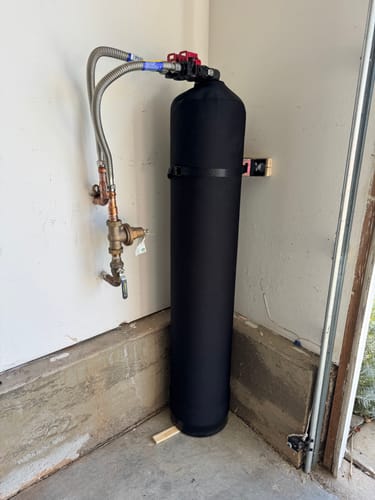
Once we comprehend our iron levels, the next piece of the puzzle is flow rate — specifically, how many gallons per minute (GPM) our household pulls at peak demand. GPM reveals exactly how hard our system works during simultaneous water use, and it directly determines the filter size we need.
Use the bucket test to measure accurately — guessing here costs us performance.
| Peak GPM | Recommended Filter Size |
|---|---|
| Up to 5 GPM | 1.0 cubic foot |
| Up to 7 GPM | 1.5 cubic foot |
| Up to 10 GPM | 2.0 cubic foot |
| Above 10 GPM | Custom sizing required |
| Variable usage | Monitor regularly |
As household demand shifts, we revisit these numbers — consistent iron removal depends on staying ahead of our actual usage.
How Iron Concentration and Household Size Change Filter Capacity
While GPM tells us how fast water moves through our system, iron concentration and household size tell us how hard our filter actually works. Together, these two variables determine true filter capacity needs.
Here's how they interact:
- Under 2 ppm iron, 4–6 members: A 1.0 cubic foot filter handles the demand efficiently.
- Under 2 ppm iron, 6–8 members: Upgrade to a 2.0 cubic foot system to match consumption.
- Above 2 ppm iron, any household size: Higher concentrations demand larger capacity, regardless of how many people live there.
- Above 2 ppm iron: Expect increased maintenance frequency and reduced operational efficiency without proper sizing.
Ignoring either variable means undersizing our system and compromising our water quality long-term.
Why pH Determines Which Iron Filter Will Actually Work
Iron concentration and household size narrow down our filter size, but they don't tell us which filter will actually work in our water. That's where pH comes in—and it's a dealbreaker.
FOBS and FOC systems need a minimum pH of 6.8 to function properly. FOK models are slightly more forgiving, requiring at least 6.0. Drop below those thresholds, and filtration efficiency collapses. We're also looking at accelerated corrosion and mounting maintenance costs.
Before installing anything, we test pH using strips for a quick baseline reading. If levels are too low, we adjust them first. That single step dramatically improves how effectively our system removes both ferric and ferrous iron—and it protects our investment long-term.
Which Iron Filter Model Matches Your GPM, PPM, and pH
Now that we recognize our pH, GPM, and iron concentration, let's put those numbers to work. Matching your specific measurements to the right model eliminates guesswork entirely.
- 5 GPM + iron below 2 ppm + pH 6.8+ → FOBS or FOC 1.0 cubic foot system handles this perfectly.
- 7 GPM household → Step up to a 1.5 cubic foot configuration for adequate flow capacity.
- 10 GPM demand → A 2.0 cubic foot system becomes non-negotiable at this flow rate.
- High iron levels, larger households, or pH as low as 6.0 → The FOK 2.0 cubic foot model is your answer.
Getting these three variables aligned means your filter works efficiently from day one.
Frequently Asked Questions
How Do You Size an Iron Filter?
We size an iron filter by determining your peak flow rate in GPM and iron concentration in PPM. Higher iron levels and larger households typically require bigger systems, so we always recommend consulting a sales engineer for precision.
How Many GPM Do I Need for a Whole House Filter?
We'll need about 5 GPM for every 4-6 people in our home. Measure peak usage during high-demand moments—like simultaneous showers—to guarantee we're capturing our home's true flow requirements accurately.
How Do I Know What Size Water Filter I Need for My Whole House?
We'll size your whole house filter by measuring three things: your peak flow rate (GPM), your water's iron concentration (PPM), and your household size. These factors together determine whether you need a 1.0 or 2.0 cubic foot system.
What Micron Filter Is Best for Iron?
We recommend using a 5-micron filter or smaller for iron removal. It'll capture both dissolved and suspended iron particles effectively, giving you cleaner, safer water throughout your entire home.






