


![SoftPro™ Chlorine+ Carbon Whole House Water Filter to Remove PFAS, Chlorine, Chloramine & Pesticides [City Water Filters Series]](http://www.softprowatersystems.com/cdn/shop/files/SoftPro_Whole_House_Carbon_Filter_with_Spin_Down_Water_Filter.webp?v=1783547361&width=140)


 855-683-8488


Iron Filter Sizing: The Proven Step-by-Step Method Experts and Manufacturers Recommend

Getting iron filter sizing right starts with knowing what's in your water. We recommend testing first to identify whether you're dealing with ferrous, ferric, or organic iron — because each type needs a different treatment approach. Next, calculate your household's flow rate and daily water usage, then match those numbers to the right filter capacity and media type. Stick with us, and we'll walk you through every step so your system works flawlessly from day one.
Key Takeaways
- Test your water first to identify iron type (ferrous, ferric, or organic) and measure concentration in mg/L before selecting any system.
- Calculate daily water usage and multiply by iron concentration to determine the required filtration capacity for your household.
- Size your filter to handle peak demand of 10–15 GPM, preventing pressure drops and iron bypass issues.
- Choose filter media based on iron type: Birm for ferric, catalytic media for ferrous, and green sand for organic iron.
- Avoid undersizing or oversizing; both cause performance problems, increased maintenance, higher operating costs, and potential additional treatment systems.
What Type of Iron Is in Your Water: and How Do You Test for It?

Before we can size an iron filter correctly, we need to know exactly what we're dealing with — and not all iron is the same.
Water carries three distinct types: ferrous iron (dissolved and invisible), ferric iron (visible as reddish-brown particles), and organic iron (bound to organic matter). Each demands a different treatment approach.
Not all iron is the same — ferrous, ferric, and organic each require a completely different treatment strategy.
We also watch for iron bacteria — the culprit behind slime and odors — because standard filtration won't touch it.
Testing is non-negotiable. Use a home test kit for quick readings, or send samples to an independent lab for precise concentration and type identification.
Once iron exceeds 0.3 mg/L, staining and taste problems follow fast. Regular retesting keeps your system performing as conditions change.
What Flow Rate Does Your Home Actually Need?
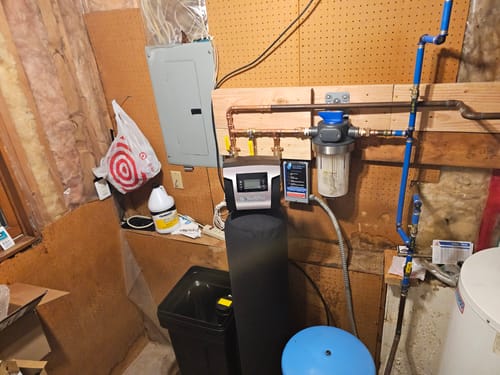
Once we recognize what type of iron we're dealing with, the next piece of the puzzle is flow rate — because even the best iron filter will underperform if it can't keep up with your home's water demand.
Most households need 10–15 GPM to handle simultaneous usage. To find your actual number, run a bucket test: measure what your faucet delivers before the well pump kicks back on.
| Iron Level | Recommended Flow | System Size |
|---|---|---|
| Under 2 ppm | 5 GPM | 1.0 cu. ft. |
| Under 2 ppm | 5+ GPM | 2.0 cu. ft. |
Match your system to real demand, not assumptions. Monitor periodically — your household's usage patterns shift, and your filter's performance should shift with them.
Birm, Catalytic, or Green Sand: Which Media Matches Your Iron Type?
Now that we've insight into our flow rate, let's talk about what's actually doing the heavy lifting inside the filter — the media.
Your choice here hinges entirely on what's in your water.
The media you choose means nothing if you don't know what's actually in your water first.
Birm works beautifully for ferric iron — the kind you can already see — and pairs well with a softener when concentrations stay under 2 ppm.
Got higher levels of dissolved ferrous iron? Catalytic media oxidizes it aggressively before filtering it out.
Green sand handles organic iron using potassium permanganate, though it demands consistent chemical maintenance.
Here's the critical rule: test first, then choose.
Each media targets a specific iron type and concentration range.
Matching the wrong media to your water doesn't just underperform — it fails completely.
How Iron Concentration Determines Your Filter Sizing
Choosing the right media is only half the battle — we also need to match the filter's size to how much iron it'll actually face. Start by multiplying your household's daily water usage in gallons by the iron concentration in mg/L. That number reveals the filtration capacity you genuinely need.
Here's where concentration becomes a game-changer: once iron exceeds 2 ppm, standard filters struggle. You'll need catalytic or AIO systems built to handle heavier removal loads — and sized accordingly.
Beyond capacity, flow rate matters too. Select a filter rated above your peak demand, typically 10–15 GPM, so pressure never bottlenecks performance.
Iron levels shift over time, so test regularly. What fits today may underperform next year if concentrations climb.
What Happens When You Get Iron Filter Sizing Wrong
Getting iron filter sizing wrong creates a cascade of problems that cost far more to fix than they would've cost to prevent.
An undersized filter can't keep pace with peak demand, so you'll notice pressure drops and iron sneaking past the media—leaving stains, odors, and levels above EPA's 0.3 mg/L limit. Go oversized, and you're triggering excessive regeneration cycles that waste water and inflate operating costs monthly.
Size it wrong, and you'll pay—through pressure drops, iron bypass, wasted water, and climbing operating costs.
Either way, maintenance becomes a headache. You'll replace media more often, schedule more repairs, and watch your budget shrink faster than expected.
Worst of all, dissatisfied homeowners eventually layer on additional treatment systems—spending far more than proper sizing ever would've required.
We've seen it happen repeatedly, and it's entirely avoidable when you size correctly from the start.
Frequently Asked Questions
How Often Should an Iron Filter Be Backwashed for Optimal Performance?
We recommend backwashing your iron filter every 2-3 days for ideal performance. This frequency flushes accumulated iron, regenerates the media, and keeps your system running at peak efficiency—preventing costly buildup that'll compromise your water quality over time.
Can an Iron Filter Be Installed Alongside a Water Softener System?
Yes, you can install an iron filter alongside a water softener—and we'd actually recommend it. Place the iron filter first, protecting your softener's resin bed from iron fouling, extending its lifespan considerably.
What Is the Average Lifespan of an Iron Filter System?
With proper maintenance, we're looking at 10–20 years for most iron filter systems. Your filter's lifespan depends on water quality, usage volume, and how consistently you're backwashing and servicing the media inside.
Does Water pH Level Affect Iron Filter Sizing and Selection?
Yes, pH absolutely affects your iron filter selection. We recommend testing pH first—acidic water below 6.5 makes iron harder to remove, requiring specialized media or pH correction systems before your iron filter can work effectively.
How Much Does a Properly Sized Iron Filter System Typically Cost?
We're looking at $500–$3,000+ for a properly sized iron filter system, depending on iron levels, flow rate demands, and technology chosen. Investing in correct sizing upfront saves you far more in avoided repairs and replacements long-term.






