


![SoftPro™ Chlorine+ Carbon Whole House Water Filter to Remove PFAS, Chlorine, Chloramine & Pesticides [City Water Filters Series]](http://www.softprowatersystems.com/cdn/shop/files/SoftPro_Whole_House_Carbon_Filter_with_Spin_Down_Water_Filter.webp?v=1783547361&width=140)


 855-683-8488


Iron Filter and UV Combo Systems: Every Contaminant They Eliminate and Why the Pairing Works

Iron filters and UV combo systems eliminate nearly every contaminant threatening your well water. Iron filters handle ferrous and ferric iron, manganese, and sediment, while UV sterilization destroys 99.9% of bacteria and viruses without chemicals. Neither system works as well alone, but together they create a powerful multi-barrier defense that covers both chemical and biological threats. There's a lot more to understand about how these two systems complement each other perfectly.
Key Takeaways
- Iron filters remove ferrous and ferric iron, manganese, and sediment, while UV sterilization eliminates 99.9% of bacteria and viruses.
- UV systems target harmful microorganisms that iron filters cannot address, including pathogens from compromised well casings.
- Reducing turbidity through iron filtration ensures UV light penetrates water effectively, maximizing pathogen elimination.
- Together, both systems create a multi-barrier defense covering biological, chemical, and physical water contamination threats.
- Proper sequencing—iron filter first, UV system second—is essential for the combined system to perform optimally.
What Iron Filters Actually Remove From Well Water

Iron filters are workhorses when it comes to tackling well water problems, but they've got a specific job description.
They target two primary iron forms: ferrous iron, which dissolves invisibly into your water, and ferric iron, the rusty culprit behind those orange stains and metallic taste.
Operating best within a pH range of 6.5 to 8.5, advanced models also knock out manganese and sediment.
Here's where it gets critical — iron filters have clear blind spots.
They won't touch bacteria, nitrates, or hydrogen sulfide.
That sulfur smell lingering in your water? An iron filter alone won't fix it.
Understanding these limitations isn't discouraging; it's precisely why pairing iron filtration with complementary technologies transforms a partial solution into a genuinely thorough water treatment system.
The Contaminants Iron Filters Miss Entirely
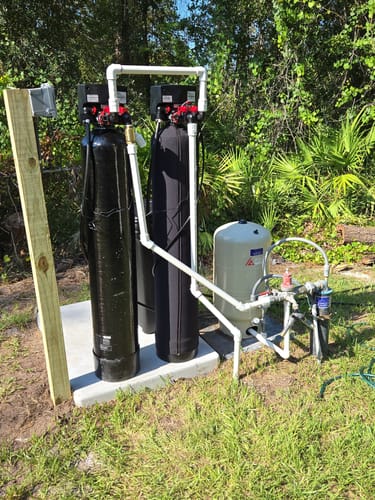
Here's what this means practically: an iron filter alone leaves significant gaps in your water's safety profile.
We're not talking minor inconveniences — we're talking contaminants that compromise health, infrastructure, and water quality simultaneously.
Understanding these blind spots is exactly why pairing iron filtration with complementary systems isn't optional — it's essential.
What UV Does That an Iron Filter Can't
Think of UV sterilization as the silent assassin that handles the threats an iron filter never sees coming. While iron filters tackle metallic contaminants, UV targets the biological dangers lurking beneath the surface—pathogens that sneak in through well casing cracks and other vulnerabilities.
Here's what UV does that an iron filter simply can't:
- Eliminates 99.9% of bacteria and viruses by disrupting their DNA
- Neutralizes pathogens from compromised well casings without chemicals
- Preserves water taste and quality—no chemical additives required
- Addresses microbial threats entirely, filling the gap iron filters leave open
We're talking about a non-chemical process that protects without altering what you drink. Iron filters handle the visible problems; UV handles the invisible ones.
Why the Iron Filter and UV Combo Works Better Together
Now that we've seen what each system brings to the table on its own, the real magic happens when we put them together. The iron filter clears the water first, reducing turbidity so UV light can penetrate fully and deactivate pathogens effectively. Neither system alone covers every threat—but together, they create a multi-barrier defense.
| Factor | Iron Filter | UV System |
|---|---|---|
| Primary Target | Iron, sediment | Bacteria, viruses |
| Ideal Condition | pH 6.5–8.5 | Clear, low-turbidity water |
| Key Benefit | Reduces staining, taste issues | Eliminates 99.9% of pathogens |
Each system strengthens the other's performance. The iron filter sets up favorable conditions for UV sterilization, making the combo exponentially more effective than either running solo.
How to Build an Iron Filter and UV Combo System That Lasts
Building a system that actually lasts starts with getting the sequencing right—the iron filter must always come before the UV unit.
Sediment and iron cloud water, blocking UV light from reaching pathogens. Get the order wrong, and you've compromised everything.
Sediment and iron don't just dirty water—they shield pathogens from the UV light meant to destroy them.
Here's what keeps the system performing long-term:
- Maintain pH between 6.5 and 8.5 — ideal iron oxidation depends on it.
- Replace UV bulbs annually — output degrades even when the bulb still glows.
- Clean filter media regularly — buildup reduces flow and contaminant capture.
- Monitor for bacterial contamination — especially critical with well water sources.
This multi-barrier approach—physical filtration paired with biological disinfection—achieves 99.9% pathogen elimination.
Built correctly and maintained consistently, it delivers reliable, safe water for years.
Frequently Asked Questions
Do Iron Filters Really Work?
Yes, they really work! We've seen iron filters effectively strip ferrous and ferric iron from water, eliminating those frustrating rust stains and metallic tastes—but they're most powerful when paired with UV sterilization for complete protection.
How Does an Iron Removal Filter Work?
We use oxidation to convert dissolved ferrous iron into solid ferric particles, then trap them in a media bed. It's a chemical reaction that's pH-dependent, working best between 6.5 and 8.5 for ideal removal.
What Are Common Problems With Iron Filters?
Iron filters can't tackle nitrates, bacteria, heavy metals, or hydrogen sulfide. They're also pH-sensitive, losing effectiveness outside 6.5–8.5. That's why pairing them with additional treatment systems, like UV, becomes essential for truly thorough water purification.
Will an Iron Filter Remove Iron Bacteria?
Iron filters won't remove iron bacteria—they're living organisms, not dissolved minerals. We need disinfection, like UV sterilization, to eliminate them. That's exactly why pairing an iron filter with UV creates a truly thorough water treatment solution.






