


![SoftPro™ Chlorine+ Carbon Whole House Water Filter to Remove PFAS, Chlorine, Chloramine & Pesticides [City Water Filters Series]](http://www.softprowatersystems.com/cdn/shop/files/SoftPro_Whole_House_Carbon_Filter_with_Spin_Down_Water_Filter.webp?v=1783547361&width=140)


 855-683-8488


Iron Filter + UV System: The Ultimate Combination for Complete Well Water Safety and Purity

When you're dealing with well water, you're up against two very different threats: minerals like iron, manganese, and hydrogen sulfide that ruin your water's quality, and invisible pathogens like bacteria and viruses that endanger your family's health. An iron filter alone can't protect you from both. That's why pairing it with a UV system is the ultimate solution. Together, they tackle every layer of the problem, and we'll show you exactly how.
Key Takeaways
- Iron filters remove up to 30 PPM of iron, manganese, and hydrogen sulfide but cannot eliminate dangerous bacteria or viruses.
- UV systems neutralize harmful microorganisms like E. coli, addressing health threats that iron filters leave untreated.
- Iron-free water maximizes UV efficiency by preventing microorganisms from hiding behind dissolved minerals and particles.
- The sequential setup—iron filter first, then UV chamber—ensures both aesthetic and microbial water quality issues are fully resolved.
- A 53-point water test helps determine the right system combination based on iron levels, hardness, and bacterial presence.
Why Well Water Needs Both an Iron Filter and UV System

Well water comes with its own set of challenges that municipal water systems simply don't have to deal with. Iron, manganese, and hydrogen sulfide lurk beneath the surface, creating foul odors, unpleasant tastes, and stubborn stains on your fixtures.
An iron filter tackles these chemical culprits effectively, removing up to 30 parts per million of iron. But here's the problem—it stops there. Bacteria, viruses, and other pathogens pass right through untouched.
That's where a UV system becomes indispensable. It neutralizes microbial threats that no iron filter can address. Together, they create a thorough defense system—one handling chemical impurities, the other eliminating biological dangers.
We're talking about extensive protection that delivers water that's truly safe, clean, and great-tasting.
What Does an Iron Filter Actually Remove From Well Water?
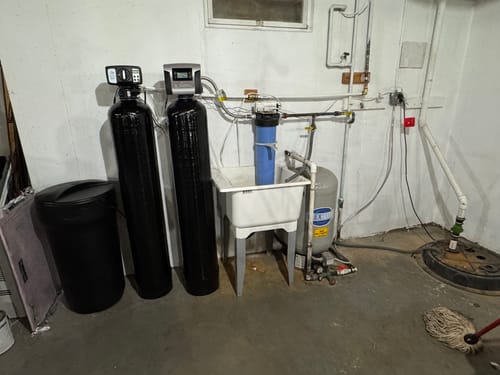
Iron filters are workhorses when it comes to tackling well water's most stubborn chemical problems. Through oxidation, they convert dissolved contaminants into solid particles, trapping them before they ever reach your tap.
Iron filters work quietly behind the scenes, turning invisible contaminants into trapped particles before they reach your tap.
Here's what they're actually eliminating:
- Ferrous iron – dissolved and invisible until it ruins your fixtures with rust stains
- Ferric iron – already visible, causing that unmistakable orange discoloration
- Manganese – the culprit behind dark staining and cloudy water clarity
- Hydrogen sulfide – responsible for that dreaded rotten egg odor affecting taste and smell
High-capacity systems handle up to 30 PPM of iron, meaning even heavily contaminated wells aren't beyond reach.
We're talking serious filtration power working quietly behind the scenes.
What Bacteria and Viruses Does Your Iron Filter Leave Behind?
As impressive as iron filters are at scrubbing out rust, manganese, and sulfur from your well water, they've got a blind spot that could put your family's health at serious risk.
Iron filters simply weren't designed to eliminate bacteria or viruses. Their oxidation process targets minerals, not pathogens, meaning dangerous microorganisms like E. coli and coliform bacteria slip right through untreated.
Think about that for a moment. Your water looks crystal clear, smells fresh, yet it's potentially harboring invisible threats capable of causing serious illness.
That's exactly why pairing your iron filter with a UV purification system isn't optional—it's essential.
UV light destroys 99.9% of bacteria and viruses, closing that dangerous gap your iron filter leaves wide open.
How Do an Iron Filter and UV System Work Together?
Together, an iron filter and UV system form a one-two punch that tackles your well water problems from two completely different angles.
Here's how they team up:
- The iron filter goes first, stripping out dissolved iron, manganese, and hydrogen sulfide before water reaches the UV lamp.
- Clean water enters the UV chamber, where ultraviolet light penetrates and inactivates bacteria, viruses, and other pathogens.
- Iron-free water maximizes UV efficiency, since iron particles can shield microorganisms from UV exposure, reducing effectiveness.
- You get dual protection, addressing both aesthetic issues like staining and odors and serious health threats like microbial contamination.
This sequential process isn't accidental—it's engineered so each system enhances the other's performance.
Which Iron Filter and UV System Fits Your Water Test Results?
Knowing how an iron filter and UV system work together is one thing—knowing which specific setup matches your water is where it gets personal. That's why we always recommend starting with a thorough 53-point water test.
| Water Condition | Recommended System |
|---|---|
| Iron up to 10 PPM | Air injection iron filter + UV |
| Hydrogen sulfide present | H₂S-rated filter (8 PPM) + UV |
| Hardness above 7 grains | Add water softener to your setup |
| Bacterial presence detected | Prioritize UV disinfection pairing |
Once your results are in, the guesswork disappears. You'll know exactly what's flowing through your pipes—and exactly what combination stops it. The right match doesn't just protect your water; it transforms it.
Frequently Asked Questions
What Is the Best Filter to Remove Iron From Well Water?
We've found the SoftPro Iron Filter removes up to 30 PPM using Air Injection Oxidation—no chemicals needed. Pair it with UV sterilization, and you'll eliminate 99.9% of contaminants, ensuring truly pure well water.
How Much Does a UV Filter Cost for Well Water?
We're looking at $700–$1,500 for a UV filter, plus $80–$120 annually for bulb replacements. Factor in pre-filters too. It's a worthwhile investment that delivers long-term protection and peace of mind for your family's water safety.
Do Iron Filters Really Work?
Yes, they absolutely work! We've seen iron filters remove up to 30 PPM of dissolved iron, eliminate sulfur odors, prevent pipe corrosion, and dramatically reduce those stubborn rust stains plaguing your fixtures and laundry.
What Are Common Problems With Iron Filters?
We've seen iron filters struggle with concentrations above 15 ppm, iron bacteria creating slimy buildup, neglected maintenance causing failures, iron sludge clogging systems, and an inability to tackle bacteria or viruses without pairing UV treatment.






