


![SoftPro™ Chlorine+ Carbon Whole House Water Filter to Remove PFAS, Chlorine, Chloramine & Pesticides [City Water Filters Series]](http://www.softprowatersystems.com/cdn/shop/files/SoftPro_Whole_House_Carbon_Filter_with_Spin_Down_Water_Filter.webp?v=1783547361&width=140)


 855-683-8488


Iron Filter and Water Softener Installation Order: What's Correct and Why It Matters So Much

When it comes to iron filter and water softener installation order, always install the iron filter first. Think of it as the bodyguard that intercepts iron before it ever reaches your softener's resin beads. Iron above 0.3 ppm coats those beads in a metallic film that standard regeneration can't fix, shrinking your softener's lifespan from 15 years down to just three. Get the sequence right, and you'll save hundreds annually — keep going and we'll show you exactly how.
Key Takeaways
- Always install the iron filter first, before the water softener, to remove ferrous and ferric iron from your water supply effectively.
- Reversed installation allows iron to coat resin beads with a metallic film that standard regeneration cycles cannot remove.
- Incorrect sequencing reduces softener lifespan from 15 years down to just 3-5 years, costing hundreds annually in repairs.
- Water with iron concentrations above 0.3 ppm accelerates resin deterioration significantly when the softener is incorrectly positioned first.
- Correct installation order extends softener lifespan, eliminates metallic tastes, prevents staining, and saves up to $700 in annual maintenance costs.
Why Iron Filters Must Always Come Before Water Softeners

Think of the iron filter as your system's first line of defense. It eliminates iron contamination upfront, so your softener can focus entirely on hardness minerals — exactly what it's designed to handle.
Reverse that sequence, and you're looking at metallic-tasting water, persistent staining, and repair costs ranging from $100 to $700 annually.
Getting this configuration right protects every downstream component, optimizes flow rates, and keeps your entire system performing at its peak.
How Wrong Installation Order Damages Your Softener Resin
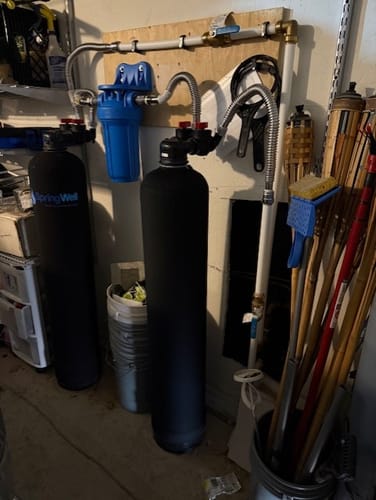
When iron bypasses the filter and flows directly into your softener, it coats the resin beads in a stubborn metallic film that ion exchange simply can't reverse.
Iron bypassing your filter doesn't just damage resin beads — it coats them in a metallic film ion exchange can't reverse.
Once that fouling begins, your softener's ability to exchange calcium and magnesium ions deteriorates fast.
We're talking about a system rated for 15 years suddenly failing within 3 to 5 years.
Here's the brutal part: standard softener regeneration cycles can't strip iron contamination from resin.
The damage compounds silently until efficiency collapses entirely.
At iron concentrations above 0.3 ppm, that timeline accelerates dramatically.
What makes this particularly costly isn't just replacement equipment — it's the cumulative repair bills, wasted salt, and degraded water quality you'll endure in the meantime.
Wrong sequencing isn't a minor oversight; it's an expensive, preventable mistake.
The Right Installation Sequence: Iron Filter to Water Softener
Getting the installation sequence right comes down to one non-negotiable rule: the iron filter goes first, the water softener goes second. This order isn't arbitrary—it's the difference between a system that lasts decades and one that fails within years.
Here's why this sequence works:
- Iron removal first eliminates ferrous and ferric iron before it ever reaches your softener resin.
- Acid neutralizer placement corrects pH levels in well water, protecting resin integrity.
- Softener second tackles calcium and magnesium hardness with a clean, uncompromised resin bed.
- Correct sequencing extends softener lifespan from a potential 3-5 years to 15+ years.
When we honor this sequence, both systems operate at peak efficiency, delivering consistently superior water quality throughout your home.
Five Installation Mistakes That Shorten Both Systems' Lifespan
Even when the installation sequence is right, five critical mistakes can still cut both systems' lifespan short—and most of them are entirely avoidable.
Skipping a water chemistry analysis means you're guessing at sizing, and oversized or undersized systems fail faster.
Leaving too little maintenance space around both units turns routine servicing into a nightmare, accelerating wear.
Installing without adequate drainage access cripples backwashing efficiency, driving up costs steadily.
Letting large sediment reach the softener without proper filtration destroys resin beds and internal components.
And placing the softener before the iron filter—even briefly—invites resin fouling that shrinks a 15-year system down to three.
We've seen each mistake shorten equipment life dramatically.
Getting the sequence right is only half the battle.
How Correct Installation Order Cuts Long-Term Repair Costs
The sequence you choose at installation either protects your investment for decades or quietly drains it.
The order you install your water treatment system either compounds your returns for decades or silently erodes them.
We've seen homeowners skip the iron filter first, only to watch their softener's resin foul within years instead of lasting 15+. That mistake compounds fast.
Here's what correct sequencing actually delivers:
- Extended softener lifespan from 3–5 years up to 15+ years
- Eliminated metallic tastes and staining throughout household water
- Avoided appliance and plumbing damage worth thousands in repairs
- Annual maintenance savings between $100–$700
We're not talking minor inconveniences.
We're talking thousands in preventable repair costs versus a straightforward installation decision made once.
When iron gets removed before softening, every downstream system runs cleaner, longer, and more efficiently.
That's a compounding return worth protecting.
Frequently Asked Questions
Do You Install Iron Filter or Softener First?
We always install the iron filter first. It protects your softener's resin from iron fouling, preserving its efficiency. Skip this step, and you'll face costly repairs, premature resin replacement, and a system that simply can't perform.
What Is the Correct Order of Water Treatment?
We recommend this sequence: sediment pre-filter first, then acid neutralizer if needed, followed by the iron filter, water softener, and finally UV light disinfection—ensuring each stage protects the next for maximum system efficiency.
In What Order Should Water Filters Be Installed?
For well water, we recommend installing filters in this order: sediment pre-filter, acid neutralizer, iron filter, then water softener. For city water, install filtration before the softener to protect the resin from chlorine damage.
Do You Need a Water Softener if You Have an Iron Filter?
Yes, you'll still need a water softener! An iron filter only removes dissolved iron, but it won't tackle the calcium and magnesium causing hardness. Both systems working together give you truly all-encompassing water treatment.






