


![SoftPro™ Chlorine+ Carbon Whole House Water Filter to Remove PFAS, Chlorine, Chloramine & Pesticides [City Water Filters Series]](http://www.softprowatersystems.com/cdn/shop/files/SoftPro_Whole_House_Carbon_Filter_with_Spin_Down_Water_Filter.webp?v=1783547361&width=140)


 855-683-8488


Iron Filtration ROI: A Step-by-Step Savings Calculation for Homeowners

Iron filter systems typically cost $1,200 to $5,800 upfront, but they can save you $100 to $1,000 annually on appliance repairs alone. Add in avoided plumbing damage that can exceed $3,000 over a decade, and the numbers get interesting fast. Most homeowners hit their breakeven point within just 2 to 4 years. Beyond that, returns can triple your initial investment. Stick with us, and we'll show you exactly how to calculate what an iron filter is worth to your home.
Key Takeaways
- Iron filter systems cost $1,200 to $5,800 upfront, including installation, making it essential to calculate long-term savings before purchasing.
- Homeowners save $100 to $1,000 annually on appliance repairs, directly offsetting the initial investment over time.
- Annual maintenance costs range from $140 to $750, which remain manageable compared to potential $3,000+ plumbing repair bills.
- Most homeowners reach their breakeven point within 2 to 4 years, with threefold returns possible after year five.
- Long-term benefits include avoiding $3,000 in plumbing repairs and increasing property value by $5,000 to $15,000.
What Does an Iron Filter System Cost Upfront?

When we're weighing whether an iron filter system is worth it, the first question that stops most homeowners dead in their tracks is price.
And honestly, the range is wide enough to raise eyebrows.
And honestly, the range is wide enough to raise eyebrows — and rethink your entire budget.
Basic systems run between $500 and $1,500. Advanced systems—built for heavier iron loads or larger homes—climb from $1,500 to $5,000.
Add installation, which typically costs $150 to $500 depending on plumbing complexity, and your total upfront investment lands somewhere between $1,200 and $5,800.
That's a real spread.
But here's what savvy homeowners recognize immediately: upfront cost is only half the story.
The system you choose today determines what you'll spend—or save—for years ahead.
How Much Can a Quality Iron Filter Save You Annually?
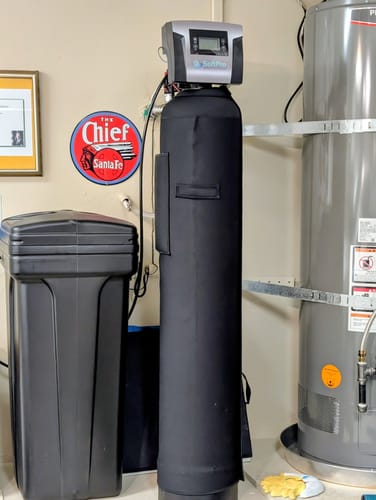
Now that we've got a handle on what you're spending upfront, let's look at what that investment starts handing back. A quality iron filter can save you between $100 and $1,000 annually on appliance repairs alone—because iron-laden water quietly destroys water heaters, dishwashers, and washing machines from the inside out.
Stretch that savings window to ten years, and you're potentially recovering $3,000 in prevented plumbing repairs, a threefold return on your original investment. Factor in reduced spending on cleaning supplies and the extended lifespan of your appliances, and annual maintenance costs of $150 to $300 become surprisingly easy to absorb.
The numbers aren't just favorable—they compound. Each year your filter runs, your break-even point gets further behind you.
Calculate Your Iron Filter ROI Against Plumbing and Appliance Costs
The math here is straightforward, and running it takes less than five minutes. Let's walk through it together.
- Estimate your installation cost: Quality systems run $1,500–$3,000.
- Project annual savings: Appliance repairs alone save $100–$1,000 yearly.
- Factor in maintenance: Budget $40–$100 annually—minimal compared to avoided damage.
- Calculate your breakeven: Most homeowners hit it within 2–4 years.
Here's what makes this compelling: plumbing repairs from iron-ridden water can exceed $3,000 over a decade. Against a one-time filtration investment, that's a potential threefold return.
We're not guessing—we're stacking real numbers against real risk. Once you see your breakeven timeline, the decision stops feeling like an expense and starts feeling like strategy.
What Are the Ongoing Maintenance and Operational Costs?
Everything we've covered so far assumes you're maintaining the system—so let's talk about what that actually costs. Annual maintenance runs $40–$100, which mostly covers inspections and minor adjustments.
Replacement filter media adds another $50–$500 depending on your system's complexity. Electricity and backwashing tack on roughly $50–$150 yearly.
Add it all up, and you're looking at $140–$750 annually to keep things running well. That might sting at first glance, but here's the perspective shift: skip that maintenance, and you're gambling with plumbing repairs that can easily top $3,000.
Skip the $140–$750 in annual maintenance, and you're gambling with plumbing repairs that can easily top $3,000.
Properly maintained systems also last 5–10 years, spreading your initial investment over a much longer timeline. The math strongly favors consistent upkeep over reactive, expensive repairs.
When Does an Iron Filter Pay for Itself?
With maintenance costs mapped out, the obvious next question is: when does all of this actually start working in your favor?
Most homeowners hit breakeven within 2-4 years. Here's how that math unfolds:
- Years 1-2: Annual repair savings of $100-$1,000 begin offsetting your initial investment.
- Years 2-4: Breakeven arrives as appliance longevity compounds your returns.
- Year 5+: You're generating a potential threefold return while avoiding $3,000+ in plumbing repairs over a decade.
- Long-term: Property value increases $5,000-$15,000, transforming a utility investment into an equity builder.
With maintenance running just $40-$100 annually, the system's financial momentum accelerates faster than most homeowners expect.
The real question isn't whether it pays for itself—it's how much you're losing by waiting.
Frequently Asked Questions
How to Calculate Filtration Rate?
We'll calculate your filtration rate by measuring flow rate in GPM during peak usage. Test your water's iron concentration first, then match your system's capacity to your household's demand—typically 10-20 GPM for larger families.
How to Calculate Backwash Rate?
We'll calculate backwash rate by dividing the volume of water used during backwashing by the duration. For iron filtration, we're targeting 5–10 GPM, ensuring our media bed stays thoroughly cleaned.
How to Size an Iron Filter?
We'll size an iron filter by analyzing peak flow rate and iron concentration through a free water analysis. Match system capacity to household usage—avoiding oversized or undersized units—while accounting for potential future iron level increases.
Is the Range of Rate of Filtration for a Normal Slow Sand Filter in Lit Hr/m2 of Filter Area?
Yes, we're looking at 0.1 to 0.4 liters per hour per square meter of filter area. That's the sweet spot where slow sand filters work their biological and mechanical magic most effectively.






