


![SoftPro™ Chlorine+ Carbon Whole House Water Filter to Remove PFAS, Chlorine, Chloramine & Pesticides [City Water Filters Series]](http://www.softprowatersystems.com/cdn/shop/files/SoftPro_Whole_House_Carbon_Filter_with_Spin_Down_Water_Filter.webp?v=1783547361&width=140)


 855-683-8488


Iron Filtration Plus UV Disinfection: The Complete Well Water Treatment System Fully Explained

If your well water has iron bacteria, a single filter won't cut it. Iron filters remove dissolved iron but can't kill the bacteria hiding in biofilms. That's where UV disinfection steps in—it destroys 99.99% of pathogens, including iron bacteria, without chemicals. Together, these two systems create a complete multi-barrier defense for your well water. Keep going, and we'll show you exactly how to build that system.
Key Takeaways
- Iron filters remove dissolved iron but cannot eliminate iron bacteria, making UV disinfection a necessary companion for complete well water treatment.
- UV-C light destroys 99.99% of pathogens, including iron bacteria and chlorine-resistant organisms, without altering water taste or creating byproducts.
- A two-stage system requires iron filtration first, then UV disinfection, ensuring UV light penetrates water effectively without obstruction.
- A five-micron pre-filter installed before the UV chamber removes suspended particles that would otherwise block UV light penetration.
- Combined iron filtration and UV disinfection systems can handle up to 7 PPM iron and 8 PPM hydrogen sulfide simultaneously.
What Is Iron Bacteria and Why Is It Hard to Detect?

If you've ever noticed a slimy, reddish-brown buildup around your faucets or a musty smell creeping through your pipes, iron bacteria might be the culprit.
These microorganisms thrive in iron-rich well water, combining dissolved iron with oxygen to form thick biofilms that cling to pipes, pumps, and tanks.
Here's what makes them particularly tricky — their symptoms mimic ordinary mineral problems.
That staining on your fixtures or laundry? Easy to dismiss as a simple iron issue.
But standard iron filtration won't touch these bacteria because they actively clog filtration pores, rendering that equipment useless.
Worse, iron bacteria create environments where other harmful microorganisms multiply, turning a nuisance into a genuine health risk.
Identifying them early is essential before they spread system-wide.
Warning Signs Your Well Water Needs Iron Filtration and UV Treatment
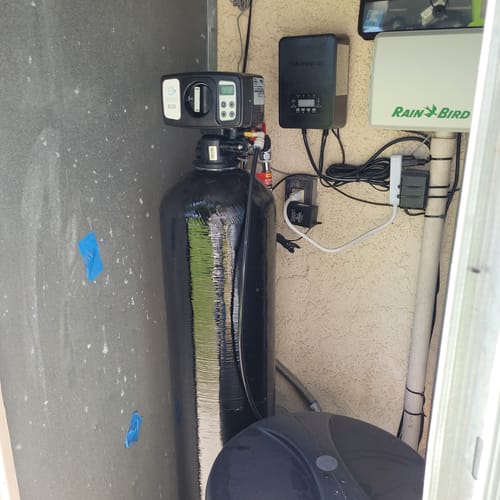
How do you know when your well water is crying out for iron filtration and UV treatment? Your water tells a story through clear warning signs we shouldn't ignore.
Watch for these red flags:
- Reddish or orange stains on fixtures and laundry signal high iron content that's actively deteriorating your pipes.
- Musty or unpleasant odors indicate iron bacteria colonies requiring both filtration and UV treatment.
- Rust-like sludge or sediment in faucets confirms biofilm formation that overwhelms conventional filtration alone.
- Rotten egg smell reveals hydrogen sulfide combined with iron, demanding thorough dual treatment.
When we also detect coliform or E. coli through testing, UV disinfection becomes non-negotiable.
Coliform or E. coli detected in testing makes UV disinfection an immediate, absolute necessity—not an option.
These signs aren't inconveniences—they're your system demanding action before contamination worsens.
Why Iron Filters Alone Can't Solve the Iron Bacteria Problem
Many homeowners install an iron filter and assume their water problems are solved—but that's where the story takes a troubling turn. Iron filters remove dissolved iron effectively, yet they leave iron bacteria completely untouched. Those bacteria don't just survive—they thrive, forming biofilms that clog filter pores, strangle flow rates, and quietly compromise your entire system.
| Issue | Iron Filter Alone |
|---|---|
| Dissolved iron removal | ✅ Effective |
| Iron bacteria elimination | ❌ Ineffective |
| Biofilm prevention | ❌ Ineffective |
| Long-term water safety | ❌ Incomplete |
That false sense of security is dangerous. Slimy sludge and musty odors signal bacterial colonies already multiplying. We need shock chlorination and UV disinfection working alongside iron filtration—because solving half the problem isn't solving the problem.
How UV Disinfection Kills What Iron Filtration Leaves Behind
UV-C light at 254 nm does something iron filtration simply can't—it strikes directly at the DNA and RNA of bacteria, viruses, and parasites, dismantling their ability to reproduce or cause harm.
Once iron filtration clears the water of particulates and dissolved iron, UV disinfection finishes the job with ruthless precision.
Here's what UV brings to the system:
- 99.99% pathogen elimination, including chlorine-resistant Cryptosporidium and Giardia
- Iron bacteria destruction, targeting what iron filters stir up but don't kill
- Chemical-free disinfection, leaving no byproducts or taste alterations
- Pre-filtration dependency, requiring clear water so UV light penetrates without obstruction
Together, these two technologies don't just treat water—they transform it into something genuinely safe to drink.
How to Combine Iron Filtration and UV Disinfection Into One System
Building a complete well water treatment system comes down to two core stages working in sequence: iron filtration first, UV disinfection second.
Systems like the SpringWell Well Water Filter handle up to 7 PPM of iron and 8 PPM of hydrogen sulfide, clearing the path for everything downstream.
Once that heavy lifting's done, a five-micron pre-filter catches remaining suspended particles before water enters the UV chamber.
That sequencing matters enormously. Iron and rust particles scatter UV light, weakening its ability to neutralize pathogens. Remove them first, and your UV unit operates at full strength, eliminating up to 99.99% of harmful microorganisms without chemicals or flavor changes.
Together, these two stages create a true multi-barrier system, each stage reinforcing the other, leaving no treatment gap unaddressed.
Frequently Asked Questions
What Is the Downside of UV Disinfection Water?
UV disinfection doesn't remove chemical contaminants or particulate matter, and it fails during power outages. We'll need pre-filtration, regular lamp replacements, and backup power to keep our water genuinely safe.
How Does an Iron Filter for Well Water Work?
We oxidize dissolved iron into rust using air injection, then capture those solid particles with filter media like Katalox-Light. Backwashing periodically flushes out accumulated rust, keeping your system running at peak performance.
What Are Common Problems With Iron Filters?
We've seen iron filters struggle with iron bacteria biofilms clogging pores, high iron levels overwhelming oxidation capacity, and filter media becoming overloaded without backwashing—all of which quietly drain your system's efficiency over time.
How Long Does a Whole House Iron Filter Last?
We'll typically get 6 to 8 years from a whole house iron filter's media, though premium options like Katalox Light can stretch to 10 years with consistent backwashing and proper maintenance routines.






