


![SoftPro™ Chlorine+ Carbon Whole House Water Filter to Remove PFAS, Chlorine, Chloramine & Pesticides [City Water Filters Series]](http://www.softprowatersystems.com/cdn/shop/files/SoftPro_Whole_House_Carbon_Filter_with_Spin_Down_Water_Filter.webp?v=1783547361&width=140)


 855-683-8488


Iron, Sulfur, and Activated Carbon Water Treatment: Why This 3-Stage Combination Works So Well

Well water with iron and sulfur needs more than one filter because each contaminant requires a completely different removal method. Iron exists in two forms — one clear, one rust-colored — while sulfur produces that infamous rotten egg smell. A 3-stage system tackles each problem separately: oxidizing iron, eliminating sulfur odors, then polishing with activated carbon to catch what's left. It's a systematic approach that single-stage filters simply can't replicate. Stick with us, and we'll break down exactly how each stage works.
Key Takeaways
- Each stage targets specific contaminants: stage one removes iron, stage two eliminates sulfur odors, and stage three adsorbs organic compounds.
- Iron filters use air injection to oxidize both ferrous iron and hydrogen sulfide, addressing two contaminants simultaneously.
- Carbon filters alone cannot handle high iron concentrations or hydrogen sulfide levels exceeding 0.3 ppm effectively.
- Iron and sulfur contaminants rarely occur in isolation, making a multi-stage approach essential for comprehensive water treatment.
- Properly maintained 3-stage systems, including automatic backwashing every 2-3 days, ensure long-lasting filtration media performance.
What's Actually in Your Well Water: Iron, Sulfur, and Why Both Matter?

When you drill down into what's actually flowing through your well, you'll often find two troublemakers lurking beneath the surface: iron and sulfur.
Iron shows up in two forms — ferrous, which runs clear but turns red upon exposure to air, and ferric, which arrives already rust-colored and ready to stain everything it touches.
Sulfur, primarily hydrogen sulfide, announces itself through that unmistakable rotten egg odor. Even at just 1 ppm, it's already a problem.
Here's why both matter: iron corrodes fixtures and ruins laundry, while sulfur tarnishes metals and makes your water genuinely unpleasant to use.
Together, they create a compounding problem — which is exactly why understanding what's in your water through proper testing is your essential first step.
How Each Stage in a 3-Stage System Removes a Different Contaminant
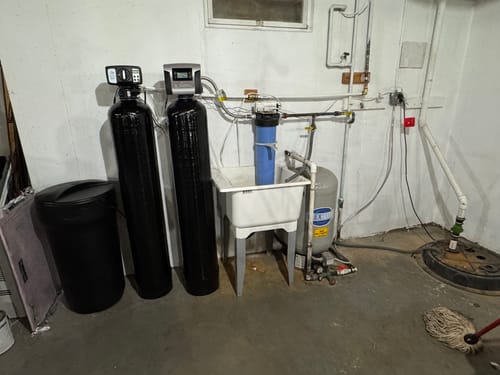
Think of a 3-stage filtration system as an assembly line, where each station has one job and does it exceptionally well.
Stage one tackles iron first, using oxidizing filtration to convert dissolved ferrous iron into solid ferric iron—making it easy to capture and remove.
Stage two introduces air injection, aggressively oxidizing hydrogen sulfide and eliminating that notorious rotten egg odor before it reaches your tap.
Stage three finishes the job with activated carbon, adsorbing leftover organic compounds, chlorine, and VOCs that compromise taste and smell.
Each stage specializes in one contaminant family, which means longer media life and lower maintenance costs over time.
Together, they don't just filter water—they systematically restore it, addressing iron, sulfur, and organic impurities with precision that a single-stage system simply can't match.
Iron Filters vs. Carbon Filters: Which One Actually Removes Sulfur?
Both iron filters and carbon filters claim a role in sulfur removal, but they don't perform equally—and choosing the wrong one means living with that rotten egg smell no matter how advanced your system looks.
Here's what actually separates them:
- Iron filters use air injection to oxidize and remove hydrogen sulfide, even at concentrations exceeding 1 ppm.
- Carbon filters rely on adsorption, which deteriorates fast once hydrogen sulfide surpasses 0.3 ppm.
- Iron filters self-maintain through automatic backwashing every 2–3 days, sustaining long-term performance.
- Carbon filters clog quickly when iron concentrations rise, demanding frequent replacements.
The smarter play? Use iron filters for heavy lifting, then let carbon filters polish what remains. That combination delivers results neither achieves alone.
Is a 3-Stage Iron, Sulfur, and Carbon System Right for Your Well?
Iron and sulfur rarely show up alone, which is exactly why a single-filter solution almost always falls short. If your well water smells like rotten eggs, stains fixtures, and tastes metallic, you're likely dealing with a layered problem that demands a layered response.
Well water problems rarely travel alone—rotten eggs, metallic taste, and stained fixtures mean one filter won't cut it.
A 3-stage system tackles this systematically: oxidation converts dissolved iron into filterable particles, a sediment filter captures those solids, and an activated carbon stage adsorbs whatever slips through. Each stage handles what the previous one can't.
But here's the key—regular water testing tells you exactly what you're fighting. Iron and hydrogen sulfide levels vary markedly between wells, so knowing your numbers lets you configure the system correctly rather than guessing.
Done right, filter media can last 2 to 10 years, making this a smart long-term investment.
How to Choose the Right Setup : and Keep It Running
Knowing a 3-stage system makes sense for your well is one thing—getting it configured correctly and keeping it running is another. Here's how we approach it:
- Test your water first. Identify exact iron, sulfur, and contaminant concentrations before selecting equipment.
- Stage your filters intentionally. Iron and sulfur filters handle the heavy lifting; activated carbon polishes what's left.
- Install by manufacturer specs. Iron and sulfur units need drain connections and clearance; carbon filters are comparatively straightforward.
- Maintain proactively. Set automatic backwashing every 2–3 days and replace carbon cartridges based on flow rate and contamination load.
Track performance consistently. Early signs of declining water quality are your system telling you it needs attention—listen to it.
Frequently Asked Questions
What Is the Best Water Treatment for Iron and Sulfur?
We've found the best solution combines oxidizing filters with activated carbon. This powerful duo transforms dissolved iron into filterable particles while eliminating hydrogen sulfide odors, delivering cleaner, better-tasting water you'll notice immediately.
What Are the Advantages of Activated Carbon in Water Treatment?
Activated carbon's massive porous structure—up to 2,000 m² per gram—lets us trap chlorine, VOCs, and foul odors effectively. It's our best tool for transforming chemically treated or naturally compromised water into something genuinely clean and pleasant-tasting.
What Is the Difference Between ACF and DMF?
We'll find ACF excels at removing chemicals and organics through adsorption, while DMF physically filters sediment and turbidity using layered sand and anthracite media — each tackling distinctly different water quality challenges.
What Are the Disadvantages of an Activated Carbon Filter?
Activated carbon filters struggle with high hydrogen sulfide levels, clog when iron's present, and need frequent media replacement every 3–12 months. They also can't tackle iron and sulfur directly, limiting their effectiveness in multi-contaminant situations.






