


![SoftPro™ Chlorine+ Carbon Whole House Water Filter to Remove PFAS, Chlorine, Chloramine & Pesticides [City Water Filters Series]](http://www.softprowatersystems.com/cdn/shop/files/SoftPro_Whole_House_Carbon_Filter_with_Spin_Down_Water_Filter.webp?v=1783547361&width=140)


 855-683-8488


Iron Plus Sulfur Plus Manganese in Well Water: Can One AIO Iron Filter System Handle All Three?

Yes, one AIO iron filter system can handle all three — iron, sulfur, and manganese simultaneously. We understand how frustrating it is when your water smells like rotten eggs, leaves rust stains everywhere, and slowly damages your appliances. An AIO system uses air-injection oxidation technology to neutralize sulfur odors instantly, convert dissolved iron and manganese into solid particles, and filter them out completely. Stick with us, and we'll show you exactly how it all works.
Key Takeaways
- An AIO Iron Filter uses air-injection oxidation technology to simultaneously remove iron, sulfur, and manganese from well water.
- The system handles up to 30 ppm iron, 10 ppm sulfur, and 7 ppm manganese in a single unit.
- Air injection instantly neutralizes hydrogen sulfide odors, while oxidation converts dissolved iron and manganese into filterable solid particles.
- Katalox Light media captures all oxidized contaminants, outperforming alternative media like Greensand and Birm in well water conditions.
- Automated backwashing maintains consistent performance without chemical treatments, making it a low-maintenance all-in-one solution.
Why Iron, Sulfur, and Manganese Are Wrecking Your Well Water

Three invisible culprits—iron, sulfur, and manganese—can quietly turn your well water from a reliable resource into a daily headache.
Iron above 0.3 ppm leaves rust-colored stains on your sinks, tubs, and laundry.
Sulfur kicks in at just 0.5 ppm, filling your water with that unmistakable rotten egg smell.
Manganese compounds the problem, creating dark stains and quietly wearing down your appliances and plumbing over time.
What makes this trio particularly frustrating is how they work together.
Individually, each contaminant creates its own set of aesthetic and functional problems.
Combined, they degrade your water quality to the point where it becomes unpalatable and potentially unsafe.
We're not just talking inconvenience—we're talking about a water supply that's actively working against you.
How an AIO Iron Filter Removes All Three Contaminants
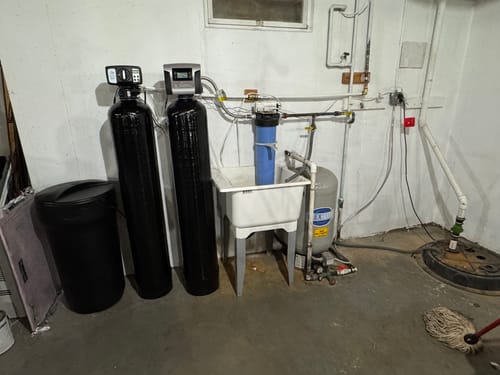
When iron, sulfur, and manganese team up to ruin your well water, you need a solution that tackles all three at once—and that's exactly what an AIO (All-in-One) Iron Filter does.
It uses air-injection oxidation technology to convert these contaminants into filterable particles—no chemicals required. Here's how it works:
Air-injection oxidation technology eliminates iron, sulfur, and manganese—no chemicals, no hassle, just clean water.
- Air injection creates an oxidation chamber that neutralizes hydrogen sulfide odors instantly.
- Oxidation converts dissolved iron (up to 30 PPM) and manganese (up to 7 PPM) into solid particles.
- Katalox Light media captures those particles, delivering consistently clean water.
- A metered control system triggers backwashing automatically, keeping performance sharp.
The result? Stain-free fixtures, odor-free water, and a system that handles everything simultaneously without adding a single chemical.
Is an AIO Iron Filter the Right Size for Your Home?
Now that you know how an AIO Iron Filter tackles iron, sulfur, and manganese all at once, the next question is whether you've got the right size for your home. Sizing matters more than most people realize—wrong size means pressure drops and underperformance.
| Bathrooms | Flow Rate |
|---|---|
| 1–2 bathrooms | Up to 12 GPM |
| 3–4 bathrooms | Up to 15 GPM |
| 5+ bathrooms | Up to 20 GPM |
| Custom needs | Consult experts |
We recommend running a quick validation—check for stains, odors, or common water problems—to confirm your selection. Consulting a water filtration expert guarantees you're matching the system to your household's actual demands, maximizing contaminant removal and protecting long-term system longevity.
Which Filter Media Performs Best Inside an AIO System?
What goes inside the filter tank matters just as much as the system itself. We recommend Katalox Light—it consistently outperforms Greensand and Birm in real-world well water conditions. Here's why it wins:
- Contaminant capacity – handles up to 30 ppm iron, 10 ppm sulfur, and manganese simultaneously
- Lifespan – lasts 6–10 years without chemical treatments, making it genuinely eco-friendly
- Odor and stain control – delivers superior performance against hydrogen sulfide's rotten-egg smell and rust staining
- Efficient backwashing – only 98–140 gallons per cycle keeps the media clean and working hard
When your water carries all three contaminants, media selection isn't a minor detail—it's the decision that determines whether your system actually solves the problem.
What an AIO Iron Filter Actually Costs to Own
Sticker shock stops a lot of people before they ever get clean water—but the real cost picture on an AIO iron filter is more encouraging than the upfront number suggests.
Most systems run between $971.49 and $1,549—the SoftPro Iron Filter sits at that top end but carries a 24% discount, lifetime warranty, and 60-day money-back guarantee.
After purchase, costs stay lean. There's no chemistry to buy, no annual service calls, and media replacements only hit every 6–10 years.
The one ongoing variable worth tracking is backwash water consumption—roughly 98–140 gallons per cycle. Factor that into your water bill over time.
Advanced systems with real-time monitoring help squeeze efficiency out of every cycle, keeping long-term ownership costs genuinely manageable.
Frequently Asked Questions
What Is the Best System for Removing Iron and Manganese From Water?
We recommend the SoftPro Iron Filter as your best choice—it removes up to 30 ppm of iron and manganese using Katalox-Light media, lasting 6-10 years with chemical-free, low-maintenance operation.
What Are Common Problems With Iron Filters?
We've seen iron filters struggle with high hydrogen sulfide levels, fail in low pH water, and require costly chemical treatments. Their media also wears out every 3-10 years, adding unexpected replacement expenses you'll want to budget for.
Which Is Not an Effective Method for Iron and Manganese Control?
Regular chlorine dosing isn't an effective long-term solution for iron and manganese control. It introduces additional contaminants, demands complex handling, and we've seen it fall short compared to specialized oxidation and filtration technologies designed for complete removal.
Is It Safe to Drink Water With Iron and Manganese?
While low concentrations are generally safe, we don't want to exceed EPA's limits—0.3 mg/L for iron and 0.05 mg/L for manganese—as higher levels cause unpleasant taste, staining, and potential health risks, especially for children.






