


![SoftPro™ Chlorine+ Carbon Whole House Water Filter to Remove PFAS, Chlorine, Chloramine & Pesticides [City Water Filters Series]](http://www.softprowatersystems.com/cdn/shop/files/SoftPro_Whole_House_Carbon_Filter_with_Spin_Down_Water_Filter.webp?v=1783547361&width=140)


 855-683-8488


Iron Test Results of 3 PPM, 10 PPM, and 20 PPM Before Buying a Filter: Which System Does Each Require?

When your well water tests at 3 PPM of iron, a standard 1.5 cubic foot filter handles it cleanly. Hit 10 PPM, and you're looking at a minimum 2.0 cubic foot system, often with pre-treatment. At 20 PPM, a two-stage system becomes essential. Each level carries its own costs, risks, and long-term consequences that go far beyond the price tag on the filter itself — and the details matter more than most people realize.
Key Takeaways
- A 3 PPM iron level requires a 1.5 cubic foot filter, with whole-house systems typically costing between $1,795 and $2,195.
- At 10 PPM, a minimum 2.0 cubic foot filter is needed, often requiring pre-treatment to prevent component damage.
- A 20 PPM iron level demands a two-stage system using both primary and secondary treatment methods, exceeding $10,000.
- Levels above 10 PPM significantly increase risks of staining, plumbing damage, and premature appliance failure.
- Choosing an undersized filter leads to frequent maintenance, pressure drops, and higher long-term household expenses.
Test Your Well Water for Iron Before Buying Any Filter

Before we spend a dime on any iron filter, we need to know exactly what we're dealing with in our well water.
Iron isn't one-size-fits-all — it shows up as dissolved ferrous iron or particulate ferric iron, and each behaves differently inside a filtration system.
Here's where testing becomes our smartest first move. Reliable at-home kits give us a quick snapshot, while professional lab services deliver precision we can act on confidently.
Testing first is the smartest move — at-home kits offer quick snapshots, while professional labs deliver precision worth acting on.
We're not guessing; we're gathering intel.
Why does this matter? Because the numbers drive every decision we'll make — filter size, system type, and long-term performance.
Water quality shifts over time, too, so regular monitoring keeps us ahead of staining, taste problems, and plumbing damage before they start.
What 3, 10, and 20 PPM Iron Results Tell You About Your Water
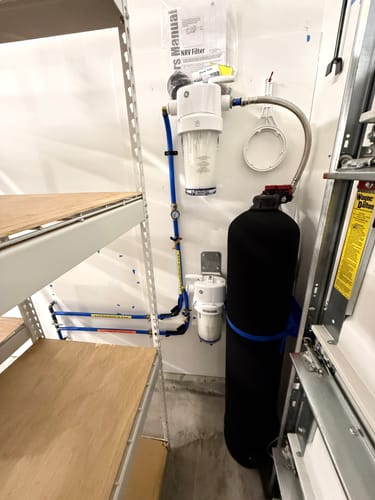
Three numbers — 3, 10, and 20 PPM — tell completely different stories about what's happening inside our well water, and each one demands a different response.
At 3 PPM, we're dealing with a manageable problem — a 1.5 cubic foot filter handles it cleanly.
Push that number to 10 PPM, and the story changes fast. Now we need 2.0 cubic feet minimum, likely paired with pre-treatment to protect system components from iron overload.
At 20 PPM, we're in two-stage territory — an iron filter working alongside dedicated pre-treatment to tackle both ferrous and ferric iron simultaneously.
Above 10 PPM, staining and plumbing damage become serious risks, making precise system selection critical.
And since water quality shifts over time, regular retesting keeps our solution matched to our actual problem.
Which Iron Filter Matches Your Contamination Level
Once we comprehend our iron concentration, matching it to the right filter size becomes straightforward. At 3 PPM, we're looking at a 1.5 cubic foot filter—enough to protect downstream systems from resin fouling.
Jump to 10 PPM, and we need at least 2.0 cubic feet to handle the heavier load without constant maintenance interruptions.
At 20 PPM, though, the game changes entirely. A single-stage system won't cut it. We're now talking about a two-stage setup—a primary iron filter paired with a specialized secondary treatment.
Higher concentrations also demand pre-treatment solutions to keep the filtration process running efficiently.
Regardless of level, we'd strongly recommend a backwashable system. Regular media maintenance isn't optional at these concentrations—it's what separates a system that lasts from one that fails prematurely.
How Much the Right Iron Filter Costs at Each PPM Level
Costs scale almost perfectly with contamination—at 3 PPM, you're looking at $1,795 to $2,195 for a whole-house system that keeps staining and resin fouling in check.
Push that to 10 PPM, and budgets jump to $5,000–$10,000. Hit 20 PPM, and you're likely exceeding $10,000 with professional sizing required.
Here's what drives those numbers:
- 3 PPM – Mid-tier systems handle capacity efficiently without oversizing.
- 10 PPM – Advanced oxidation and larger media beds demand higher investment.
- 20 PPM – Custom engineering and robust components become non-negotiable.
- All tiers – Ongoing media replacement and service intervals add recurring costs that compound considerably at higher concentrations.
Tier 1 filters ($800–$1,200) won't survive elevated PPM—don't let upfront savings mislead you.
The Real Cost of Choosing the Wrong Iron Filter
Picking the wrong iron filter doesn't just leave you with orange-stained sinks—it quietly drains your wallet in ways most homeowners never see coming.
An undersized system at 3 PPM struggles constantly, triggering frequent maintenance cycles, dropping your water pressure, and stacking up plumbing repair bills you never anticipated.
Scale that mistake up to 10 PPM, and you're watching appliances fail prematurely from iron buildup and clogging. That's an expensive replacement cycle nobody budgets for.
Here's what we've learned: the higher upfront investment in a correctly sized filter actually saves you money over time.
Fewer media replacements, fewer service calls, fewer surprises. The wrong filter isn't just ineffective—it's a slow, invisible leak in your household budget.
Frequently Asked Questions
What Micron Filter Is Best for Iron?
We recommend matching your micron filter to your iron level: use 5 microns for 3 ppm, 1-5 microns for 10 ppm, and a specialized 1-micron system for 20 ppm.
How to Check Iron Filter System for Clogging?
We'll want to inspect the pre-filter for sediment, monitor water pressure drops, watch for rust stains on fixtures, and check if water's cloudy or has a metallic taste — these all signal clogging.
How Many Ppm Is High Iron?
We classify 10 ppm as high iron, demanding specialized filtration. At 20 ppm, we're facing serious health risks and plumbing damage. Anything above 0.3 ppm already compromises your water's taste and quality noticeably.
How Many Micron Filters to Remove Iron?
We recommend using a 5-micron or smaller filter to effectively remove iron. For particulate iron, 10 microns works, but finer filtration guarantees clearer water and better overall treatment efficiency for your specific needs.






