


![SoftPro™ Chlorine+ Carbon Whole House Water Filter to Remove PFAS, Chlorine, Chloramine & Pesticides [City Water Filters Series]](http://www.softprowatersystems.com/cdn/shop/files/SoftPro_Whole_House_Carbon_Filter_with_Spin_Down_Water_Filter.webp?v=1783547361&width=140)


 855-683-8488


Is Activated Carbon Iron Filter Water Treatment Right for Your Home? Here's How to Know for Sure

If you're seeing reddish-brown stains on your sinks or tasting something metallic in your water, iron is likely your culprit. Activated carbon iron filters can help, but they're not a one-size-fits-all solution. Your water chemistry, pressure levels, and contamination profile all determine whether this technology actually fits your home. We'll walk you through everything you need to know to make the right call.
Key Takeaways
- Reddish-brown stains, metallic taste, or clogged pipes indicate iron problems that an activated carbon iron filter may help address.
- Standard activated carbon filters cannot remove iron effectively; only oxidation-based systems, like activated carbon iron filters, can manage iron removal.
- Your household water pressure must meet the 30-40 PSI minimum required for activated carbon iron filters to function properly.
- Certified laboratory testing identifies iron and manganese levels, helping determine whether an activated carbon iron filter suits your specific water chemistry.
- If iron levels are high, combining reverse osmosis with carbon filtration provides more comprehensive water treatment than either system alone.
Does Your Home Actually Have an Iron Problem?

Before assuming your home has an iron problem, let's look at the telltale signs. Notice reddish-brown stains on your laundry, fixtures, or sinks? That's iron. Detecting a metallic taste in your drinking water? Also iron. These aren't cosmetic nuisances—they're warnings.
Left unchecked, iron deposits clog plumbing and strangle water pressure.
If you're on a private well, you're especially vulnerable. Groundwater naturally absorbs iron from surrounding soil and rock, making contamination almost inevitable over time.
That's why we recommend testing your water every 3-5 years.
Here's your clear threshold: iron levels above 0.3 mg/L signal a real problem requiring specialized treatment.
Without testing, you're guessing—and guessing costs you money, appliances, and peace of mind. Test first. Then act.
What Does an Activated Carbon Iron Filter Remove?
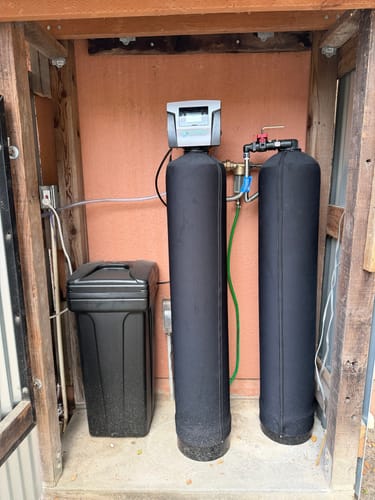
Here's what activated carbon filters actually do well—and where they fall short when iron's in the picture. Carbon filters excel at adsorbing chlorine, VOCs, pesticides, and herbicides—dramatically improving taste and odor. But iron? That's a different chemistry requiring oxidation-based removal, not adsorption.
| Contaminant | Activated Carbon Effective? |
|---|---|
| Chlorine & VOCs | ✅ Yes |
| Pesticides & Herbicides | ✅ Yes |
| Heavy Metals (trace) | ⚠ Partially |
| Iron & Manganese | ❌ No |
We can't stress this enough—carbon filters weren't engineered to tackle elevated iron or manganese concentrations. Without a dedicated iron filtration system, you're really running the wrong tool for the job. That's precisely why thorough water testing isn't optional; it's your roadmap to the right solution.
How Does a Carbon Iron Filter Compare to Softeners and Reverse Osmosis?
When homeowners discover iron in their water, they often wonder whether a water softener or reverse osmosis system might be the smarter fix—and honestly, it's a fair question.
Here's the truth: softeners target calcium and magnesium, not iron, so they'll fail you when concentrations climb.
Reverse osmosis removes iron effectively but demands more maintenance and wastes water in the process.
Carbon filters handle taste and odor beautifully but lack the oxidizing power that dedicated iron filters deliver.
The smartest move? Combine systems. Pairing a carbon filter with reverse osmosis creates thorough coverage—tackling iron, dissolved solids, taste, and odor simultaneously.
Understanding these distinctions helps you stop guessing and start building a filtration strategy that actually matches your water's specific chemistry.
Is Your Water Pressure Compatible With an Activated Carbon Iron Filter?
Water pressure isn't just a comfort issue—it's the backbone of whether an activated carbon iron filter will work at all. These systems demand 30-40 PSI minimum, while traditional carbon filters can limp along at 20 PSI. That gap matters enormously.
Here's what catches homeowners off guard: activated carbon iron filters create significant pressure drops because of their fine mesh design. More resistance means less flow reaching your faucets and showerheads.
We always recommend measuring your household's baseline pressure and flow rate in GPM before committing. Proper system sizing guarantees multiple water sources run simultaneously without pressure loss.
And don't overlook backwashing cycles—they create temporary pressure fluctuations, so your system needs the capacity to absorb those changes without disrupting daily life.
How to Test Your Water Before Buying an Activated Carbon Iron Filter?
Before spending money on an activated carbon iron filter, you've got to know exactly what's in your water. Start by hiring a certified laboratory to analyze your water sample — they'll identify iron, manganese, and mineral concentrations that generic municipal reports often miss.
Speaking of municipal reports, don't rely solely on them. They frequently overlook localized issues specific to your home's supply. If you're on well water, test every three to five years minimum.
Once your results arrive, compare them against EPA acceptable contaminant levels. This comparison tells you whether your iron concentrations actually require a specialized iron filter or whether a standard activated carbon filter handles the job.
Skipping this step means potentially buying the wrong system entirely — an expensive mistake worth avoiding.
Frequently Asked Questions
What Are the Disadvantages of Activated Carbon Water Filter?
Activated carbon filters can't remove fluoride, nitrates, or heavy metals, and they're ineffective against high iron concentrations. They also lose adsorption power over time, cause pressure drops, and underperform against bacteria compared to UV or reverse osmosis systems.
What Is the Best Filter to Remove Iron From Well Water?
For high iron levels in well water, we recommend iron filters that use oxidizing agents and fine mesh systems. They're specifically designed to tackle reddish-brown stains and metallic taste that carbon filters simply can't handle.
What Is the Healthiest Type of Water Filter?
The healthiest filter depends on your water's specific contaminants. We recommend activated carbon for taste and organic pollutants, but if you're battling lead, arsenic, or iron, you'll need reverse osmosis or specialized iron filtration systems.
Are Activated Carbon Water Filters Worth It?
Activated carbon water filters are absolutely worth it. They're cost-effective, reduce harmful contaminants like chlorine and organics, and eliminate the need for expensive bottled water—giving us cleaner, better-tasting water straight from our tap.






