


![SoftPro™ Chlorine+ Carbon Whole House Water Filter to Remove PFAS, Chlorine, Chloramine & Pesticides [City Water Filters Series]](http://www.softprowatersystems.com/cdn/shop/files/SoftPro_Whole_House_Carbon_Filter_with_Spin_Down_Water_Filter.webp?v=1783547361&width=140)


 855-683-8488


Large Household Iron Filter Selection Guide: Everything You Need to Know for 4+ Bathrooms

Choosing an iron filter for a large home isn't as simple as grabbing the biggest unit on the shelf. We'll need to test our water first, calculate our peak flow rate, and match the right filtration technology to our specific iron type. Get any of those steps wrong, and we're looking at expensive mistakes, pressure drops, and stubborn stains. Stick with us, and we'll walk you through everything that actually makes a difference.
Key Takeaways
- Always test water first to identify iron concentration and type, as this determines which filtration technology your household needs.
- Calculate peak flow rate by totaling simultaneous fixture demands; four-bathroom homes typically require systems rated between 15–40 GPM.
- Choose catalytic media filters for iron levels above 3.0 mg/L, as standard air injection systems handle only moderate concentrations.
- Size your filter 20–30% above your calculated peak flow rate to prevent pressure drops during high-demand periods.
- Single iron filters rarely suffice for large homes; layered systems better handle multiple iron types and coexisting contaminants.
Why High Iron Costs More to Treat in Large Homes

When iron levels climb, so does the cost of treating them—especially in large homes.
Here's why: high iron often brings acidity along for the ride, meaning you're not just filtering—you're also correcting water chemistry. That's two problems requiring two solutions.
Add four or more bathrooms into the equation, and your flow rate demands jump considerably. Larger, more advanced systems become necessary just to keep up.
And if you're dealing with multiple iron types—clear water, oxidized, or bacterial—you'll likely need a customized treatment strategy rather than an off-the-shelf fix.
Customization costs more upfront and demands more maintenance long-term.
Understanding why costs escalate helps you make smarter decisions about which systems actually deliver value for your specific situation.
Test Your Water Before Choosing Any Iron Filter
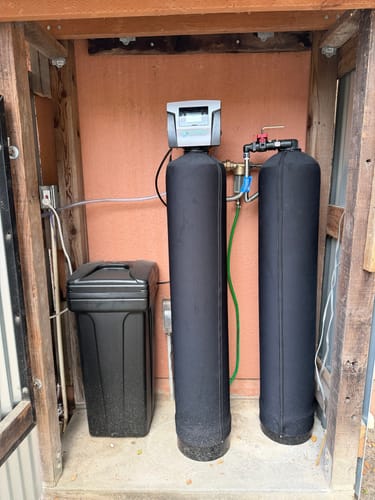
Before spending a dime on an iron filter, we need to know exactly what we're dealing with—and that starts with testing our water. A proper test reveals iron concentration, type—ferrous or ferric—and whether manganese or bacteria are lurking alongside it. Each variable changes our treatment strategy entirely.
Iron levels range from trace amounts requiring minimal intervention to severe concentrations above 5.0 mg/L demanding industrial-grade solutions. Without this data, we're guessing—and guessing gets expensive fast in a four-plus bathroom home.
Testing also tells us how to size our system correctly for peak demand. The right filter chosen without accurate water data is still the wrong filter.
Size your system for peak demand—because accurate water data separates the right filter from an expensive mistake.
Know your numbers first, then select your system with confidence and precision.
How to Calculate Peak Flow Rate for 4+ Bathrooms
Once we've got our water test results in hand, the next number we need is our peak flow rate—because even the best iron filter becomes a bottleneck if it can't keep up with a full house running hot.
Add up every fixture running simultaneously during peak hours:
| Fixture | Flow Rate (GPM) | Simultaneous Use |
|---|---|---|
| Shower | 2.0–2.5 | Multiple likely |
| Toilet | 1.6 | Frequent |
| Faucet | 1.0–2.2 | Moderate |
Four-person households typically land between 15–40 GPM. Want precision? Fill a 5-gallon bucket during your busiest morning—that's your real number.
Once calculated, select a filter rated 20–30% above that peak. That buffer prevents pressure drops and keeps iron removal consistent under real-world demand.
Air Injection vs. Catalytic Media: Match the Iron Filter to Your Water
Choosing the right filter technology is where peak flow rate meets water chemistry—and getting this match wrong means paying for equipment that either underperforms or overkills your actual problem.
Air injection systems work beautifully for moderate iron levels—we're talking 1.0 mg/L or lower—by oxidizing ferrous iron into filterable solids. Push beyond that threshold, and you'll need catalytic media, which handles concentrations above 3.0 mg/L through specialized media that accelerates oxidation far more aggressively.
Here's what most homeowners miss: your iron type matters as much as concentration. Add manganese or acidity into the equation, and suddenly you're combining both technologies strategically.
That's why we always recommend a thorough water analysis first—it eliminates guesswork and guarantees your filtration investment targets your exact contamination profile.
Why One Iron Filter Rarely Solves Every Problem in Large Homes
Matching your filter technology to your water chemistry gets you most of the way there—but large homes introduce a complication that even the right filter can't always handle alone. With four or more bathrooms, iron levels shift across fixtures, and iron rarely travels alone—sulfur odors and acidity often tag along.
| Challenge | Why One Filter Falls Short |
|---|---|
| Variable iron levels by fixture | Pressure and distance affect concentration |
| Multiple iron types | Ferrous, ferric, and bacteria need different technologies |
| Coexisting contaminants | Acidity and sulfur require separate treatment |
| Extensive plumbing systems | Single units can't maintain consistent performance |
| Long-term maintenance | Combination systems reduce cumulative costs |
We recommend layering sediment filters, softeners, and targeted iron filtration. Combined systems aren't overkill—they're the architecture large homes demand.
Frequently Asked Questions
How Big of an Iron Filter Do I Need?
For 4+ bathrooms, you'll need a filter handling 15–40 GPM—but we recommend sizing up 20–30% beyond your peak demand to maintain peak performance and prevent frustrating clogs from iron buildup.
What Are Common Problems With Iron Filters?
Iron filters can struggle with iron bacteria, clogging from undersizing, media saturation, excess backwash waste, and poor-quality media. We'll help you dodge these pitfalls by choosing the right system from the start.
What Is the Best Whole House Iron Filter for Well Water?
For large homes with 4+ bathrooms, we recommend catalytic media filters—they're unmatched at tackling high ferrous and ferric iron levels exceeding 5 mg/L, preventing staining, and maintaining strong 15-40 GPM flow rates throughout your home.
How Often Should an Iron Filter Backwash?
We recommend backwashing your iron filter every 2-4 weeks, though high-iron well water may demand weekly cycles. Dialing in your schedule prevents clogs, maintains strong flow, and dramatically extends your filter's lifespan.






