


![SoftPro™ Chlorine+ Carbon Whole House Water Filter to Remove PFAS, Chlorine, Chloramine & Pesticides [City Water Filters Series]](http://www.softprowatersystems.com/cdn/shop/files/SoftPro_Whole_House_Carbon_Filter_with_Spin_Down_Water_Filter.webp?v=1783547361&width=140)


 855-683-8488


Manganese Dioxide Iron Filter Media Maintenance vs AIO Air Injection — Which System Is Less Work?

When comparing manganese dioxide iron filter media maintenance vs AIO air injection, manganese dioxide systems are clearly the lower-effort choice. They backwash automatically every three to six months, and the media lasts eight to ten years with minimal hands-on involvement. AIO systems, on the other hand, need monthly valve inspections, bi-annual air injector checks, and frequent timing adjustments. If you want predictable costs and fewer headaches, stick around — we've got the full breakdown ahead.
Key Takeaways
- Manganese dioxide filters backwash automatically every 3–6 months, while AIO systems require constant evaluation and unpredictable backwashing schedules.
- AIO systems demand monthly valve inspections and bi-annual air injector checks, significantly increasing hands-on maintenance requirements.
- Manganese dioxide filter media lasts 8–10 years with minimal user involvement, unlike AIO systems requiring frequent timing adjustments.
- AIO systems need water pH above 8.0 for optimal performance, adding complexity manganese dioxide filters simply don't require.
- Long-term costs favor manganese dioxide systems, as AIO systems accumulate expenses through ongoing chemical treatments and frequent inspections.
How Do Manganese Dioxide Filters and AIO Systems Work?

When dealing with iron and manganese in your water supply, two popular treatment options are manganese dioxide filters and AIO (Air Injection Oxidation) systems—and understanding how each works helps you make the right choice for your home.
Manganese dioxide filters use oxidation to convert dissolved iron and manganese into solid particles, which the media then captures and removes. It's a straightforward, chemistry-driven process that handles high contamination levels effectively.
AIO systems take a different approach—they inject air directly into the water, using oxygen to oxidize the contaminants before filtering them out.
However, they perform best when your water's pH sits above 8.0, particularly when paired with media like Birm. That pH dependency is something you'll need to account for upfront.
How Much Daily Maintenance Does Each System Actually Require?
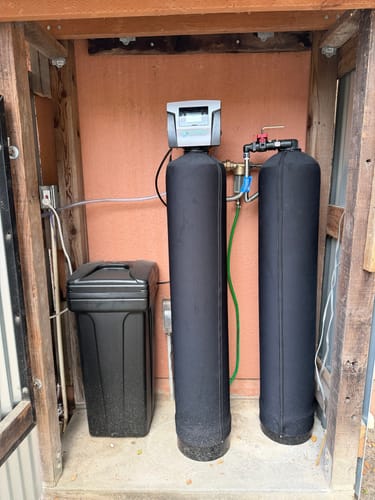
How much time you'll actually spend maintaining each system matters more than most people realize.
Manganese dioxide filters handle most of the work themselves — automatic backwashing runs without your involvement, and you won't touch the media for 8–10 years.
Manganese dioxide filters largely run themselves — automatic backwashing handles the heavy lifting, and the media lasts nearly a decade.
Air injection systems tell a different story. They demand consistent attention to stay effective:
- Monthly control valve inspections for buildup and sediment
- Bi-annual air injector checks to catch early wear
- Regular timing adjustments to keep cycles optimized
- Active monitoring for iron bacteria susceptibility
We've seen homeowners underestimate how those small, recurring tasks compound over time.
Manganese dioxide systems are genuinely designed for minimal intervention — no first-year replacements, just periodic inspections and backwashing.
If you want a system that largely manages itself, that distinction matters enormously.
Which Iron Filter: Manganese Dioxide or AIO: Needs More Frequent Backwashing?
Maintenance time is one thing — backwashing frequency is another, and the two don't always move together.
With manganese dioxide media, you're typically backwashing every three to six months. It's predictable, schedulable, and easy to plan around. That consistency alone reduces mental overhead.
AIO air injection systems tell a different story. Because performance varies with water conditions, you can't just set a calendar reminder and move on. You're constantly evaluating whether backwashing is actually needed — which ironically creates more touchpoints, not fewer.
Here's the bottom line: manganese dioxide gives you a disciplined, repeatable schedule. AIO demands ongoing judgment calls.
If you value simplicity and predictability over flexibility, the manganese dioxide filter wins this round without much debate.
Long-Term Maintenance Costs: Manganese Dioxide vs AIO Iron Filters
The real cost difference between these two systems becomes clear when you stretch the timeline out over a decade. Manganese dioxide media lasts 8–10 years, requiring little beyond routine backwashing. AIO systems? They demand ongoing chemical treatments, labor-intensive cleaning, and additional filtration to manage cloudiness.
Manganese dioxide media lasts 8–10 years. AIO systems drain your budget with chemicals, cleaning, and extra filtration.
Here's what that gap looks like in practice:
- Manganese dioxide media replacement happens once every 8–10 years
- AIO systems accumulate costs through chemical treatments and frequent inspections
- Iron bacteria vulnerability in AIO systems drives up remediation expenses
- Manganese dioxide backwashing keeps maintenance predictable and budget-friendly
We're talking about a system that fundamentally runs itself versus one that consistently pulls your time and money. For long-term value, manganese dioxide wins on cost efficiency.
Which Iron Filter System Is Less Work Over Its Lifetime?
Cost tells part of the story, but it doesn't tell all of it. What truly separates these two systems is the daily and yearly burden each places on you.
Manganese dioxide filters win on simplicity. You're looking at automatic backwashing, a control valve inspection here and there, and media replacement every 5–10 years. No chemical handling. No chasing airborne bacteria. No residual chlorine complications.
Air injection systems demand more of your attention — more frequent checks for sediment buildup, potential bacterial contamination from introduced air, and additional filtration needs down the line.
Homeowners using manganese dioxide systems consistently report fewer long-term headaches: less cloudy water, less contamination risk, less intervention overall.
When you add it all up, manganese dioxide isn't just cheaper — it's genuinely easier to live with.
Frequently Asked Questions
Do Air Injection Iron Filters Work?
Yes, air injection iron filters do work! They use oxygen to oxidize iron and manganese for filtration. However, we've found they require proper pH levels above 8.0 and can demand more maintenance than modern alternatives.
Does RO Remove Iron and Manganese?
RO can reduce iron and manganese, but it's not our best standalone solution. We'll get far superior results when we pair RO with a dedicated pre-treatment system like an air injection or manganese dioxide filter first.
Does a 0.2 Micron Filter Remove Air?
No, a 0.2 micron filter won't remove air bubbles. Since air's a gas, it passes right through. We'd need dedicated degassing equipment or air removal systems to tackle entrained air effectively.
What Is the Difference Between Iron Filter and Carbon Filter?
Iron filters oxidize and trap iron and manganese, while carbon filters adsorb chlorine and odors. We're targeting different contaminants with each system—iron filters need higher pH levels, whereas carbon filters work more universally across water conditions.






